Teacher Lesson Plan Format — KPK Guide with Example
A lesson plan is a teacher’s short written plan for one lesson: what students will learn, how the teacher will teach it, and how the teacher will check that students understood. In Khyber Pakhtunkhwa, the Directorate of Curriculum and Teacher Education (DCTE) has developed scripted lesson plans for Grades 1 to 5, aligned with the Single National Curriculum textbooks. This guide gives the teacher lesson plan format used in KP government schools, explains every section, and works through one filled example.
What a Lesson Plan Is
The DCTE’s own lesson plan books define it plainly: a lesson plan is a description of the instructions for teaching the contents of the textbook of a particular subject and achieving the Student Learning Outcomes (SLOs), and it is the road map for teachers for the achievement of SLOs effectively during class time.
In the National Curriculum framework, a lesson plan answers three questions:
- Where are the students going? The SLOs — what students should know and be able to do by the end of the lesson.
- How will they get there? The lesson procedure — introductory activities, developmental activities, concluding activities — and the material required.
- How will you know when they have arrived? The assessment of learning.
A plan is not an essay about the lesson. It is a working note the teacher can glance at while thirty children settle — one page, with the objective, the steps, the materials and the closing check on it. Plans built on clearly defined SLOs keep teaching on the curriculum and the teacher prepared.
Teacher Lesson Plan Format at a Glance
Copy this format into your register or a Word file. Every section below is explained in the next part of this guide.
| Section | What to write |
|---|---|
| Header | Teacher name, class, subject, date, period, duration, topic |
| SLOs / curriculum link | The SLOs from the textbook or curriculum this lesson covers |
| Learning objectives | What students will be able to do by the end, using action verbs |
| Materials | Textbook pages, chart, real objects, board, worksheet |
| Previous knowledge | What students already know that this lesson builds on |
| Introduction (about 5 min) | A question, picture or object to start the lesson |
| Presentation (about 15 min) | How you will explain the new idea, step by step |
| Activity (about 10 min) | What students will do: pair work, group task, practice |
| Assessment (about 5 min) | Questions or a short task to check understanding |
| Homework | A small task to practise at home |
| Reflection | After the lesson: what worked, what to change |
How to Fill Each Section
Header. Teacher, class, subject, date, period, duration and topic. Thirty seconds to fill, and the first thing a head teacher looks for. Write the topic exactly as it appears in the textbook.
SLOs and learning objectives. Take one or two SLOs from the textbook unit or the curriculum — never more than the lesson can cover. Then write the objectives as things students will be able to *do*, starting with a verb a child can perform: identify, name, read, write, solve, explain, label, compare. “Students will be able to name the main parts of a plant” is an objective; “Teach parts of a plant” is not — it describes the teacher, not the learning.
Materials. List everything before the bell: textbook pages, chart, real objects, flashcards, worksheet. Finding out mid-lesson that the chart is in the staff room costs the first five minutes.
Previous knowledge. One or two questions that link today’s topic to what students already know. If the last lesson was on living things, today’s lesson on plants starts from there.
Introduction (about 5 minutes). One question, one picture, one real object, or a quick recap of yesterday — enough to make students curious and show you where they stand.
Presentation (about 15 minutes). The main explanation and board work. Explain in small steps, write the key words on the board, and work one good example in front of the class — planned in advance, not improvised.
Activity (about 10 minutes). The class tries it with you — together, in pairs, or in small groups — while you move around, watch and correct.
Assessment (about 5 minutes). Two or three questions at the end that prove — or disprove — that the objective landed, asked orally, on a quick worksheet, or by show of hands. This is the box most plans skip, and the only one that tells you what to do tomorrow.
Homework. Keep it short and directly linked to the objectives: one drawing, five questions, one sentence per part. The DCTE academic calendar guidelines say homework should carry clear instructions and examples, and assessment should be regular with a proper record kept.
Reflection. One honest sentence after the lesson: what worked, what to change next time. It takes a minute, and it is what makes next year’s plan better.
A Filled Example: Class 6 General Science, “Parts of a Plant”, 40 Minutes
Class: 6 — Subject: General Science — Topic: Parts of a plant — Duration: 40 minutes
SLOs. Students will be able to name the main parts of a plant, describe one function of each part, and label a diagram of a plant.
Materials. Textbook, one real plant in a pot, a labelled chart, board and chalk.
Previous knowledge. Students know plants are living things and need water and sunlight. Ask: “What happens to a plant if it gets no water?”
Introduction (5 minutes). Hold up the potted plant and ask which part takes in water from the soil; take two or three answers before confirming.
Presentation (15 minutes). Explain the four parts one by one on the board — root, stem, leaf, flower — with one function each: the root takes in water, the stem carries it up, the leaf makes food, the flower makes seeds.
Activity (10 minutes). In pairs, students label a blank diagram from the worksheet and write one function beside each part, while you walk around and correct.
Assessment (5 minutes). Five quick questions: name the four parts; which part makes food; which part takes in water; what does the stem do; which part makes seeds.
Homework. Draw and label a plant from home or the school garden and write one sentence about each part.
Reflection. Most pairs labelled the leaf correctly but mixed up stem and root functions — repeat the water journey next lesson.
The timed stages add to 35 minutes inside a 40-minute period; the rest covers attendance and settling in.
The DCTE Scripted Lesson Plans for Grades 1–5
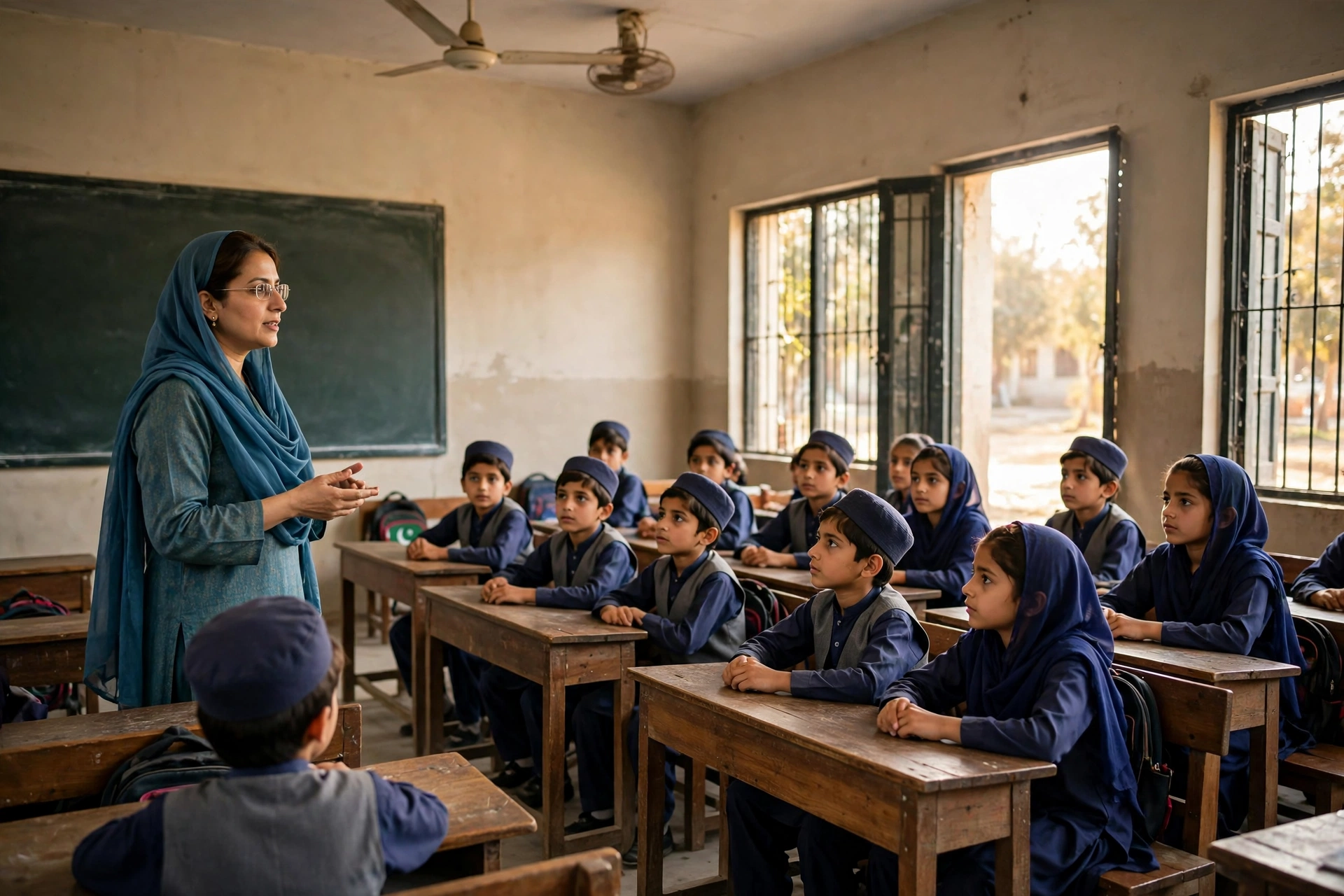
Teachers of Classes 1 to 5 do not have to start from a blank page. The Directorate of Curriculum and Teacher Education has developed and circulated scripted lesson plans, aligned with the SNC textbooks, in English, Urdu, Mathematics, Islamiyat, Nazra-e-Quran and Science for Grades 1 to 5 (KPESE, 30 May 2026) — KP was the first province to do so under the Single National Curriculum. The plans are organised month by month, each lesson giving the SLOs, the teaching steps and the activities: https://kpese.gov.pk/scripted-lesson-plans/
If you teach these grades, start from the scripted plan for your week and adapt it — change the example, add a local object, shorten an activity that ran long. Do not write from scratch what the department has already written.
One timing note matters. The KP Curriculum 2026 for Grades 1 to 5 was notified on 17 September 2026 and takes effect from Academic Year 2027; the current session, 2026–27, continues under the existing textbooks and the Scheme of Studies 2025. The scripted plans follow the textbooks in use now — check your plans against the new books when they arrive. See the KPK Curriculum 2026 for Grades 1 to 5 for what changes.

Primary and Secondary: What Changes
The format stays the same at every level — only the timing and the source of the SLOs change:
- Period length. Primary 35 minutes, middle and high 40 minutes, higher secondary 45 minutes, under the Directorate’s standardised timetable.
- Grades 1–5. Use the DCTE scripted lesson plans and the academic calendar, which plans the session over 210 days.
- Grades 9–12. There are no scripted plans for these grades. Build the plan from the subject curriculum’s SLOs under the National Curriculum of Pakistan 2026 — see the National Curriculum 2026 for Grades 9 to 12 — and keep the exam in view: the KPK 9th Class Past Papers show what the board asks, and the KPK Board Date Sheet sets the calendar.
- Assessment. Whatever the level, the plan should include its own closing check. For a ready-made test from your plan, use the Test Paper Generator, whose question bank follows the KPK Test Paper Syllabus for Classes 1–12.
Common Mistakes
- Objectives written as teaching, not learning. “Teach fractions” is a topic, not an objective.
- No assessment. The lesson ends without checking whether the objective landed — then tomorrow’s lesson starts blind.
- Copying last year’s plan unchanged. Check it against the current textbook and SLOs first; the primary curriculum changes from Academic Year 2027.
- Homework unrelated to the lesson. Homework should practise exactly what the objectives promised.
- Too many SLOs in one period. One or two SLOs, properly taught and checked, beat four rushed ones.
Frequently Asked Questions
Do I have to write a lesson plan for every period? A lesson plan is the teacher’s working record, and the DCTE academic calendar guidelines direct teachers to ensure the proper use of lesson plans. Keep it to one page — a short plan you actually use beats a long one copied the night before.
Where do I get the SLOs for my lesson? From the textbook unit and the curriculum for your grade. For Grades 1 to 5, the DCTE scripted lesson plans already list the SLOs for each lesson.
What is the difference between a lesson plan and a unit plan? A lesson plan covers one period. A unit plan designs a study in depth over an extended period — several days to several weeks — taking a sequence of lesson plans.
Can I use the same plan next year? Only after checking it against the current textbook and SLOs — for primary grades, the KP Curriculum 2026 takes effect from Academic Year 2027.
Is there one official DCTE lesson plan proforma I must follow? No single proforma with a notification number could be verified. What the department has issued is the set of scripted lesson plans for Grades 1 to 5 — use the format in this guide and adapt it to what your head teacher asks to see.
Where can I find the DCTE scripted lesson plans? On the department’s website at https://kpese.gov.pk/scripted-lesson-plans/ — English, Urdu, Mathematics, Islamiyat, Nazra-e-Quran and Science for Grades 1 to 5.