Published: October 23, 2026 • Updated: November 21, 2026
Government Appointment in KPK: What Actually Applies in 2026
Government jobs in Khyber Pakhtunkhwa still offer what people want: security, a pension pathway, medical cover, and steady promotion — which is why a government appointment in KPK remains one of the most sought-after goals in the province.
But the rules around how you get one have changed significantly — and a lot of what’s written online is now out of date. Some of it will send you chasing a route that no longer exists.
This guide covers what actually applies today: which quotas still exist, how KP’s zonal system works, what the 2022 Teachers Act means if you’re on ad-hoc or contract, and the real process from advertisement to joining. Every claim below carries its source, because on this topic a wrong article costs people years.
On this page:
- The son / deceased quota has closed — and what that means for a pending case
- The quotas that do exist
- KP’s zonal system — the part nobody explains
- For teachers: the Regularization Act, 2022
- Who recruits in KP, and the fee
- Age limits, documents, the process
- Common mistakes and FAQs
Important: The Son and Deceased Quota Has Changed
Let’s start with the change that affects the most families, because getting this wrong wastes years.
For decades, children of retired or deceased government employees could be appointed under a family quota. That route is now closed for new cases.
What happened
On 26 September 2024, the Supreme Court of Pakistan decided General Post Office, Islamabad v. Muhammad Jalal. A three-judge bench headed by Chief Justice Qazi Faez Isa, with Justice Naeem Akhtar Afghan and Justice Shahid Bilal Hassan, was hearing the Post Office’s appeal against a Peshawar High Court decision of 13 April 2021 that had gone in Muhammad Jalal’s favour.
The Court held that appointing the widow, widower, spouse or child of a civil servant who died in service or became permanently disabled — without open advertisement, competition and merit — was discriminatory and ultra vires Articles 3, 4, 5(2), 18, 25(1) and 27 of the Constitution. Federal and provincial governments were directed to withdraw such rules.
The reasoning is simple enough to state in a sentence: public employment must rest on equal opportunity and merit, not on family connection.
What KP did
The provincial government instructed departments to implement the decision. As reported, the Human Resource Department told provincial departments and district administrations that children of employees who retired or died after 26 September 2024 are not entitled to fresh appointments under the old quota arrangement — the judgment date itself being the dividing line.
The same instructions reportedly told departments to deal with pending cases from before the cut-off in accordance with law, examining each on its own facts — dates of retirement or death, and when the claim was filed — and to refer doubtful or disputed files to the Law Department for review.
Get the actual notification, not a summary. The instructions above have been widely reported but the operative wording matters in a legal case. Ask your department for a copy of the communication it is relying on, in writing, with its number and date. A paraphrase in an article — including this one — is not what an appellate court will read.
What about older cases? This is where people panic unnecessarily
If your case was already in the system before 26 September 2024, do not assume it is finished — but be clear about what the Supreme Court has actually protected. The protection runs to cases that have attained finality, not to every application that was merely pending. A case already decided in your favour stands. A case still lying undecided is examined individually, in accordance with law, and the outcome is not guaranteed. The two judgments below are what you argue from:
Ayaz Ali and another v. Federation of Pakistan — Supreme Court, 17 July 2025. On whether Jalal could retrospectively nullify employment applications filed under an earlier (2011) policy, the Court held: “the judgments of this Court has prospective effect unless declared otherwise. The prospective declaration of law cannot reopen the past.” Applications submitted while the earlier policy was in force had to be assessed under that policy — and the matter was sent back for the applications to be reconsidered on that basis. (2026 SCLR 12, also reported as 2025 SCP 471)
Province of Sindh v. Azhar Ali — Supreme Court, 1 September 2025. The government’s petition was dismissed. The Court held that “the law declared by this Court will apply to the cases arising in future but the cases which have attained finality are fully protected under the doctrine of past and closed transactions.” Because the High Court’s orders pre-dated Jalal, they stood. (2026 SCLR 6)
The direction of travel has continued: in March 2026 the press reported the Federal Constitutional Court dismissing a Sindh government petition against a deceased-quota appointment on the same reasoning.
| Your situation | Position |
|---|---|
| Employee retired or died after 26 September 2024 | No fresh appointment under the family quota. Compete in open advertisement like every other candidate |
| Application filed / case pending before that date | To be decided individually, on its own facts and under the policy in force when it was filed — Jalal operates prospectively |
| Case already decided in your favour before that date | Protected as a past and closed transaction |
If you have a pending case, do these three things:
- Get the current status of your file in writing from the department, including the date your application was received.
- Keep proof of the filing date and of the policy in force at that time — that is what Ayaz Ali turns on.
- Take legal advice on your specific facts, and put those two judgments in front of whoever is advising you.
Don’t abandon the case — and don’t assume it is automatically approved either. This is a legal matter where the details genuinely decide the outcome.
The Quotas That Do Exist
So what’s actually available? KPPSC‘s own advertisements allocate posts across:
- General quota — distributed by zone (see the next section)
- Female / women quota
- Disabled (Disable) quota
- Minority quota — reserved for non-Muslim citizens
These are real and current; they appear as separate columns in live advertisements.
Disabled quota requires a disability certificate and medical board verification. Age relaxation is generally available: relaxations for various categories are governed by the Initial Appointment to Civil Posts (Relaxation of Upper Age Limit) Rules, 2008, which have themselves been amended — KPPSC lists amendments dated 20 June 2025. Check the version current when you apply.
KP’s Zonal System — The Part Nobody Explains
Here’s something specific to Khyber Pakhtunkhwa that most “Pakistan government jobs” articles skip entirely, and it can matter more than your test score.
KP allocates many posts by zone, not just on province-wide merit. Advertisements show allocations across Zone-I through Zone-VI, alongside merit seats.
This flows from the Civil Servants (Appointment, Promotion and Transfer) Rules, 1989, under which initial recruitment to posts in BPS-16 and 17, and other posts in BPS-3 to 15 borne on the provincial cadre, is made according to the zonal quota specified by Government from time to time. The Government issued a Revised Zonal Allocation Notification dated 22 December 2022, and KPPSC operates a Zonal Rotational Cycle (updated 31 January 2023) — both published on the Commission’s own site.
What this looks like in a real advertisement
Take a recent Provincial Planning Service advertisement for 13 posts. The allocation was:
| Merit | Z-I | Z-II | Z-III | Z-IV | Z-V | Z-VI | Women | Minority | Disabled |
|---|---|---|---|---|---|---|---|---|---|
| 1 | 0 | 1 | 2 | 1 | 1 | 2 | 3 | 1 | 1 |
Look at Zone-I: zero posts. A candidate from that zone had nothing to apply for on the general quota in that cycle, however good their score. Meanwhile Zone-III and Zone-VI had two each.
In a Provincial Management Service advertisement the same year, general-quota posts ran Zone-I 08, Zone-II 05, Zone-III 07, Zone-IV 05, Zone-V 05, Zone-VI 04 — a completely different shape.
So competition is not province-wide. Your district falls in a zone, and in a given cycle the seats available to your zone may be many, few, or none. A candidate from a zone with fewer applicants can face a very different merit threshold than one from a crowded zone.
The exception worth knowing — and it can be your better route. No zonal reservation applies to posts allocated to the minority, disabled and female quotas — those are filled on open merit. So if you are eligible for one of those quotas, you are not confined to your zone’s allocation at all. In the example above, the women’s quota had three posts and the minority quota one, none of them tied to a zone.
Before applying, read the zone table in the advertisement itself. It tells you who you are actually competing against — and whether the quota you’re eligible for gives you a wider field.
For Teachers: The Regularization Act, 2022
If you’re a teacher in KP on ad-hoc or contract terms, this section is the most important thing in this guide. Every line below is from the Act’s own text.
The Khyber Pakhtunkhwa Teachers (Appointment and Regularization of Services) Act, 2022 — KP Act No. XLI of 2022 — was first published, after the Governor’s assent, in the Gazette of the Khyber Pakhtunkhwa (Extraordinary) dated 20 September 2022, and came into force at once. It provides for the appointment and regularization of the services of certain teachers appointed on ad-hoc / contract basis in the Elementary & Secondary Education Department. When the Assembly passed the bill on 13 September 2022 it was reported as covering some 38,000 teachers, including in the merged districts.
Who counts as a “teacher” under the Act
Section 2(1)(d) defines teachers as duly qualified persons appointed as:
- Primary School Teachers (PST)
- Certified Teachers (CT)
- Certified Teachers IT
- Secondary School Teachers (SST)
- Primary Teachers
- Drawing Masters
- Physical Education Teachers
- Theology Teachers
- Arabic Teachers
- Qari / Qaria Teachers
— having different pay scales, in the E&SE Department, on ad-hoc / contract basis, through the National Testing Service, ETEA, or any other testing service.
Who is excluded — check this first. The definition expressly does not include teachers engaged on work-charge basis, those paid out of contingencies, or those engaged by a Parent Teachers Council (PTC). If your appointment falls in any of those three categories, this Act does not cover you, and no amount of pursuing it will change that.
What the Act actually gives you
Section 3(1): notwithstanding anything in any other law or rules, all teachers holding various posts from 08.03.2017 till the commencement of the Act shall be validly appointed, on regular basis, from the date of their initial appointment — subject to four conditions:
- They possess the same qualification and experience required for a regular post;
- They had not resigned, and were not terminated for misconduct, inefficiency or any other ground, before the Act commenced;
- The service promotion quota of all service cadres shall not be affected; and
- They shall be entitled to seniority and pay from the date of their initial appointment on ad-hoc basis.
Read that fourth condition again, because it is the provision that carries real money. Not from the date of regularization — from your original appointment date. For a teacher who served years on ad-hoc terms, that difference in seniority can shape an entire career, and the pay entitlement runs with it.
Note the date, because the reporting got it wrong. Several news reports at the time described the Act as covering teachers inducted “till 30 June 2022.” The Act’s own words are “holding various posts from 08.03.2017 till the commencement of this Act” — and the Act commenced on 20 September 2022. If you’re arguing your case, argue from the statute, not the headline.
The condition everyone misses
Section 3(2), in full:
“The services of the teachers shall be deemed to have been regularized only on the publication of their names in the official Gazette.”
Section 3(2), KP Teachers (Appointment and Regularization of Services) Act, 2022
You are not regularized because the Act exists. You are not regularized because your colleague was. You are regularized when your name appears in the official Gazette.
So do this: confirm in writing whether your name has been gazetted, and get the Gazette reference. If it hasn’t, pursue it through your DEO and the department with a copy of the Act in hand. Don’t assume.
One more provision in your favour — Section 4 gives the Act overriding effect: where any other law or rule is inconsistent with it, that law or rule ceases to have effect to the extent of the inconsistency. And the expression “ad-hoc appointment” carries the meaning assigned to it in the KP Civil Servants Act, 1973.
Talent Pool (KPK E&SE) — Temporary Teacher Recruitment
The KP Elementary & Secondary Education Department hires temporary teachers through the Talent Pool portal on iemis.kpese.gov.pk. District Education Officers invite applications for temporary PTC teacher engagement through Parent Teacher Councils; deadlines and interviews are announced district by district, so check your DEO office notice. Register on the Talent Pool portal with your CNIC, domicile and academic record, then add the schools you want to apply for.
Who Recruits in KP
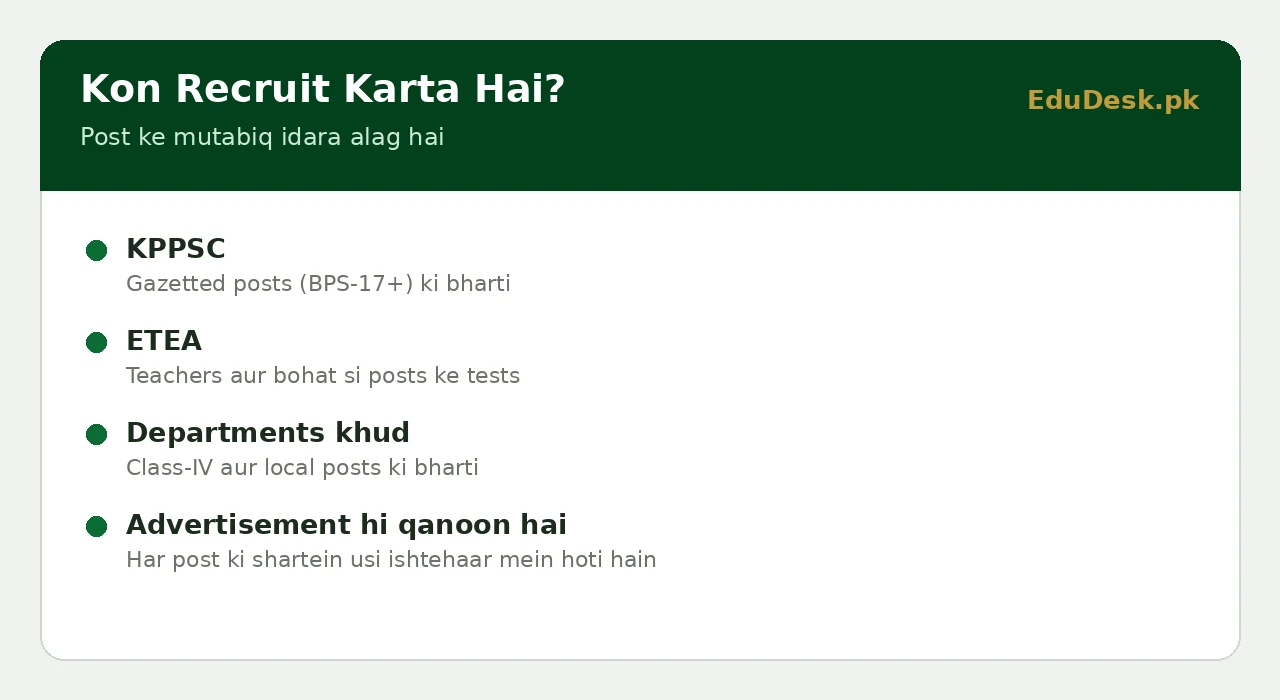
| Body | What they handle |
|---|---|
| KPPSC / kppsc.gov.pk | Provincial civil service posts — PMS officers, subject specialists, and posts in higher scales |
| ETEA / etea.edu.pk | KP’s own testing agency — widely used for education department and other provincial recruitment |
| NTS / nts.org.pk | Testing services used for various posts, including past teacher recruitment |
Note that FPSC is federal, and PPSC, SPSC and BPSC belong to other provinces. If you hold a KP domicile and want a KP provincial post, KPPSC and ETEA are your route.
KPPSC essentials
- Applications are online only, through the Commission’s apply portal. Paper applications are not accepted.
- The fee is paid through the 1Bill option available in most banking and mobile wallet apps.
- The application fee is not refundable — so check the amount and your eligibility in the advertisement before you pay. The figure is stated in each advertisement; don’t rely on a number quoted in a blog, including this one.
- Roll number slips are downloaded from your KPPSC account. No hard copy is posted.
- Thresholds can apply at the screening stage: amendments to the KPPSC Function Rules in July 2025 set a 50% passing threshold for the PMS screening test.
Age Limits — Be Careful With What You Read Online
You’ll find confident age tables published everywhere. Be sceptical: limits vary by post, by department and by advertisement, and they change.
What’s reliable to say:
- The advertisement itself states the age limit for that specific post. That is the only figure that matters.
- Age is normally counted up to the closing date of the advertisement.
- Relaxations exist for certain categories — including disabled persons and serving government employees — under the Initial Appointment to Civil Posts (Relaxation of Upper Age Limit) Rules, 2008, as amended on 20 June 2025.
Don’t rely on a blog’s age table. Open the advertisement and read the age row for your post.
Documents You’ll Need
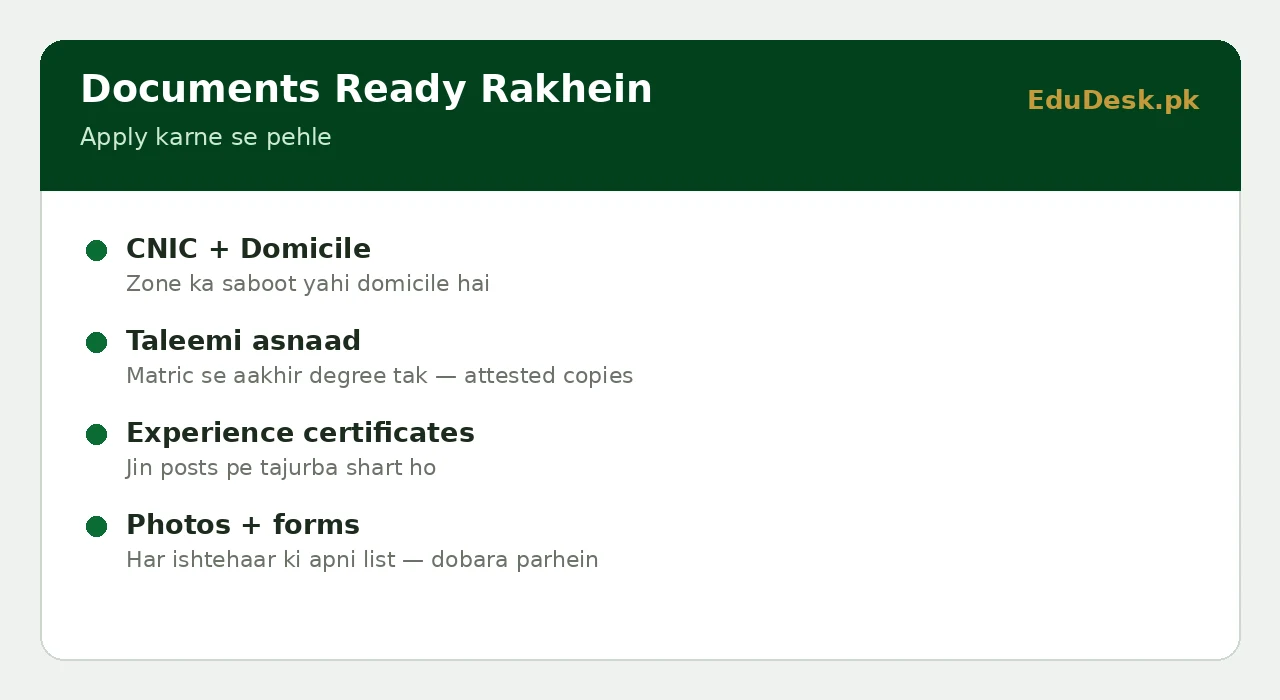
Basic set: CNIC · Domicile of Khyber Pakhtunkhwa (including the merged tribal districts) · educational certificates and degrees · experience certificates where required · character certificate · passport-size photographs.
| Category | Additional document |
|---|---|
| Disabled quota | Disability certificate + medical board verification |
| Minority quota | Minority declaration |
| Teachers claiming regularization | Original ad-hoc / contract appointment order, testing service result, service record — and the Gazette notification once issued |
Keep clean scans of everything. Online portals reject blurred uploads, and re-uploading after a deadline is not possible.
The Government Appointment KPK Process, Step by Step
Step 1 — The advertisement. Posts are published in newspapers and on official portals. Read the whole advertisement — especially the zone allocation, the age row and the exact qualification wording.
Step 2 — Apply online. For KPPSC, online is the only accepted route. Pay through the specified channel and keep the receipt — the fee is not refundable.
Step 3 — Upload documents. Clear scans, correct category, nothing missing.
Step 4 — Written test / screening. Conducted by the relevant agency, and note that passing thresholds can apply — 50% for the PMS screening test.
Step 5 — Interview. Before the selection committee or departmental panel.
Step 6 — Merit list. Prepared on merit and by quota / zone allocation.
Step 7 — Appointment letter. Stating your terms, pay scale, posting and joining date.
Step 8 — Joining and verification. Degrees, domicile, CNIC, character record and medical fitness may all be checked before final joining.
⚠ A serious warning on documents. Fake degrees or forged certificates don’t just cost you the job. They can result in an FIR and permanent disqualification from public service. It is never worth it — and verification now happens at the joining stage as a matter of routine.
Common Mistakes
- Assuming the family quota still applies. Check the 26 September 2024 line first — and if your case pre-dates it, don’t give up either.
- Ignoring the zone allocation and misjudging your real competition.
- Missing that female, disabled and minority posts carry no zonal reservation — that may be your wider field.
- Trusting an age limit from a blog instead of the advertisement.
- Applying to FPSC or PPSC for a KP provincial post.
- Assuming you’re regularized under the Teachers Act without Gazette publication.
- Building hopes on the Teachers Act when you were engaged on work-charge, contingency or PTC terms — you’re excluded.
- Paying a non-refundable fee before checking that you meet the eligibility.
- Blurred document scans, missed deadlines, wrong quota claimed.
Free tools for KPK government staff
Once you’re appointed, the paperwork starts. EduDesk builds tools for KPK school and office staff — in the exact formats the office expects.
- Salary Slip Downloader — Your slip by name, personnel no & CNIC
- KPK Salary Calculator — Pay & allowances from BPS and stage
- Office Letters & Forms — Charge, leave, pension and TA paperwork
- Expenditure Generator — Monthly statement in E&SE format
Related guides:
- Leave rules in KPK: every day limit, with rule numbers
- Pension & retirement in KPK: old pension vs CP Fund
- PIFRA registration: get your salary slip by email →
- E-Transfer KPK: complete guide for teachers →
Frequently Asked Questions
Is the son quota still available in KP?
Not for new cases. Following the Supreme Court’s judgment of 26 September 2024 in General Post Office, Islamabad v. Muhammad Jalal, KP instructed departments that children of employees who retired or died after that date are not entitled to fresh appointments under the quota. Cases pending from before that date are examined individually in accordance with law.
Why was the deceased quota struck down?
The Supreme Court held that appointing the spouse or child of a civil servant who died in service or became permanently disabled, without open advertisement, competition and merit, was discriminatory and ultra vires Articles 3, 4, 5(2), 18, 25(1) and 27 of the Constitution. Federal and provincial governments were directed to withdraw such rules.
My father died in service before 2024 and my case is pending. What now?
Pending pre-cut-off cases are to be decided on their individual facts and legal status, not rejected wholesale. In Ayaz Ali v. Federation of Pakistan (17 July 2025) the Supreme Court held that Jalal operates prospectively and that applications filed while the earlier policy was in force must be assessed under that policy. Get the written status of your file and the date it was received, and take legal advice on your specific facts.
Can a case already decided in my favour be reopened?
In Province of Sindh v. Azhar Ali (1 September 2025) the Supreme Court dismissed the government’s petition and held that cases which have attained finality are fully protected under the doctrine of past and closed transactions.
Which quotas still exist in KP?
KPPSC advertisements show general, female, disabled and minority quotas, alongside zonal allocation of the general quota.
What is the zonal quota in KP?
Many posts are allocated across Zone-I to Zone-VI rather than purely on province-wide merit, under the Civil Servants (Appointment, Promotion and Transfer) Rules, 1989 and the Revised Zonal Allocation Notification dated 22 December 2022. KPPSC also operates a Zonal Rotational Cycle. Check the zone table in each advertisement.
Does the zonal quota apply to female, disabled and minority posts?
No. No zonal reservation applies to posts allocated to the minority, disabled and female quotas — those are filled on open merit, so you are not limited to your zone’s allocation.
Can my zone have zero posts in an advertisement?
Yes. In a recent Provincial Planning Service advertisement for 13 posts, Zone-I was allocated none, while Zone-III and Zone-VI had two each. This is why the zone table matters as much as your score.
Which teachers are covered by the 2022 Regularization Act?
PSTs, CTs, CT-IT, SSTs, Primary Teachers, Drawing Masters, Physical Education Teachers, Theology Teachers, Arabic Teachers and Qari/Qaria Teachers appointed on ad-hoc or contract basis through NTS, ETEA or any other testing service. Teachers engaged on work-charge basis, paid out of contingencies, or engaged by a Parent Teachers Council are expressly excluded.
What dates does the Teachers Act cover?
Teachers holding various posts from 08.03.2017 until the commencement of the Act, which was first published in the Gazette (Extraordinary) on 20 September 2022 and came into force at once.
From when do I get seniority under the Act?
From the date of your initial ad-hoc appointment — and pay along with it, under section 3(1)(d) — not from the date of regularization.
How do I know if I’ve actually been regularized?
Section 3(2) says services are deemed regularized only on the publication of the teacher’s name in the official Gazette. Confirm it in writing and get the Gazette reference; don’t assume.
What if another rule conflicts with the Teachers Act?
Section 4 gives the Act overriding effect: any other law or rule inconsistent with it ceases to have effect to the extent of the inconsistency.
Should I apply through KPPSC or FPSC?
For a KP provincial post with KP domicile, apply through KPPSC for a government appointment in KPK — and through ETEA for many education and departmental posts. FPSC is federal, and PPSC, SPSC and BPSC belong to other provinces.
How do I apply and pay for a KPPSC post?
Applications are online only, through the Commission’s apply portal, with the fee paid via the 1Bill option in banking and mobile wallet apps. The fee is not refundable, so confirm the amount and your eligibility in the advertisement before paying. Roll number slips are downloaded from your account.
Is there a passing threshold for the PMS screening test?
Yes. Amendments to the KPPSC Function Rules in July 2025 set a 50% passing threshold for the PMS screening test.
What is the age limit for KP government jobs?
It varies by post, department and advertisement, so the advertisement is the only figure that matters. Age is normally counted to the closing date, and relaxations for certain categories fall under the Initial Appointment to Civil Posts (Relaxation of Upper Age Limit) Rules, 2008, amended on 20 June 2025.
What happens if a degree turns out to be fake?
Documents are verified before final joining. A forged degree or certificate can result in an FIR and permanent disqualification from public service, quite apart from losing the appointment.
In Short
Three things decide your route to a government appointment in KPK in 2026:
- The family quota is closed for new cases. 26 September 2024 — the date of the Supreme Court’s judgment — is the dividing line. But if your case pre-dates it, two Supreme Court judgments from 2025 say it must be judged under the policy that applied when you filed.
- Zone matters. Check the zonal allocation before you assume you know the competition — and remember that female, disabled and minority posts aren’t tied to a zone at all.
- If you’re an ad-hoc teacher, the 2022 Act may already entitle you to regular status, with seniority and pay from your original appointment date — but only once your name is in the Gazette.
Before you apply for a government appointment in KPK, read the advertisement. Verify your own status in writing. And never rely on a forwarded WhatsApp message for a decision that shapes your career.
Disclaimer: EduDesk.pk is an independent resource — not a government website. Recruitment rules, quotas and age limits change through official notifications and court judgments; the advertisement and the official notification for a post always prevail.