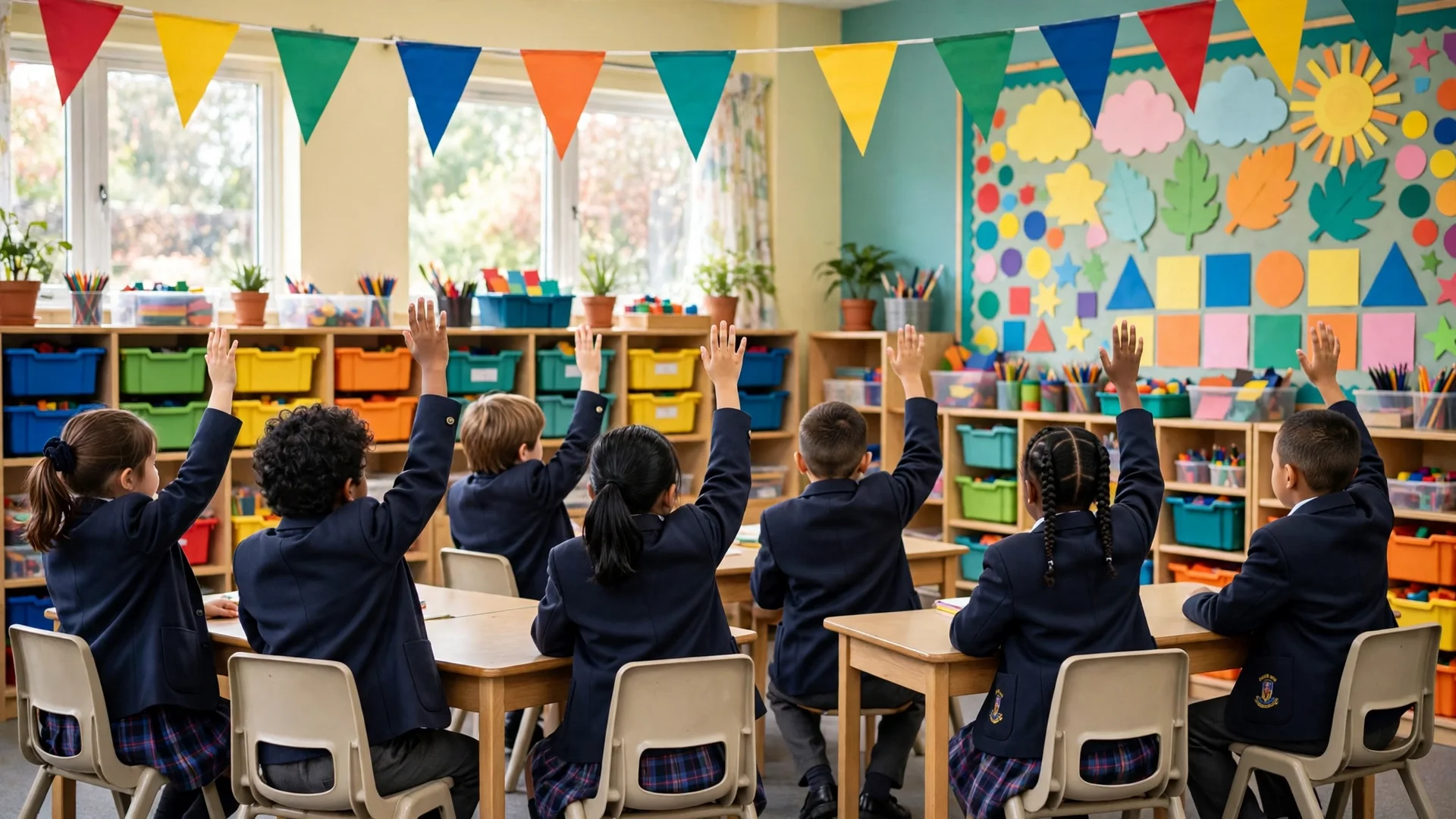
KPK Curriculum 2026 – Grades 1 to 5
In September 2026, the Directorate of Curriculum and Teacher Education (DCTE), Khyber Pakhtunkhwa, notified a new curriculum for the early grades of government and private schools across the province. The Khyber Pakhtunkhwa Curriculum-2026 for Grades 1 to 5 was notified on 17 September 2026, and it will take effect from Academic Year 2027. For teachers of Classes 1 to 5, this is the document that will shape the textbooks, the lesson plans, and the classroom work of the coming years.
This guide explains what the new curriculum contains, what has changed, and what teachers should do now. It is based on the DCTE notification itself and on the Scheme of Studies 2025, which continues to govern the current session. Where a point is still unclear, this guide says so plainly rather than guessing.
What changed in 2026
The notification is numbered 4153-67/AD/(C&TR)/DCTE, dated Abbottabad, 17 September 2026, and signed by Rehana Yasmin, Additional Director (C&TR), DCTE Khyber Pakhtunkhwa. It was issued after meetings held on 11 September 2026, and it states that it was made in pursuance of provincial government directives to simplify the curriculum of the early grades.

The most important change is simplification. The provincial government directed that the early grades curriculum be made simpler, and the new curriculum carries seven subjects only. The aim, as stated in the notification, is a lighter and more manageable course for young children in Classes 1 to 5.
The new curriculum does not apply immediately. It is effective from Academic Year 2027. The current session, 2026–27, continues under the existing textbooks and the Scheme of Studies 2025. Teachers should not change what they are teaching in the middle of this session. The new curriculum is something to prepare for, not something to apply tomorrow.
The notification also gives clear directions to everyone involved in producing and using school books. The Khyber Pakhtunkhwa Textbook Board (KPTBB) has been directed to develop or revise textbooks according to the new curriculum. Schools, both public and private, are to use only DCTE-approved books aligned with it. Private publishers must obtain prior approval or a no-objection certificate from the DCTE before publishing textbooks. Development partners have been asked to align their training materials with the new curriculum. Non-compliance can be proceeded against under the Khyber Pakhtunkhwa Supervision of Curricula, Textbooks and Maintenance of Standard of Education Act, 2011.
For a classroom teacher, the practical meaning is simple: new books will arrive for Academic Year 2027, and they will be built on this curriculum. Until then, the books already in use remain the books to teach from.
The seven subjects
The Khyber Pakhtunkhwa Curriculum-2026 covers seven subjects for Grades 1 to 5. The full list is:
- English — Grades 1 to 5
- Urdu — Grades 1 to 5
- Mathematics — Grades 1 to 5
- General Knowledge — Grades 1 to 3 only
- Islamiyat — Grades 1 to 5
- General Science — Grades 4 to 5 only
- Social Studies — Grades 4 to 5 only
The pattern is worth noting. In Classes 1 to 3, children study General Knowledge, which combines early science and social studies in one subject. From Class 4 onwards, General Knowledge gives way to two separate subjects, General Science and Social Studies. English, Urdu, Mathematics and Islamiyat run through all five classes.
Teachers should be careful about one thing: this list of seven is the complete list in the notification. There are no other subjects in the Khyber Pakhtunkhwa Curriculum-2026 for Grades 1 to 5. If a subject is not in this list, it is not part of this curriculum document. The full subject list is also available on the official DCTE notification page, and teachers who want to check the original should look there.
Two questions teachers are asking
Since the notification appeared, teachers have raised two questions about subjects that are not in the seven-subject list: Nazra Quran and Regional Language.
Nazra Quran. The notification’s seven subjects do not include Nazra Quran. Under the current Scheme of Studies 2025, Nazra Quran is a compulsory subject in Grades 1 to 5. The 2026 curriculum notification does not say that Nazra Quran has been removed, and it does not say that it continues. Until the DCTE issues a clear direction on this point, teachers should continue to teach Nazra Quran as they do now, following the Scheme of Studies 2025 and the instructions of their school and district education office. Do not drop a subject on the basis of a social media post or a rumour. A subject is only removed when the DCTE says so in writing.
Regional Language. The notification also does not list Regional Language. Under the Scheme of Studies 2025, Regional Languages is a compulsory subject in Grades 1 to 3 and Regional Language is compulsory in Grades 4 to 5. In most districts of Khyber Pakhtunkhwa the regional language is Pashto, although other regional languages apply in some areas. As with Nazra Quran, the 2026 curriculum notification neither confirms nor removes the subject. Teachers should continue teaching Regional Language under the current scheme until the DCTE gives a written direction.
The honest position is this: the seven-subject list is what the new curriculum contains, and the position of Nazra Quran and Regional Language under the new curriculum has not yet been clarified in writing. This guide will be updated when the DCTE clarifies it.
What it means for teachers
For teachers of Classes 1 to 5, the new curriculum brings three practical consequences.
First, the course will be simpler. The whole point of the 2026 revision was to simplify the early grades. That should mean fewer topics to rush through, more time to teach each topic properly, and less pressure on young children. When the new textbooks arrive, teachers should read them against the old ones and note what has been dropped and what has been kept, so that their lesson plans match the new books.
Second, the change is phased, not sudden. The current session continues on the old books and the Scheme of Studies 2025. Teachers do not need to rewrite their lesson plans this year. The time to change is when the new KPTBB textbooks reach the school for Academic Year 2027. A teacher who starts teaching from the new curriculum before the new books arrive will be teaching a course for which the children have no book.
Third, only approved books count. From Academic Year 2027, schools must use books that the DCTE has approved against the new curriculum. Teachers should check that any book they use in class carries DCTE approval. Private publishers’ books need prior approval or a no-objection certificate, so a book that looks new is not automatically an approved book.
There is also a point about Grades 6 to 8. The September 2026 notifications covered Grades 1 to 5 and Grades 9 to 12. No new curriculum was notified for Grades 6 to 8. Teachers of the middle grades continue under the existing curriculum and the Scheme of Studies 2025.
How teachers should use the new curriculum
A curriculum document tells a teacher what to teach. It does not, by itself, tell a teacher how to teach it day by day. That is the work of lesson planning, and the new curriculum is best used as the backbone of that planning.

Start with the subject list for your class. A Class 2 teacher works with English, Urdu, Mathematics, General Knowledge and Islamiyat. A Class 5 teacher works with English, Urdu, Mathematics, Islamiyat, General Science and Social Studies. Build the weekly timetable around those subjects, and keep Nazra Quran and Regional Language in the timetable under the current scheme until the DCTE directs otherwise.
Then, for each subject, list the topics the new textbook covers once it arrives, and plan the term around them. A good lesson plan for a primary class has three parts: what the children will learn, how the teacher will teach it, and how the teacher will check that they have learned it. A short oral question, a written exercise, or a small activity at the end of the lesson is enough. Long written tests are not the only way to check learning in the early grades, and for young children they are often not the best way.
For practice and revision, teachers can use the EduDesk [Test Paper Generator](https://edudesk.pk/test-paper-generator/) to make short class tests from the topics they have taught. A short test built from the topics of the week tells a teacher quickly which children have understood the lesson and which need more help. The generator covers the subjects of Classes 1 to 5, and a teacher can use it to set a class test that matches the topics in the textbook.
One more practical habit is worth building now. When the new textbooks arrive, compare each new book with the old one, chapter by chapter, and mark the differences. The chapters that have been dropped need no more teaching. The chapters that have been added need new lesson plans. The chapters that remain may still have changed inside, so do not assume that an old lesson plan fits a new chapter. A single afternoon spent on this comparison will save weeks of confusion in the classroom.
A note on ECCE
The Khyber Pakhtunkhwa Curriculum-2026 notification covers Grades 1 to 5 only. It does not cover Early Childhood Care and Education (ECCE), the pre-primary stage.
ECCE is covered by a separate federal notification. The National Curriculum Council of the Ministry of Federal Education approved the New National Curriculum of Pakistan (NNCP-2026) for ECCE and Grades 1 to 5 on 27 October 2026, for Islamabad Capital Territory and federal institutions from academic year 2027–28. That is a federal notification, not a Khyber Pakhtunkhwa notification, and it does not govern KP government schools. Teachers in KP should follow the DCTE’s Khyber Pakhtunkhwa notification for Grades 1 to 5, and look to the DCTE for any future direction on ECCE in the province.
Official sources
Teachers who want to read the original documents should start with the DCTE itself:
- DCTE Khyber Pakhtunkhwa, notifications page: https://dcte.kp.gov.pk/notifications
- DCTE Khyber Pakhtunkhwa, official website: https://dcte.kp.gov.pk
- Scheme of Studies 2025, DCTE notification No. 4492-4508/AD-SSW/SoS, dated 5 September 2025: https://dcte.kpese.gov.pk/wp-content/uploads/Notification-SOS-September-2025.pdf
The curriculum documents themselves are stated in the notification to be available on the DCTE website. If a copy of the notification cannot be found on the website, the district education office can provide it.
Frequently asked questions
When does the new curriculum for Grades 1 to 5 start? From Academic Year 2027. The notification was issued on 17 September 2026, and the current session continues under the existing textbooks and the Scheme of Studies 2025.
Which subjects are in the new curriculum? Seven: English, Urdu, Mathematics, General Knowledge (Grades 1 to 3), Islamiyat, General Science (Grades 4 to 5), and Social Studies (Grades 4 to 5).
Has Nazra Quran been removed from Classes 1 to 5? The notification does not say so. Nazra Quran is not in the seven-subject list, but the notification does not state that it has been removed. Under the current Scheme of Studies 2025 it remains a compulsory subject. Teachers should continue teaching it until the DCTE issues a written direction.
Has Pashto, the regional language, been removed? The notification does not list Regional Language among the seven subjects, and it does not state that it has been removed. Under the Scheme of Studies 2025, Regional Languages is compulsory in Grades 1 to 3 and Regional Language is compulsory in Grades 4 to 5. Teachers should continue teaching it until the DCTE directs otherwise.
Will there be new textbooks? Yes. The notification directs the Khyber Pakhtunkhwa Textbook Board to develop or revise textbooks according to the new curriculum, and schools are to use only DCTE-approved books. The new books are expected for Academic Year 2027.
Does the new curriculum apply to private schools too? Yes. The notification directs all public and private institutions to follow the new curriculum, and private publishers must obtain prior DCTE approval before publishing textbooks.
*Last updated: 15 November 2026*
Sources
- DCTE Khyber Pakhtunkhwa, Notification No. 4153-67/AD/(C&TR)/DCTE, dated Abbottabad, 17 September 2026 — Khyber Pakhtunkhwa Curriculum-2026 for Grades 1–5, effective Academic Year 2027. Notification listing: https://dcte.kp.gov.pk/notifications
- DCTE Khyber Pakhtunkhwa, Scheme of Studies 2025, Notification No. 4492-4508/AD-SSW/SoS, dated 5 September 2025: https://dcte.kpese.gov.pk/wp-content/uploads/Notification-SOS-September-2025.pdf
- National Curriculum Council, Ministry of Federal Education, approval of the New National Curriculum of Pakistan (NNCP-2026) for ECCE and Grades 1–5, 27 October 2026 (federal notification, Islamabad Capital Territory and federal institutions).