

Published: October 23, 2026 • Updated: November 21, 2026
Pension & Retirement in KPK: The Complete 2026 Guide
By EduDesk.pk · Updated 9 September 2026 · Figures checked against AG KP and the Finance Department
Ask ten government employees in Khyber Pakhtunkhwa how their pension works, and you’ll get ten different answers.
That’s not because people are careless. It’s because the rules changed — and depending on when you joined service, you may be on a completely different system from the teacher sitting next to you.
This guide explains the pension rules in KPK in plain language, with the real rules, and with an honest note wherever you need to confirm a figure with your own accounts office.
⚠ Start here: which system are you on?
Before anything else, answer this: when were you appointed? Khyber Pakhtunkhwa was the first province in Pakistan to move away from the traditional pension system, so there are now two very different worlds.
| If you were appointed… | You are on |
|---|---|
| Before 7 June 2022 | The old pension system — a monthly pension for life |
| On or after 7 June 2022 | The Contributory Pension System (CP Fund) — no monthly pension |
The C.P Fund was introduced through the Khyber Pakhtunkhwa Contributory Provident Fund Rules, 2022, and applies to employees appointed on or after 7 June 2022. It follows the Khyber Pakhtunkhwa Civil Servants (Amendment) Act, 2022.
If you joined before 7 June 2022, relax: the new system was introduced for new employees. Your existing pension terms were not taken away from you.
ON THIS PAGE
- Part 1 — the old pension system: types, family pension, LPR
- Part 2 — the new CP Fund
- Part 3 — benefits that apply to everyone: GP Fund, RBDC, Benevolent Fund, EEF
- Part 4 — the practical side: going digital, death in service, documents, process
Why KP changed the system
A quick bit of background, because it explains everything.
The province’s pension bill was growing fast — from a small share of the budget in the early 2000s to a very large one two decades later. Money that could have built schools and hospitals was going into pension payments instead.
So KP shifted new employees onto a funded system, where the money is actually invested and set aside as you earn it, rather than paid out of next year’s budget. Whether you think that is good or bad, it is the reality — and knowing which side of the line you’re on is what matters.
Why this matters so much
Under the new system you do not get a monthly pension after retirement. You get what has built up in your investment account. That is a fundamentally different retirement — and it is the single most important fact about your own.
PART 1
Pension rules KPK: the old pension system
If you joined before 7 June 2022, this is you.
Types of pension
The Accountant General KP recognises several kinds of pension. Which one applies depends on how you leave service.
| Type | When it applies |
|---|---|
| Superannuation | Granted on completing 60 years of age. The normal route for most employees. |
| Retiring | For those who leave earlier — after 25 years of qualifying service or on attaining age 55, whichever is later. Also covers compulsory retirement ordered in the public interest, or on grounds of inefficiency, misconduct or corruption. |
| Invalid | When a government servant becomes permanently incapacitated for further service through physical or mental infirmity, certified by a duly constituted Standing Medical Board. This is what people mean by “medical board retirement”. |
| Compensation | If your permanent post is abolished and you are selected for discharge, you may take a compensation pension or gratuity for the service already rendered. |
| Special additional | Retiring civil servants in BPS-20, 21 and 22 who were eligible for orderly allowance get a special additional pension equal to the admissible pre-retirement orderly allowance. |
| Anticipatory | Granted before the final pension assessment is complete at retirement — so you are not left with nothing while the case is being finalised. Worth asking about if your case is running late. |
Read “whichever is later” carefully
Retiring pension is not simply “25 years and you’re out”. If you completed 25 years at age 48,
you still wait until 55. Both conditions have to be satisfied, and the later one governs.
Work it out with our pension calculator KPK.
Family pension
This is the section families need most, and the one most articles get wrong. The share depends on whether the death happens before or after retirement.
| When | What the family gets |
|---|---|
| (death in service) | 25% of the gross pension paid to the spouse/successor as a gratuity — a one-time amount |
| (a pensioner dies) | 100% of the net pension the deceased was drawing, paid to the spouse/successor as a monthly family pension |
There is also Life Time Arrears (LTA) — amounts that were due to a pensioner who has passed away, payable to the family.
Note the difference — this is where families get short-changed
Before retirement the family gets 75% (plus a gratuity). After retirement they get 100% of what was being drawn. If someone tells a widow she is entitled to 75% of her late husband’s pension when he had already retired, that is wrong, and it is a 25% error every single month. AG Khyber Pakhtunkhwa states the post-retirement share as “100% of his/her Net Pension (drawn by deceased) as a Family Pension per month”.
LPR
At retirement you take either LPR or leave encashment — never both — for up to 365 days. Full guide: Leave Encashment & LPR KPK: Full Guide 2026.
PART 2
The new Contributory Pension System (CP Fund)
CP Fund applies to government servants appointed on or after 7 June 2022 — 10% comes from the employee and 12% from the government, 22% in total. Full guide: CP Fund KPK: Contributory Pension Guide 2026.
PART 3
Benefits that apply to everyone
These don’t depend on when you joined — the pension rules in KPK keep them the same for everyone.
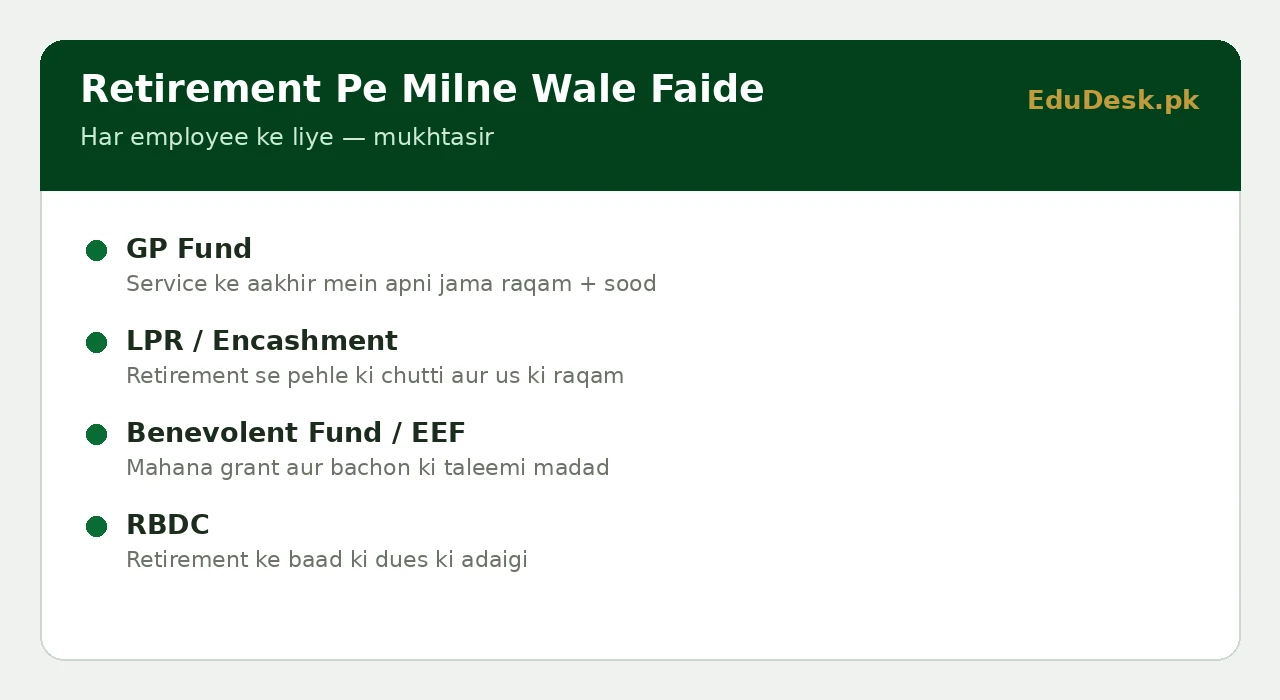
GP Fund
The one every employee knows about — money deducted monthly and paid back with profit.
The G.P Fund is governed by the Khyber Pakhtunkhwa General Provident Fund Rules, 2008, and applies to all regular government employees of KP, irrespective of their date of appointment. So even new employees on the CP Fund still have GP Fund. They are two separate things:
| GP Fund | CP Fund | |
|---|---|---|
| Rules | KP General Provident Fund Rules, 2008 | KP Contributory Provident Fund Rules, 2022 |
| Who it covers | All regular KP employees, any joining date | Employees appointed on or after 7 June 2022 |
| What it is | Your own savings + profit | Your pension replacement |
The GP Fund profit rate is notified each year and it changes — for 2024-25 it was 12.46% and for 2025-26 it is 12.05%. Check the current rate on the AG KP website rather than trusting a blog.
Before you retire
Verify your GP Fund balance and confirm your nomination is up to date. Nomination errors cause serious problems for families later — and they are trivial to fix while you are still in service.
RBDC
Let’s clear up an acronym that gets mangled constantly online. RBDC stands for Retirement Benefit and Death Compensation — not “Relief Benevolent” or anything similar.
It was established under the Khyber Pakhtunkhwa Civil Servants Retirement Benefits and Death Compensation Act, 2014, enforced with effect from 6 November 2014, and is further governed by the RBDC Fund Rules, 2017.
What it covers: a contributory scheme providing financial protection to civil servants and their families on retirement, disability, or death during service. It is deducted monthly from your salary against object head 4004, at a rate that rises with your pay scale.
Unlike some other provincial funds, RBDC does not receive equity support from the government — it runs on employee contributions. That is your money in there.
How to claim: the KP Finance Department publishes the RBDC Fund application form and claim information on finance.gkp.pk. Download the current form from there rather than using a copy someone forwarded on WhatsApp.
To file an RBDC claim, the family submits the death/retirement documents to the Finance Department — the current RBDC claim payment lists are published on finance.gkp.pk.
Benevolent Fund
The Provincial Benevolent Fund Khyber Pakhtunkhwa works for the welfare of serving and retired provincial government employees and their families, under the KP Benevolent Fund Ordinance, 1972.
You are already paying into it — the contribution is deducted from your salary every month at source, against object head 3501:
| Basic Pay Scale | Monthly contribution |
|---|---|
| BS-01 to BS-04 | Rs 600 |
| BS-05 to BS-15 | Rs 1,200 |
| BS-16 and above | Rs 1,500 |
Rates effective 1 March 2021.
The money is collected by District Account Officers, routed through the AG Office, and transferred to the KP Benevolent Fund Board. The fund is split into Part I (Gazetted) for BS-16 and above and Part II (Non-Gazetted) for BS-01 to BS-15. District Benevolent Fund Boards exist so BS-01 to BS-15 employees can access the fund in their own district rather than travelling to Peshawar.
What you can claim
- Lump Sum Grant
- Retirement Grant
- Funeral Charges
- Merit Scholarship for children
- Interest Free Loan scheme
- Monthly Grant (older scheme)
Rates for retirement grant, funeral charges and merit scholarship have been revised over time. The Board publishes current figures and all downloadable grant forms — along with released funeral grants and grant case lists, so you can check a case’s status yourself — on bfkp.org.
EEF
If you work in education in KP, this section may be worth real money to you — and most employees have no idea it exists.
First, clear up the acronym. EEF stands for Education Employees Foundation — not “Educational Endowment Fund,” which is a different thing entirely, a mistake repeated across the internet.
The Foundation was established with effect from 1 July 1986 and later strengthened through the KP Education Employees Foundation Act, 2018 (KP Act No. VI of 2019).
The Foundation states that no mentionable grant has been provided by the Government or any other organisation. It runs entirely on the monthly contributions of education employees, deducted against object head 3990. Every rupee it pays out was contributed by staff.
Who it covers: employees under the Directorate of Higher Education, the Directorate of Elementary & Secondary Education, DG Commerce Education & Management Sciences, Directorate of Education FATA, the Bureau of Curriculum and Teacher Education, the Foundation itself, and eligible KP-TEVTA education employees.
What EEF actually pays
| Scheme | Amount |
|---|---|
| Retirement Grant | BPS 1–10: Rs 40,000 · BPS 11–16: Rs 50,000 · BPS 17 & above: Rs 60,000 (once) |
| Merit Scholarship | Rs 7,000 p.a. |
| Cash Award | Rs 20,000 SSC · Rs 25,000 HSSC once |
| Talent Support | Rs 25,000/month, 5 yrs MBBS / 4 yrs Engineering |
| Cancer assistance | up to Rs 400,000 once (raised from Rs 300,000 under Notification EEF/325/2025 — applies to cases received on or after 1 February 2025) |
| Marriage Grant | Rs 30,000 once |
Look at that Talent Support scheme again. Rs 25,000 a month for five years for a top-three HSSC position holder’s child going into MBBS. How many teachers in your school know it exists?
The Foundation’s objectives also include low-cost accommodation (there is an EEF Housing Scheme) and financial assistance on retirement, medical treatment, leaving service, or death.
How to claim: forms for each scheme — retirement grant, merit scholarship, marriage grant, cancer assistance, position-holder awards and talent support — are published on the Higher Education Department website, along with the KP Education Employees Foundation Welfare and Financial Assistance Regulations, 2021.
Claim the retirement grant. It is money you contributed to for your whole career, and nobody will chase you to claim it. The retirement grant amounts above match the Pay & Allowance chart your own DDO office uses, so your deduction record will back the claim up.
PART 4
The practical side
Going digital: the Pension Envelope System
KP’s Performance Management & Reforms Unit built a Pension Envelope System — an ICT-based system that processes pre-pension cases automatically. Instead of a clerk hand-filling forms over several months, the system generates the pension documents itself.
The idea is simple and rather good: on your last day of service you walk out with a single envelope containing all your pension papers — already prepared, calculated and approved.
It is designed to fix exactly the problems that delay pensions today: papers not available, retirement notification not issued, forms filled incorrectly, pension miscalculated, and cases bounced back for not matching the AG checklist.
What it does: holds your bio data, service history, dependants and bank information; calculates the pension; generates the papers; gives the department a dashboard of everyone retiring next month or next year; and lets you track your own case.
The system has been implemented in establishment departments in pilot mode, with replication to attached units and districts planned — so don’t assume it is running where you work. Ask your department directly: “Is my pension case being processed through the Pension Envelope System?” If yes, you can track it. If not, you are on the manual route and need to be far more proactive about your paperwork.
E-Pension for education employees
The Elementary & Secondary Education Department also runs its own e-pension portal for education employees, where cases are initiated online — login, employee information, uploading the required documents, then departmental verification.
If you’re an E&SE employee approaching retirement, ask your office whether your case goes through this portal and what documents need to be scanned. Having clean scans of your CNIC, service book pages and family documents ready in advance turns a multi-week process into a much shorter one.
Death in service
This is the hardest situation, and families usually deal with it while grieving. Here is what may be claimable:
- Family pension (old system) — 25% of gross pension as gratuity, plus 75% as monthly family pension
- RBDC death compensation
- Benevolent Fund — grant plus funeral charges
- GP Fund final payment
- Leave encashment — a lump sum equal to leave pay for up to 180 days out of the leave at credit (Rule 21; the 365-day ceiling applies only to encashment in lieu of LPR)
Documents the family will need
- Death certificate
- CNIC of the deceased and of the claimants
- Succession certificate / legal heir documents
- Family Registration Certificate (FRC) from NADRA
- Service book and service particulars
- Bank account details
Practical advice: appoint one family member to handle the paperwork, keep certified copies of everything, and start with the deceased’s DDO — they hold the service record that everything else depends on.
Documents for retirement
Start collecting these at least a year before you retire, not in the final month:
- CNIC
- Service book — complete and verified
- Pension papers / forms
- Retirement notification
- Bank account details
- Family details and Family Registration Certificate
- NOC from the Estate Office, where the civil servant has occupied government accommodation
- Medical Board certificate, in invalid pension cases
The retirement process, step by step
01 — Retirement notification. Your department issues the notification ahead of your retirement date.
02 — Service verification.
03 — LPR or encashment.
04 — Pension papers.
05 — Case submitted to accounts. Your DDO forwards the case to the District Accounts Office, which reports up to the Accountant General Khyber Pakhtunkhwa.
06 — Authorisation.
07 — Release. Pension begins, GP Fund is released, and any arrears are paid.
Fix these before you retire
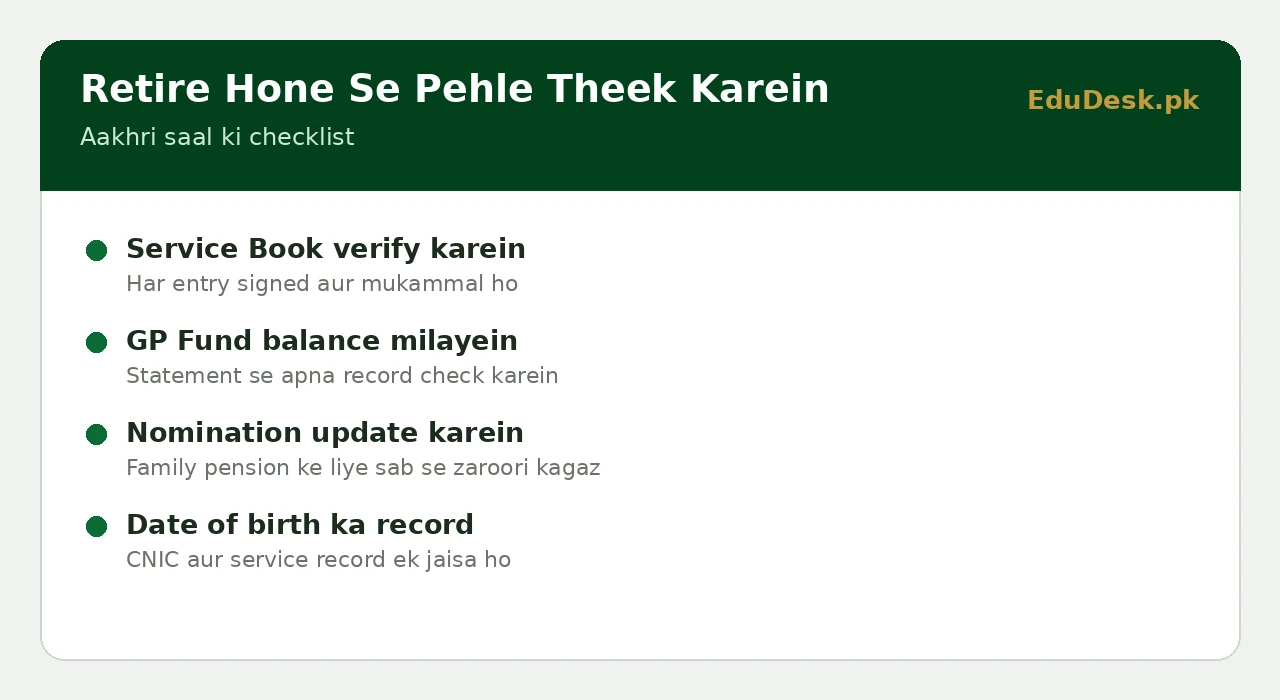
Almost every delayed pension case comes down to something that could have been fixed years earlier:
- Incomplete or unverified service book — the single biggest cause of delay
- Leave record not reconciled — check your leave account now
- Outdated GP Fund nomination
- Family records not updated (marriage, children, deaths)
- Wrong date of birth in the service record — this decides your retirement date, and fixing it late is very hard
- Pension papers submitted at the last minute
Do this today: ask to see your service book. Check your date of birth, your service entries, and your leave account. It takes an afternoon and can save you months.
Official contacts
| For | Where to go |
|---|---|
| AG KP office | Accountant General Khyber Pakhtunkhwa, 10th Fort Road, Peshawar — Post Box No. 1340, GPO Peshawar Cantt |
| CP Fund / DCPS | Pension Cell, Finance Department — finance.gkp.pk |
| EEF — education employees | Higher Education Department website (forms and regulations); ask your office for the Retirement Grant Section |
| Phone numbers and section emails | Take them from the official list: AG KP phone list |
| Anything about your record | Your DDO first, then your District Accounts Office |
| Pension / accounts | District Accounts Office, then AG Khyber Pakhtunkhwa (36 District Accounts Offices province-wide) |
Direct numbers and section emails change, and a wrong number wastes a trip to Peshawar. Every organisation above publishes its own current contact list — take the number from there. And always start with your DDO: most problems are record problems, and your DDO holds the record.
Frequently asked questions
Am I on the old pension system or the new one?
It depends on your appointment date. The C.P Fund applies to employees appointed on or after 7 June 2022, under the KP Contributory Provident Fund Rules, 2022. If you joined before that, you remain on the old pension system.
Do new employees get a monthly pension?
No. Under the contributory system you receive what has accumulated in your investment account rather than a monthly pension for life.
How much are the CP Fund contributions?
22% in total — 10% from you and 12% from the government, a ratio of 1.2 to 1. You may contribute more if you wish.
Do I still get GP Fund if I’m on the new CP Fund?
Yes. GP Fund is governed by the KP General Provident Fund Rules, 2008 and applies to all regular KP government employees regardless of joining date. GP Fund, Benevolent Fund and RBDC all continue alongside the CP Fund.
At what age do KP government employees retire?
Superannuation pension is granted on completing 60 years of age. Earlier retirement is possible after 25 years of qualifying service or age 55, whichever is later — both conditions must be met.
What is medical board retirement?
It is invalid pension — granted when a civil servant is permanently incapacitated for further service through physical or mental infirmity, certified by a duly constituted Standing Medical Board.
What happens to my family if I die during service?
Under the old system, 25% of the gross pension is paid as a one-time gratuity and 75% as a monthly family pension. Your family may also claim RBDC, Benevolent Fund grant and funeral charges, GP Fund, and a leave-encashment lump sum of up to 180 days’ leave pay out of the leave at credit.
And if I die after retirement?
Your spouse or successor receives 100% of the net pension you were drawing, as a monthly family pension — not 75%.
What is anticipatory pension?
A pension granted before the final assessment is complete at retirement, so a retiring employee is not left without income while the case is being finalised. Worth asking about if your pension case is running late.
What is LPR and how long is it?
Leave Preparatory to Retirement — Rule 14 of the KP Revised Leave Rules, 1981, up to 365 days, on full pay or half pay or a mix. It cannot be combined with any other kind of leave.
Can I take money instead of LPR?
Yes. Encashment in lieu of LPR allows up to 365 days’ basic pay, calculated as basic pay × days × 12 ÷ 365 and booked against head A04114. Death and invalidation cases are capped at 180 days’ leave pay under Rule 21.
What does RBDC stand for?
Retirement Benefit and Death Compensation. It was created under the KP Civil Servants Retirement Benefits and Death Compensation Act, 2014, enforced from 6 November 2014, and covers retirement, disability and death during service.
How much Benevolent Fund is deducted from my salary?
Rs 600 per month for BS-01 to BS-04, Rs 1,200 for BS-05 to BS-15, and Rs 1,500 for BS-16 and above — rates effective 1 March 2021.
What does EEF stand for?
Education Employees Foundation — not Educational Endowment Fund. It is a welfare foundation for KP education employees, established in 1986 and governed by the KP Education Employees Foundation Act, 2018. It runs on employees’ own monthly contributions.
How much is the EEF retirement grant?
Grade-wise, once: BPS 1–10 Rs 40,000, BPS 11–16 Rs 50,000, and BPS 17 and above Rs 60,000. Ask your office for the Retirement Grant Section, and claim it — it is money you contributed for your whole career.
Does EEF help with cancer treatment?
Yes. Financial assistance of up to Rs 400,000 (once) is available for cancer-affected education employees and their family members, for cases received on or after 1 February 2025 (Notification EEF/325/2025).
What is the GP Fund profit rate?
It is notified annually and changes. It was 13.97% for 2023-24, 12.46% for 2024-25, and 12.05% for 2025-26. Check the AG KP website for the current year rather than relying on a blog.
Can I track my pension case online?
If your department is using the Pension Envelope System, yes. The system is being rolled out in phases from a pilot in establishment departments, so ask your department whether your case is on it.
LPC full form: Last Pay Certificate — in Urdu, آخری تنخواہ سرٹیفیکیٹ (Aakhri Tankhwah Certificate). It is the certificate your office issues showing your last drawn pay, and it is required with your pension papers.
In short
Retirement in KP now comes down to one question first: when did you join?
- Before 7 June 2022 → old system. Monthly pension, family pension, LPR, the lot.
- On or after 7 June 2022 → CP Fund. No monthly pension; a 22% contribution invested in your name.
Everyone, regardless of joining date, still has GP Fund, Benevolent Fund and RBDC — and education staff also have EEF.
And whichever system you’re on under the pension rules in KPK, the advice is the same: check your service book now. Verify your date of birth, your service entries, your leave account and your nominations. Retirement paperwork rarely fails because of the rules — it fails because of a record nobody checked for twenty years.
Free tools for the paperwork
Salary Slip Downloader — Your slip by name, personnel no & CNIC
KPK Salary Calculator — Pay & allowances from BPS and stage
Retirement & Pension Forms — Pension papers in the prescribed format
Expenditure Generator — Monthly statement in E&SE format
Related guides
- PIFRA registration: get your salary slip by email →
- e-Transfer Plus Policy 2026: eligibility, criteria and scoring →
- E-Transfer KPK: complete guide for teachers →
Disclaimer: EduDesk.pk is an independent resource — not a government website and not affiliated with the Accountant General KP or the Finance Department. Pension rules and figures change through official notifications; where anything here differs, the official notification prevails.




5 Comments
Comments are closed.