Double Shift School (DSS) KPK: Timings, Pay & Full Guide
Double Shift School KPK: A Double Shift School (DSS) in Khyber Pakhtunkhwa is a government school building used twice in one day: the regular morning shift, and a second (evening) shift in the same building, so that more children can study without a new building being constructed. The model is simple — a primary school building hosts middle classes in the second shift, a middle school hosts high classes, and a high school hosts higher-secondary classes — and it is used only where there is a need for it. This Double Shift School KPK guide explains how the second shift works, what the department’s own published figures say about its scale, what teachers were paid when the scheme launched in 2021, what is reported about a 2026 relaunch, and what is not confirmed. Every rate in this Double Shift School KPK guide carries its year with it, because a 2021 rate presented as a current rate would mislead every reader who acts on it.
What a Double Shift School Is
The second shift is an evening shift run in an existing government school building, using the same classrooms, and usually the same head and support staff, after the morning shift ends. The idea, as decided in an Elementary and Secondary Education Department meeting chaired by then Chief Minister Mahmood Khan and reported in 2021, was to increase access to education — above all for out-of-school children and for girls in far-flung areas — without waiting for new school buildings. The scheme was to start only on a need basis, under a comprehensive policy prepared in consultation with the law and establishment departments, and overseen by a committee headed by the education minister. It was not a blanket order for every school: a school got a second shift because the local need — enrolment pressure, overcrowding, or children out of school — justified one.
The pairing of shifts follows the level of the school. A primary school building runs middle-school classes in the second shift. A middle school building runs high-school classes. A high school building runs higher-secondary classes. In each case the second shift takes the next level up, so that children who finish one level in the morning can continue to the next level in the same building in the evening, rather than travelling to a distant school or dropping out. That pairing is the core of the model, and it has stayed the same from the 2021 launch through the department’s current programme description.
Parents and students meeting the scheme for the first time should understand one further point. The second shift is a government programme run through the Education Department and the district education offices, and enrolment in it is enrolment in a government school. For admission and board registration questions, the admission and board registration guide explains the regular process; a second-shift class follows the same school system, in the same building, at a different time of day.
The Official Programme in Numbers
The department’s own programme page for the Double Shift School, published on kpese.gov.pk on 30 May 2026, states the scale of the programme in the following figures, reproduced here exactly as published. Read them as the department’s figures for the programme as a whole, not as figures for any single district or school.
| Item (as published 30 May 2026) | Figure |
|---|---|
| Schools where a Double Shift School was initiated, for the first time | 1,453 |
| Functional schools | 1,012 |
| Schools funded under the Human Capital Investment Program (KP-HCIP) — Abbottabad, Haripur, Peshawar and Swabi | 150 |
| Overcrowded Model — schools | 283 |
| Overcrowded Model — enrolment | 29,937 |
| Upgraded Model — schools | 729 |
| Upgraded Model — enrolment (out-of-school children) | 49,147 |
| Total enrolment (as stated) | 79,804 |
| Female enrolment | 26,818 |
| Male enrolment | 52,266 |
| Total staff engaged on stipend (as stated) | 7,876 |
| Government staff | 2,434 |
| PTC staff | 5,603 |
| Budget allocated, financial year 2025–26 | Rs 1.8 billion |
One transparency note about those figures, because this guide checks arithmetic before repeating it. The two enrolment breakdowns each add to 79,084 — 29,937 plus 49,147, and 26,818 plus 52,266 — which is 720 below the stated total of 79,804. Likewise, the two staff components add to 8,037 — 2,434 plus 5,603 — which is 161 above the stated total of 7,876. The figures in the table are reproduced exactly as the department published them, and this guide does not adjust them: the differences are in the department’s own page. The school counts, by contrast, are consistent: 283 overcrowded-model schools plus 729 upgraded-model schools equals the 1,012 functional schools. The stated purpose of the programme, on the same page, is to increase access to free and compulsory education, and the upgraded model’s enrolment is described as out-of-school children brought into school.
The Two Models: Overcrowded and Upgraded
The programme page divides the functional schools into two models, and the distinction matters for understanding what the second shift is doing in a particular school. The Overcrowded Model, with 283 schools and 29,937 enrolled students, covers schools where the morning shift is overcrowded: the second shift relieves the pressure by teaching part of the enrolment in the evening, in the same building. The Upgraded Model, with 729 schools and 49,147 enrolled students, covers schools upgraded to the next level in the second shift, and its enrolment is described as out-of-school children — children who were not in school at all and who are brought into education through the second shift. Between them, the two models account for all 1,012 functional schools and, on the department’s stated total, 79,804 enrolled students, of whom 26,818 are female and 52,266 male.
Part of the programme is funded through the Khyber Pakhtunkhwa Human Capital Investment Program (KP-HCIP), which funds 150 schools in four districts: Abbottabad, Haripur, Peshawar and Swabi. That funding is a subset of the programme, not the whole of it — the remaining functional schools operate under the programme’s regular funding, which for financial year 2025–26 is stated at Rs 1.8 billion. A reader in Abbottabad, Haripur, Peshawar or Swabi is therefore in a district where the HCIP funding applies; a reader elsewhere is in the programme’s regular stream. The programme page does not break the budget down by district, and this guide does not invent such a breakdown.
How the First Phase Worked in 2021
The second shift began with a first phase announced by the Education Minister, Shehram Khan Tarakai, at a press conference in 2021. In that phase, the second shift started in 120 schools — 76 for boys and 44 for girls — across 16 districts of the province. The breakdown by level was 48 boys’ primary schools upgraded to middle level and 20 boys’ middle schools upgraded to high level, and 28 girls’ primary schools upgraded to middle level and 16 girls’ middle schools upgraded to high level. One arithmetical note: the reported boys’ breakdown (48 plus 20) adds to 68, not the stated 76 boys’ schools, and the reporting did not account for the remaining eight; the girls’ breakdown (28 plus 16) adds exactly to 44. The figures are given here as reported.
| First phase, 2021 | Boys’ schools | Girls’ schools | Total |
|---|---|---|---|
| Primary school → middle classes in second shift | 48 | 28 | 76 |
| Middle school → high classes in second shift | 20 | 16 | 36 |
| Total schools in first phase | 76 (as stated) | 44 | 120 |
| Districts covered | 16 districts | ||
Staffing for the first phase was fixed per school. Each middle school in the second shift had four teachers and one naib qasid. Each high school in the second shift had seven teachers, one clerk, and one naib qasid. About 704 people were recruited across the 120 schools in that phase, as reported. Hiring was from the open market, including under the PTC, with chances also given to teachers of the first shift; priority was given to far-flung areas facing a shortage of schools, and a second phase was to follow. The pattern set in 2021 — local hiring, PTC involvement, and priority to areas with the greatest shortage — is the pattern the later scale-up reports describe as well.
| Second-shift school level | Teachers | Clerk | Naib qasid | Staff per school |
|---|---|---|---|---|
| Middle school (second shift) | 4 | — | 1 | 5 |
| High school (second shift) | 7 | 1 | 1 | 9 |
Double Shift School KPK Timings and Class Size
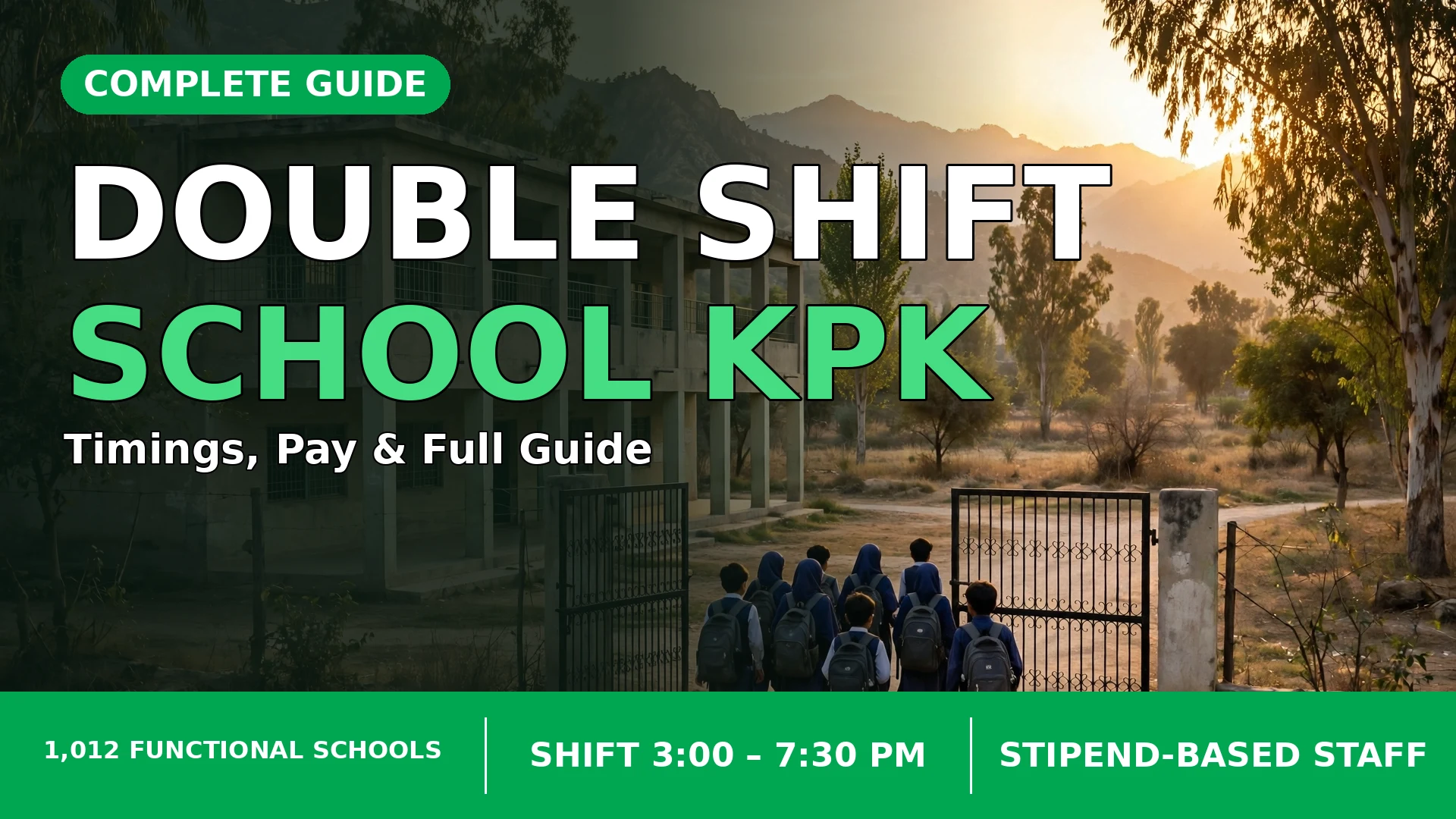
At the 2021 launch, the second shift ran from 3:00 pm to 7:30 pm, according to Dawn’s launch reporting of August 2021. The launch was in schools where a classroom held 60 or more students, with a maximum of 40 students per class in the second shift — the second shift was, in part, the mechanism for bringing oversized classes down to a manageable size. Funding at the launch was Rs 110 million for the settled districts and Rs 35 million for the merged districts, starting in 100 schools and rising to 400 schools within two to three months, as reported at the time. Those are 2021 launch figures: they describe how the scheme started, not its present scale, which the department’s 2026 programme page puts at 1,453 schools initiated and 1,012 functional.
One timing change is documented by a formal notification and should not be confused with the regular timings. By notification of the Directorate of Elementary and Secondary Education, Endst No. 7499-2570, dated 28 February 2025, each period in double-shift schools — primary, middle, high, and higher secondary — was reduced by 10 minutes during Ramazan (March 2025), with immediate effect. That was a Ramazan-2025 order. It is not a permanent timing, it does not apply outside Ramazan, and it does not change the 3:00 pm to 7:30 pm shift window reported at the launch. Readers should check the current year’s Ramazan notification for the current year’s arrangement rather than assuming the 2025 order repeats.
No other generally applicable timing change for double-shift schools is documented in the public sources used for this guide. If a district or school has set its own second-shift timings to suit local conditions, that is a local arrangement, and the school’s own notice — not this guide — is the authority for it.
Pay and Stipend: Read the Dates on Every Rate
Pay is the subject on which this guide must be most careful, because three different sets of figures circulate, from three different years, and mixing them up produces a wrong answer. They are set out below in date order, each with its year and its status attached.
The first set is the 2021 fixed pay, reported by Dawn at the August 2021 launch. Teachers in the second shift were paid a fixed monthly amount by level: primary Rs 12,000, middle Rs 15,000, high Rs 18,000, and higher secondary Rs 20,000. Those are the 2021 rates. They are not stated here as current rates, and no public source used for this guide confirms what the corresponding rates are in 2026. Teachers already serving in the same school in the first shift were given first priority for the second-shift posts, and if they were not interested, teachers from the nearest government schools were hired. That priority for the school’s own first-shift teachers is a feature of the scheme from its launch.
| Level (second shift) | Fixed pay, 2021 launch (Rs per month) |
|---|---|
| Primary | 12,000 |
| Middle | 15,000 |
| High | 18,000 |
| Higher secondary | 20,000 |
The second set is a reported proposal, not a confirmed rate. When the scheme was later scaled up — second-shift classes reported as started in about 2,100 schools, with hiring purely on merit from the same locality, and with the headmaster or head teacher, clerks, and class-IV staff of the same schools given extra payment — The News reported that a summary was put to the Chief Minister to raise the pay of ad-hoc second-shift teachers to up to Rs 25,000 a month from about Rs 12,000. That is a proposal as reported at the time. This guide does not present Rs 25,000 as the confirmed current second-shift rate, because no public source used here confirms that the proposal was approved or what rate followed from it. Any reader who is offered a second-shift post should confirm the stipend in the engagement letter itself, not from a newspaper report of a proposal.
The third set is the 2026 position, which is less complete. The department’s programme page states that staff are engaged on stipend — 7,876 in total, of whom 2,434 are government staff and 5,603 PTC staff, as published — and the financial year 2025–26 budget allocation of Rs 1.8 billion, but it does not publish a current per-teacher stipend rate by level. Separately, in 2026, Rs 95.468 million was released for the Double Shift School Programme for the timely payment of teachers, principals, and administrative staff, according to official-notification reporting. That release is evidence that payments under the programme were being made in 2026; it is not a rate, and it does not by itself tell any individual teacher what their monthly stipend is. The honest position for 2026 is therefore this: the programme is running, staff are engaged on stipend, money has been released for their payment, and the current per-level stipend rates are not confirmed in any public source used for this guide.
The 2026 Relaunch: More Teachers, Far-Flung Areas, Girls’ Education
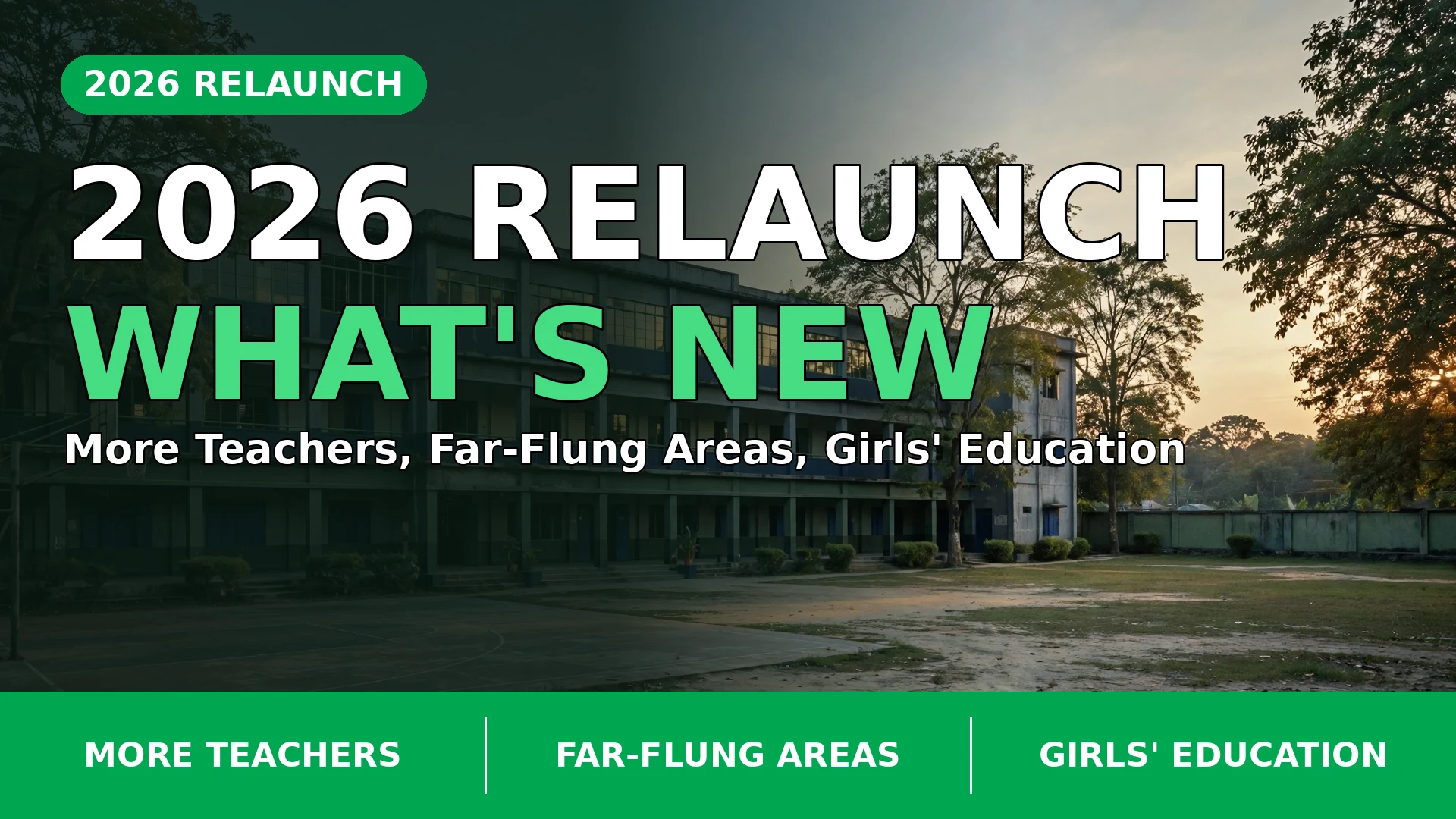
In 2026, the second-shift system was launched again in selected schools, with the emphasis on far-flung and underprivileged regions, so that students there could avoid long commutes and overcrowded classrooms. The relaunch was announced by Faraz Ahmad Mughal, spokesperson for Chief Minister Ali Amin Gandapur, as reported by ilmkidunya. More than 2,500 teachers were to be recruited on a temporary or contract basis for the second shift — 1,804 for primary and 639 for secondary, according to the report. (The two components add to 2,443, so the “2,500+” figure is the report’s rounded total.) Applications were to be submitted at the respective District Education Officer offices or through the department’s website, and the announcement placed special emphasis on girls’ education, including new girls’ schools and scholarships.
That relaunch is best read together with the 2021 pattern: temporary or contract engagement, local hiring, and priority to the areas with the worst access. The relaunch does not change the temporary character of the engagement. A second-shift teacher recruited on a temporary or contract basis in 2026 is in the same position as the 2021 recruits in one important respect: the engagement is for the second shift, for a fixed arrangement, and it is not a regular appointment. Regular appointments, and the rights that come with them, are a different process — and transfers of serving teachers are governed separately by the e-Transfer Plus Policy 2026. A second-shift engagement should not be confused with either.
How to Apply for a Second-Shift Post
Second-shift posts are temporary or contract posts, not permanent appointments. In the 2026 relaunch round, the department reported more than 2,500 temporary or contract teachers — 1,804 for primary schools and 639 for secondary schools. In that round, applications were invited at DEO offices or through the department’s website. No separate application portal or form for second-shift posts is published on the department’s programme page, so the DEO office and the department’s notifications are the places to check whether a round is open and what it asks for. No deadline, document list, or eligibility rule beyond what is set out here is published in the sources used for this guide, and this guide does not guess at them. At launch, teachers already teaching the first shift in the same school were given first priority for the second-shift posts. The evening shift ran from 3:00pm to 7:30pm at launch. Before joining, confirm the stipend amount, the payment schedule, and the timings in the engagement letter itself.
What the Programme Offers
For students, the programme adds an evening shift in the same school buildings. The department’s programme page presents it as two things at once: relief for overcrowded morning shifts — 283 schools and 29,937 students on that count — and places for out-of-school children — 729 upgraded schools and 49,147 students on that count. Classes were capped at 40 students, with the evening shift starting where a classroom held more than 60. For teachers, it is additional evening work with a stipend. The fixed monthly rates published at launch in 2021 were Rs 12,000 for primary, Rs 15,000 for middle, Rs 18,000 for high, and Rs 20,000 for higher secondary school posts. The current rates are not confirmed in any public source used for this guide, so this guide does not state a current figure. For the system, the programme uses buildings that already exist, in hours when they would otherwise sit empty, rather than building new schools.
Training of Double Shift School Teachers
Very little is published about training. A separate official page on kpese.gov.pk, dated 30 May 2026, states only this: “Training of Double Shift School Teachers in collaboration with KPHCIP.” No duration, no venue, no syllabus, no batch dates, and no eligibility detail is published on that page or anywhere else in the public sources used for this guide. This guide therefore says only what the department says: training of double-shift school teachers is conducted in collaboration with the Khyber Pakhtunkhwa Human Capital Investment Program. Readers who need training dates or venues should ask their DEO office, which administers the programme at district level, rather than relying on any schedule circulating unofficially.
DSS Is Not the Talent Pool
Readers may meet two similar-sounding schemes in the same period and should keep them apart. The Double Shift School programme engages staff — government and PTC — on stipend to run a second shift in an existing school building, for the next level up. The Talent Pool is a separate arrangement: a notified pool from which PTCs hire temporary primary teachers for fixed periods of four or five months. Both involve PTCs and both involve temporary engagement, but they are different programmes, with different purposes, different published figures, and different portals. The Talent Pool is explained in a separate guide on this site. Nothing in this guide’s pay or staffing figures applies to the Talent Pool, and nothing in the Talent Pool’s Rs 25,000 honorarium applies to a second-shift stipend: the two must not be interchanged.
The standing position of this guide is the same as for every figure on this page. The 2021 rates are 2021 rates. The 2026 programme figures are the department’s published figures as of 30 May 2026, with the arithmetical note given above. The 2026 stipend rates by level are not confirmed in public sources. If a later department notification publishes current stipend rates, that notification governs, and any reader offered a second-shift post should rely on the engagement letter and the DEO office for the rate that applies to them.
FAQs
What is a Double Shift School (DSS) in KPK?
A government school building used twice in one day: the regular morning shift plus a second (evening) shift in the same building. A primary school hosts middle classes in the second shift, a middle school hosts high classes, and a high school hosts higher-secondary classes, so more children can study without a new building.
How many schools and students are in the DSS programme?
According to the department’s programme page of 30 May 2026, a Double Shift School was initiated in 1,453 schools and 1,012 are functional — 283 under the Overcrowded Model (29,937 enrolled) and 729 under the Upgraded Model (49,147 enrolled, described as out-of-school children) — with a stated total enrolment of 79,804 and a financial year 2025–26 budget allocation of Rs 1.8 billion.
What are the timings of the second shift?
At the 2021 launch the second shift ran from 3:00 pm to 7:30 pm. During Ramazan in March 2025, a Directorate notification (Endst No. 7499-2570, dated 28 February 2025) reduced each period by 10 minutes in double-shift schools; that was a Ramazan-2025 order, not a permanent timing change.
What is the pay for a second-shift teacher?
The confirmed figures are the 2021 fixed rates: primary Rs 12,000, middle Rs 15,000, high Rs 18,000, and higher secondary Rs 20,000 per month. A later reported proposal to raise ad-hoc second-shift pay to up to Rs 25,000 a month was not confirmed as approved in any public source used here, and current (2026) per-level stipend rates are not published — confirm the stipend in your engagement letter.
Who can teach in the second shift, and how are they hired?
At the launch, teachers of the same school’s first shift got first priority, and if they were not interested, teachers from the nearest government schools were hired; hiring was from the open market, including under the PTC, with priority to far-flung areas. For the 2026 relaunch, applications were to be submitted at the respective DEO offices or through the department’s website, for temporary or contract engagement.
Is a Double Shift School post a permanent government job?
No. Second-shift engagement is temporary or contract-based, on stipend, for running the second shift. It is not a regular appointment, and it is separate from the Talent Pool temporary primary-teacher hiring as well. Regular appointments follow the regular appointment process, and transfers of serving teachers follow the e-Transfer Plus Policy 2026.
Sources: KPESE Double Shift School Program page (30 May 2026) · KPESE Training of Double Shift School Teachers page (30 May 2026) · ilmkidunya — 2026 second-shift relaunch · Dawn report — second shift launch, August 2021 · The News — scale-up and pay proposal · Vocal Pakistan — Rs 95.468 million released for the DSS Program · Vocal Pakistan — Ramazan 2025 period-reduction notification.