The bps-15 salary kpk 2026 starts at a basic pay of Rs 28,730 per month under the Revised Basic Pay Scale 2026, known as RBPS-2026, which took effect for Khyber Pakhtunkhwa government employees on 1 July 2026. BPS-15 carries an annual increment of Rs 2,380 across 30 stages, so the basic pay rises step by step to a maximum of Rs 100,130. Basic pay alone, however, is only part of the salary: the ad-hoc relief allowances, conveyance, medical, and house rent amounts paid on top of it more than add to the total, and the deductions taken from it decide what actually reaches the bank account.This guide sets out every verified component for BPS-15, works the stage-by-stage pay out in full, and gives one fully shown illustration of take-home pay at the starting stage, with every figure labelled as an illustration and with the components that vary by individual left out rather than guessed.
BPS-15 Salary KPK 2026 at a Glance
The table below collects the verified BPS-15 figures in one place. The basic pay figures come from the KP Finance Department notification FD (SOSR-1) 1-1/2026, dated 22 July 2026. The allowance figures at the minimum stage come from the verified compilation of standing rates that sits beside that notification: the ad-hoc allowances calculated at the minimum basic pay, the conveyance rate for the BPS-11 to BPS-15 band, the medical allowance for the grade, and the frozen house rent amounts for other cities and for big cities. No figure in this table is estimated, and the arithmetic behind each one is shown in the sections that follow.
Component
Amount (Rs per month)
Basic pay at the minimum (starting stage)
28,730
Annual increment
2,380
Number of stages
30
Basic pay at the maximum
100,130
ARA-2026 at the minimum (7% of running basic)
2,011
ARA-2023 at the minimum (35%)
10,056
ARA-2024 at the minimum (25%)
7,183
Conveyance allowance (BPS 11 to 15 band)
4,284
Medical allowance
1,500
House rent allowance, other cities (frozen rate at minimum)
2,349
House rent allowance, big cities (frozen rate at minimum)
3,524
BPS-15 sits in an interesting place in the service structure. It is the highest grade in the BPS-11 to BPS-15 conveyance band, and it is one step below BPS-16, the highest non-gazetted grade. In schools, BPS-15 is a familiar grade for senior teaching and support posts, and it is the grade many employees reach after years of service in lower grades followed by promotion. That career path matters for reading the stage table below: a newly appointed BPS-15 employee starts at Rs 28,730, but a promoted employee fixed point to point from a lower grade may enter BPS-15 at a higher stage, because fixation preserves the number of increments already earned. Two employees with the same BPS-15 post can therefore draw quite different basic pay, and the stage table, not the minimum alone, is the right reference for either of them.
Stage-by-Stage Basic Pay for BPS-15
The stage table below shows the basic pay at every fifth stage, from the starting stage to the maximum, together with ARA-2026 at that stage. The basic pay at any stage is the minimum plus the increment multiplied by the number of increments earned, and ARA-2026 is 7% of that running basic pay, rounded to the nearest rupee. The full 30-stage ladder can be filled in from the same rule: each single step adds Rs 2,380 to basic pay and roughly Rs 167 to ARA-2026, since 7% of Rs 2,380 is Rs 166.60. The maximum checks out exactly: Rs 28,730 plus 30 times Rs 2,380 is Rs 28,730 plus Rs 71,400, giving Rs 100,130.
Stage (increments earned)
Basic pay (Rs)
ARA-2026 at 7% (Rs)
0 (starting stage)
28,730
2,011
5
40,630
2,844
10
52,530
3,677
15
64,430
4,510
20
76,330
5,343
25
88,230
6,176
30 (maximum)
100,130
7,009
The annual increment is admissible on 1 December each year, subject to the existing conditions, so the movement up this ladder happens on a common date rather than on the anniversary of joining. An employee who joins mid-year therefore waits until the next 1 December for the first increment, subject to those conditions, and the same date governs every step after that. Once the maximum of Rs 100,130 is reached, no further annual increment is admissible in BPS-15, and the only route to higher basic pay is promotion to BPS-16, where the minimum is Rs 33,720. That promotion point deserves a moment of attention, because it exposes a quirk of the scale: a BPS-15 employee at the maximum draws far more basic pay than a newly promoted BPS-16 employee at the minimum, yet the BPS-16 post carries the higher grade, the higher conveyance band of Rs 7,500, and the promotion channel to gazetted grades. Grade and stage must always be read together, and neither alone tells the whole story of a career.Fixation for employees already in service on 30 June 2026 was point to point under the 2026 notification: basic pay in BPS-2026 was fixed at the stage corresponding to the stage occupied above the minimum of BPS-2022. In BPS-15, the 2022 minimum was Rs 23,920 with an increment of Rs 1,980 and a maximum of Rs 83,320. An employee who had earned, for example, 10 increments in BPS-2022, drawing Rs 23,920 plus 10 times Rs 1,980, which is Rs 43,720, would be fixed in BPS-2026 at the corresponding stage, drawing the stage-10 basic pay of Rs 52,530. The number of increments was preserved; only the value of each stage changed. The notification also allowed an irrevocable written option within 30 days of issuance to continue in BPS-2022, with an employee who did not opt in time deemed to have opted for BPS-2026. That window has passed, but the point-to-point rule still explains the spread of basic pay among serving BPS-15 employees today.
Allowances on Top of Basic Pay
Three ad-hoc relief allowances sit on top of BPS-15 basic pay, and they must not be confused with one another. ARA-2026, at 7% of running basic pay, is the fresh allowance introduced with the 2026 revision, effective 1 July 2026 and until further orders. It is subject to income tax, it is admissible during leave and during the entire period of leave preparatory to retirement except during extraordinary leave, and it is not treated as part of emoluments for pension or gratuity or for the recovery of house rent. ARA-2023 and ARA-2024 were not merged into the new scales and remain payable. For grades BPS-1 to BPS-16, the verified compilation shows ARA-2023 at 35% and ARA-2024 at 25%, which at the BPS-15 minimum gives Rs 10,056 and Rs 7,183 respectively. At higher stages, these allowances are calculated on the running basic pay, so they grow with every increment just as ARA-2026 does. Together, the three ad-hoc allowances at the minimum amount to Rs 19,250, which is two-thirds of the starting basic pay itself, and that is why a BPS-15 salary slip total looks so much larger than the basic pay figure that headlines most discussions.Two allowances were merged into the new scales and must not be added again. Ad-hoc Relief Allowance 2022, at 15% of BPS-2017 basic pay, and Ad-hoc Relief Allowance 2025, at 10% of BPS-2022 basic pay, both ceased to exist from 1 July 2026, and their value was folded into the RBPS-2026 minimums. An employee who adds 15% and 10% to a BPS-15 basic pay of Rs 28,730 will overstate the salary by more than Rs 7,000 before any other error. This is the single most common mistake in informal BPS-15 salary discussions, and it is worth checking any quoted figure against it first: if the figure includes ARA-2022 or ARA-2025 as live additions to a 2026 basic pay, the figure is wrong. The merger is also the reason the BPS-15 minimum rose from Rs 23,920 in 2022 to Rs 28,730 in 2026. The rise is largely the absorption of previously separate allowances, not a fresh increase on top of the old total.Conveyance allowance for BPS-15 is Rs 4,284 per month, the rate for the BPS-11 to BPS-15 band after the 50% revision in notification FD (SOSR-I) Conveyance Allowance/2026, dated 22 July 2026 and effective 1 July 2026. It is a flat amount, identical at every stage, and it is not drawn at all by an employee who has availed an official vehicle or monetisation. Medical allowance is Rs 1,500 per month for BPS-15, again a flat amount rather than a percentage of basic pay. House rent allowance is the allowance that needs the most care. It is computed on a frozen older-scale base, not as a percentage of current basic pay, and it must never be calculated as a percentage of the RBPS-2026 basic pay. The frozen-rate amounts at the BPS-15 minimum are Rs 2,349 per month in other cities and Rs 3,524 per month in declared big cities, and those amounts do not rise with increments. Which of the two applies depends on whether the station is a declared big city, and the notification itself does not list which cities those are, so the salary slip is the final check. Post-specific allowances, such as allowances that attach to a particular post rather than to every BPS-15 employee, are not included anywhere in this guide, because they vary by posting and adding them generally would mislead most readers.
Illustrated Take-Home Pay at the Starting Stage
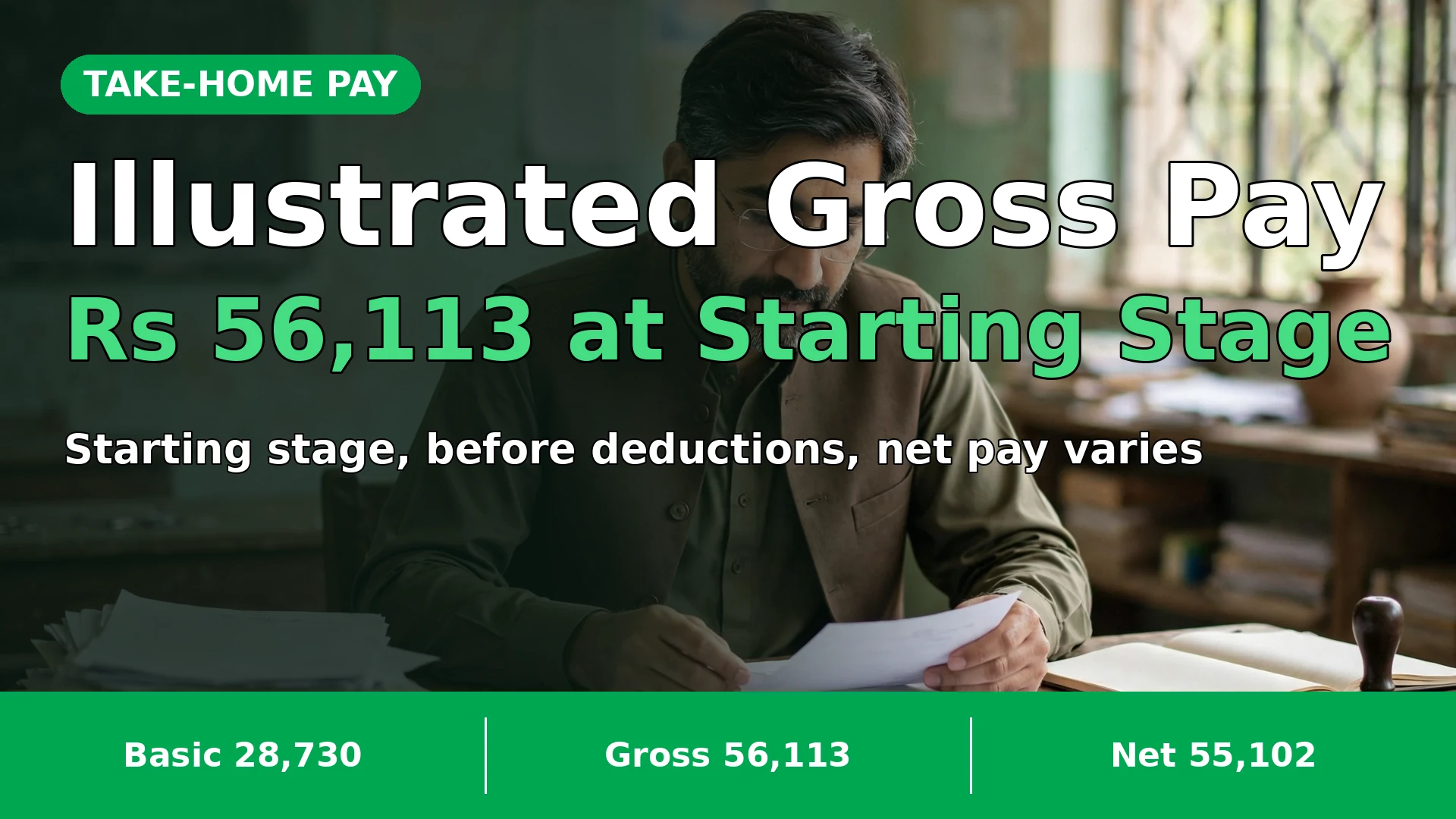
The illustration below works out a BPS-15 salary at the starting stage, in an other-city station, using only the verified components set out above, with every step of the arithmetic shown. It is an illustration, not a payslip, and it is labelled as one throughout, because real take-home pay varies with deductions and postings that this guide does not guess at. The components are: basic pay Rs 28,730, plus ARA-2026 Rs 2,011, plus ARA-2023 Rs 10,056, plus ARA-2024 Rs 7,183, plus medical allowance Rs 1,500, plus conveyance allowance Rs 4,284, plus house rent allowance (other cities) Rs 2,349. Adding them in order: Rs 28,730 plus Rs 2,011 is Rs 30,741; plus Rs 10,056 is Rs 40,797; plus Rs 7,183 is Rs 47,980; plus Rs 1,500 is Rs 49,480; plus Rs 4,284 is Rs 53,764; plus Rs 2,349 is Rs 56,113. The illustrative gross pay at the starting stage is therefore Rs 56,113 per month.
Illustration at the starting stage (other cities)
Rs per month
Basic pay
28,730
ARA-2026 (7% of basic)
2,011
ARA-2023 (35%)
10,056
ARA-2024 (25%)
7,183
Medical allowance
1,500
Conveyance allowance
4,284
House rent allowance (other cities, frozen rate)
2,349
Illustrative gross total
56,113
Less: Benevolent Fund (3% of basic)
862
Less: Group Insurance / Welfare Fund
149
Illustrative take-home after those two deductions only
55,102
Two deductions are then shown, because they are the two flat, verified deductions in the compilation for this grade: Benevolent Fund at 3% of basic pay, which is Rs 862 at the starting stage, and Group Insurance / Welfare Fund at Rs 149. Subtracting them from the illustrative gross gives Rs 56,113 minus Rs 862 minus Rs 149, which is Rs 55,102. That figure of Rs 55,102 is an illustrative take-home after those two deductions only. It is before income tax and before GP Fund or Contributory Pension Fund subscriptions, which vary by the employee’s appointment date and individual position and are therefore not included or estimated here. In a big-city station, the same illustration changes only in the house rent line: Rs 3,524 instead of Rs 2,349, a difference of Rs 1,175, giving an illustrative gross of Rs 57,288 and an illustrative take-home after the same two deductions of Rs 56,277. The honest summary is that a BPS-15 employee at the starting stage in an other-city station can expect a gross around Rs 56,113 on these verified components, with the actual amount in hand lower once tax and fund subscriptions are applied, and higher at every higher stage as basic pay and the percentage-based allowances rise together.At higher stages the same method applies, with one important difference: the house rent, conveyance, and medical amounts stay flat, while basic pay and all three ad-hoc allowances rise. At stage 10, for example, basic pay is Rs 52,530 and ARA-2026 is Rs 3,677, and the 2023 and 2024 allowances at 35% and 25% of Rs 52,530 would be Rs 18,386 and Rs 13,133 respectively, before the flat allowances are added. Readers who want a stage-by-stage total for their own position should use the KPK salary calculator tool on this site, which carries out the same arithmetic for the exact stage entered, rather than scaling the starting-stage illustration by eye. The neighbouring per-grade guides for BPS-14 and BPS-16 follow the same method, so a reader comparing grades can compare like with like.
What the Salary Does Not Include, and Why Net Pay Varies
No general guide can state a single net salary for BPS-15, and any article that does so without showing its components should be treated with suspicion. Income tax depends on total annual income, including income from other sources where applicable, and on the slab structure for the tax year, so it cannot be fixed from the grade alone. Fund subscriptions depend on whether the employee is on the General Provident Fund or, for appointees on or after the contributory pension cut-off, the Contributory Pension Fund, and on the subscription rate that applies to the individual. Recoveries, such as house rent recovery where applicable, loans, or advances, are individual. Post-specific allowances, as already noted, attach to posts rather than grades. All of these are real, and all of them vary, which is why this guide gives a fully shown illustration on verified components and then states plainly that the net varies, rather than inventing a single take-home figure and presenting it as the BPS-15 salary.The pension point deserves repeating in this section, because it affects long-term planning more than any monthly figure. ARA-2026 is expressly not treated as part of emoluments for pension or gratuity, and the same applies to the older ad-hoc allowances that remain payable. Pension is calculated on a narrower base than the monthly gross, so an employee who saves or borrows against the full gross figure, assuming the same amount will carry into pension, will be disappointed at retirement. The pension side of the calculation is a separate question from the monthly salary, and readers approaching retirement should work it out on the pensionable base, not on the gross illustration in this guide. The same caution applies to any loan or commitment sized against the gross: the deductions that follow, beginning with tax and fund subscriptions, come out before the money reaches the account.Finally, the salary slip remains the authority for what an individual actually draws. If a slip disagrees with this guide, the slip should be checked first, and then the Drawing and Disbursing Officer and the District Accounts Office, because an individual record can carry personal pay beyond the maximum, a recovery, or a posting-specific allowance that no general guide can show. What this guide guarantees is that the scale, the stage arithmetic, and the allowance rates used here are the verified figures from the 2026 notification and the standing allowance rates beside it, with the arithmetic shown so that any reader can reproduce every total. A reader who can reproduce the totals can also spot an error in a slip, and that is the practical purpose of setting the working out in full rather than quoting a single headline number.
FAQs
What is the starting basic pay for BPS-15 in KPK in 2026?
Rs 28,730 per month under RBPS-2026, with an annual increment of Rs 2,380 across 30 stages, rising to a maximum basic pay of Rs 100,130. The scale took effect on 1 July 2026 under notification FD (SOSR-1) 1-1/2026.
How much is ARA-2026 for BPS-15?
ARA-2026 is 7% of the running basic pay, so it is Rs 2,011 at the starting stage on a basic pay of Rs 28,730, and Rs 7,009 at the maximum on a basic pay of Rs 100,130. It is subject to income tax and is not counted for pension or gratuity.
What is the illustrated take-home pay for BPS-15 at the starting stage?
On the verified components only, the illustrative gross is Rs 56,113 in an other-city station, and after Benevolent Fund of Rs 862 and Group Insurance of Rs 149 the illustrative take-home is Rs 55,102. That figure is before income tax and GP Fund or Contributory Pension Fund subscriptions, so the actual net varies.
Are ARA-2022 and ARA-2025 still paid on top of BPS-15 basic pay?
No. ARA-2022 at 15% of BPS-2017 basic pay and ARA-2025 at 10% of BPS-2022 basic pay were merged into RBPS-2026 and ceased to exist from 1 July 2026. ARA-2023 and ARA-2024 were not merged and remain payable.
What is the conveyance allowance for BPS-15 in 2026?
Rs 4,284 per month, the rate for the BPS-11 to BPS-15 band after the 50% revision effective 1 July 2026. It is not drawn by an employee who has availed an official vehicle or monetisation.
Is house rent allowance for BPS-15 a percentage of current basic pay?
No. House rent allowance is computed on a frozen older-scale base, not as a percentage of current RBPS-2026 basic pay. At the BPS-15 minimum the frozen-rate amounts are Rs 2,349 in other cities and Rs 3,524 in big cities, and they do not rise with increments.
Sources: Government of Khyber Pakhtunkhwa, Finance Department, notification FD (SOSR-1) 1-1/2026, dated 22 July 2026, effective 1 July 2026 (Revision of Basic Pay Scales and Allowances 2026), as set out in the verified notification extract; Government of Khyber Pakhtunkhwa, Finance Department, notification FD (SOSR-I) Conveyance Allowance/2026, dated 22 July 2026, effective 1 July 2026 (50% revision of conveyance allowance); verified compilation of standing allowance rates at the minimum of each scale (house rent frozen rates, medical allowance, Benevolent Fund and Group Insurance amounts). · Revision of Basic Pay Scales & Allowances 2026 (KP Finance Department, PDF)
The kpk pay scale chart 2026 is the Revised Basic Pay Scale 2026, known as RBPS-2026, which replaced the 2022 scales for Khyber Pakhtunkhwa government employees with effect from 1 July 2026. It was introduced by the Khyber Pakhtunkhwa Finance Department notification FD (SOSR-1) 1-1/2026, dated 22 July 2026, and it covers every grade from…
Published: October 21, 2026 • Updated: November 14, 2026 KPK Salary Calculator 2026 — How to Calculate Your New Pay Every July, one question runs through every government school in Khyber Pakhtunkhwa: “Meri tankhwah kitni barhi?” (How much did my salary increase?) The KPK Budget 2026-27 changed the pay structure in a way that confuses…
The bps-12 salary kpk 2026 starts at a basic pay of Rs 23,750 per month under the Revised Basic Pay Scale 2026, known as RBPS-2026, which took effect for Khyber Pakhtunkhwa government employees on 1 July 2026. BPS-12 carries an annual increment of Rs 1,720 across 30 stages, so the basic pay rises step by…
A BPS-17 officer in KPK starts on a basic pay of Rs 54,140, with an annual increment of Rs 4,110 and a maximum basic pay of Rs 136,340. BPS-17 is the gazetted scale where senior school leadership in Khyber Pakhtunkhwa sits — Subject Specialists, headmasters and headmistresses of high and higher secondary schools, and officers…
If you work in a government school in Khyber Pakhtunkhwa, your salary does not simply stay where it was. Every time something important changes in your service — a promotion, a transfer, a fresh appointment, or a revision of the pay scales — your pay has to be fixed again in the right scale and…
If your pay changed but your salary did not change at the same time, the money owed for the gap is called arrears. For a KPK school teacher, this is common: a new pay scale is announced in July but reaches the pay roll in September. The difference belongs to you, but it does not…