PTC Fund in KPK — Demand, Utilisation & Non-Drawal (A Guide for Schools)
Every government school in Khyber Pakhtunkhwa has a Parent Teacher Council, and almost every small job in that school — a broken door, chalk for the classrooms, a leaking tap — is paid for through the council’s fund. The PTC Fund is the school-level money that keeps a school running day to day. It is not a salary fund, it is not a construction fund, and it is not the same thing as hiring teachers through the PTC.
This is monthly, routine work for a head teacher: a demand, a council resolution, a cash book entry, a utilisation report, and a balance checked monthly.
What the PTC Fund is
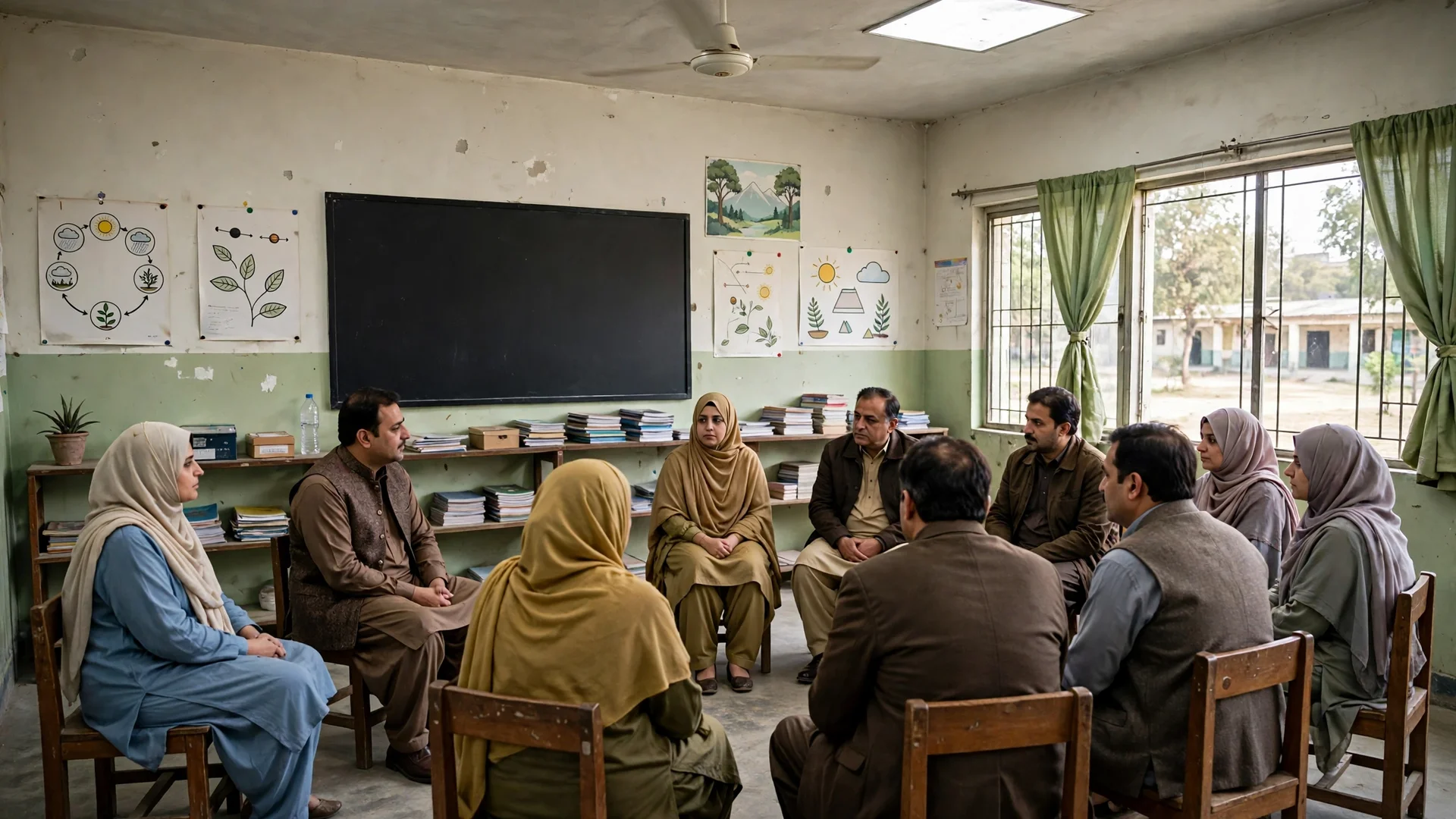
A Parent Teacher Council (PTC) is the council of parents and teachers formed in every government school in the province. The council receives and spends the PTC Fund on the school’s behalf. The fund is a tied, non-salary grant: money from the provincial budget earmarked for school-level needs, usable only for the purposes the government has prescribed.

Under the Financial Procedure for Parents-Teachers-Councils laid down by the Finance Department in 2007, funds are transferred from the Provincial Consolidated Fund (Account No. 1) through Account-IV of the respective district government, as a tied budgeted grant, and each district government budgets an allocation for each PTC on a yearly basis. The funds are then credited to the council’s own bank account, in quarterly tranches to District Account-IV. Each PTC maintains a commercial bank account, jointly operated by the Chairman or Chairperson and the Secretary of the council — a core safeguard, so that no single person controls the school’s money. The fund is governed by the PTC Guide of the Schools and Literacy Department (now the Elementary and Secondary Education Department), read with the Finance Department’s procedure.
The three heads of the fund
For the financial year 2025-26 the Elementary and Secondary Education Department reorganised the PTC grant into three clearly defined, separate heads, following approval by the Provincial Cabinet on 14 November 2025. The department issued instructions on their use on 26 December 2025.
| Head | Rate for FY 2025-26 | Basis | | — | — | — | | Classroom Related Consumables (CRC) | Rs. 13,000 per classroom | Per classroom | | Petty Repairs | Rs. 16,000 per classroom | Per classroom | | Capitation Grant | Rs. 300 per student | Per enrolled student |
The CRC rate was raised from Rs. 6,000 to Rs. 13,000 per classroom, and the Petty Repairs rate from Rs. 7,000 to Rs. 16,000 per classroom. The Capitation Grant, at Rs. 300 per student, was introduced for the first time, to link resources to enrolment, reduce dropouts among vulnerable students, and enrol out-of-school children.
Two rules matter more than the rates. First, the three components are distinct and non-interchangeable: money given for one head may not be re-appropriated to another. Second, the accounting must be head-wise, with each head tracked separately in the PTC’s records and the PTC Module. These were the FY 2025-26 rates, so check the current year’s notification first; the 2007 procedure’s figure of up to Rs. 200,000 per annum per PTC no longer applies.
What the fund may — and may not — pay for
The permitted uses follow the three heads. Classroom Related Consumables (CRC) covers the things a classroom uses up in daily teaching: chalk, markers, dusters, charts, maps, registers, stationery, examination supplies, photocopying and notice-board material. Petty Repairs covers minor maintenance of the school building and its fittings: doors, windows, locks, fans, electrical work, plumbing, painting and whitewash, repair of electric appliances, and water supply repairs. The key word is petty: this head covers the small repair that keeps a classroom usable, not major construction or a new building. Capitation Grant is linked to enrolment: resources that follow the student, meant to support retention and bring out-of-school children in. A school that under-reports its enrolment under-claims this grant; for how enrolment is counted and reported, see our [Enrolment Campaign guide](/enrolment-campaign-kpk-2026-27/).
The fund may not be spent outside the prescribed purposes in the PTC Guide, may not be moved between heads, and may not be spent without the prior approval of the council. Nor may it be handed to an unauthorised person: in August 2026 the department barred unauthorised individuals, contractors and firms from involvement in PTC fund utilisation, after people falsely claiming to represent UNICEF approached PTCs. If someone approaches your PTC claiming to act for an outside organisation, check with your District Education Officer first.
Demand: how a school asks for the fund
The allocation for each PTC is budgeted yearly by the district government, and the fund is credited to the council’s bank account through District Account-IV. The school’s job is to put its demand on record, in writing, so the district knows what the school is claiming, under which head, and for how many classrooms and students. The Letter Bank document for this step is the PTC Fund Demand (CRC / Petty Repair) template, which states the school, the heads being demanded, the number of classrooms and the enrolment, and the amount that follows from the notified rates.
Count first: CRC and Petty Repairs are claimed per classroom, Capitation per student, and a wrong count is difficult to correct after the release. Work from the current year’s rates, put the demand through the council, and keep a dated copy on file. No province-wide demand deadline was verified for this guide; your District Education Officer’s office is the authority on the current cycle’s dates.
Utilisation: spending the fund and reporting it
Utilisation is where the rules are most detailed, and where most audit objections arise. Under the 2007 financial procedure, all expenditure needs the prior approval of the Parents-Teachers-Council, and all purchases and work must be carried out transparently and economically. The Secretary must keep receipts and expenditure in a simple cash book in the prescribed format, entered head-wise with vouchers. The cash book, vouchers and receipts must be verified and approved by the PTC at quarterly meetings, and the vouched accounts are subject to inspection and third-party validation.
The Letter Bank document for this step is the CRC / Petty Repair — Utilization Report template, which states, head by head, how much was received, how much was spent, on what, and what balance remains. It should be possible for a stranger to read it and reconstruct every rupee from the bank credit to the final balance. The monthly expenditure statement is the companion record: spending that is not carried into it is spending the district cannot see. For the format, see our [Monthly Expenditure Statement guide](/monthly-expenditure-statement-format/); for the DDO’s side of the picture, see our [DDO BER guide](/ddo-ber-2026/). Before any purchase, check that a council resolution approves it, that it is under the correct head, that an original bill is filed with the voucher, and that the cash book is written up.
Non-drawal: when the fund is not drawn
Not every school draws its PTC Fund in every cycle. Sometimes the account has a problem, sometimes the council has not met, sometimes the head teacher is newly posted and the record is incomplete, and sometimes the school simply has not completed the demand. Whatever the reason, a fund that is not drawn should not be left silent. The Letter Bank document for this situation is the Non-Drawal of PTC Fund letter, which puts on record that the fund has not been drawn, for which period, and why.
That letter tells the district the school is aware of the position, records the reason, and creates the starting point for fixing the cause — a dormant account, a missing signature, an unformed council. Non-drawal is not neutral: an undrawn fund is an unspent fund, and unspent funds come under the re-appropriation and lapse process described next. No specific penalty for non-drawal was verified for this guide.
Lapse, unspent balances and re-appropriation
A PTC Fund balance that sits unspent does not sit unnoticed. In April 2026 the Elementary and Secondary Education Department’s Roadmap Implementation Committee directed District Education Officers to re-appropriate unspent funds in school PTC accounts and report compliance, to expedite fund utilisation to avoid lapses, and to submit status reports on furniture, PTC funds and conditional grants. The message is consistent: unspent balances are to be used, or moved to where they can be used.
The Letter Bank documents here are the Lapse of Fund — Notice / Explanation template and the Un-spent / Balance Amount Statement template. The balance statement is the document a head teacher should be able to produce at any time: how much was received under each head, how much was spent, and how much remains. Know your balance head-wise, every month — a single combined balance hides the real position. Spend early in the year, not at its end: the financial year ends on 30 June, and a rush of spending in its last weeks is the pattern auditors question first. If your school has a genuine reason for a balance, record the reason and the expected date with the balance statement.
The PTC account: the documents a head teacher keeps ready
Most PTC Fund problems that reach a head teacher’s desk are, at root, bank account problems. The account is jointly operated, it is in the council’s name rather than any individual’s name, and any change to it needs the bank and the department to agree on the record. The Letter Bank carries a template for each account situation a head teacher is likely to meet: NOC — Opening of PTC Account; Change of Account Title (PTC); Correction in Account Number; Dormant Account — Activation; and Account Closure Request.
These are listed here as documents that exist, not as procedures: the procedure for each depends on the bank and the district. When an account matter arises, take the matching template, check the current requirement with the bank and the District Education Officer’s office, and do not draw the fund through any other account. A dormant account is a common cause of non-drawal: it cannot receive or pay the fund until it is activated.
The monthly routine
Handle the fund as a short monthly routine, not a crisis at the end of the term. In the first week of the month, check the bank balance head-wise and update the cash book. During the month, make only purchases the council has approved, under the correct head, with original bills kept. Before the month ends, carry the spending into the monthly expenditure statement and update the PTC Module. Every quarter, place the cash book and vouchers before the council. When a release is due, send the demand head-wise; when nothing has been drawn, send the Non-Drawal letter and start fixing the cause.
A school that runs a double shift has the same fund routine, with heavier wear on the same classrooms. For the double-shift arrangement itself, see our [Double Shift School guide](/double-shift-school-kpk/). The fund does not double because the school runs two shifts; the rates are per classroom and per student, so the claim follows the counted classrooms and the counted enrolment.
What the PTC Fund is not: PTC hiring
The same letters — PTC — appear in two different places, and the confusion must be cleared up. The PTC Fund is the school fund described in this guide: money for classroom consumables, petty repairs and the capitation grant, spent by the Parent Teacher Council. PTC hiring is a different thing: the programme under which primary teachers are engaged on an interim basis through Parent Teacher Councils, from the Talent Pool, to meet minimum staffing in primary schools. Its figures, eligibility rules and timelines belong to that programme and must not be mixed into the fund’s accounts. For the hiring programme, see our [Talent Pool guide](/talent-pool-kpk/).
The PTC Fund rewards the head teacher who is regular. Count the classrooms, count the students, demand head-wise, spend only with the council’s prior approval, keep the original bill for everything, and report the balance honestly. The fund is small money, but it is the money the children see: the chalk on the board, the fan that works, the door that closes.
Sources
- KP Finance Department, “Financial Procedure for incurrence of expenditure by the Parents Teachers Councils”, No. BO-V/FD/3-10/2006-07, 9 June 2007.
- KP Finance Department, “Opening of Parents Teachers Councils (PTC) Accounts in all Government Schools in Khyber Pakhtunkhwa”, No. 6-2(F/L)/FD/2019-20/Vol-V/PTC, 10 March 2020.
- KP Elementary and Secondary Education Department, “Instructions Regarding Utilization of PTC Funds Under Petty Repairs, CRC and Capitation Grant (FY 2025-26)”, 26 December 2025 (Cabinet approval 14 November 2025).
- Dawn, “Govt approves Rs21.8 billion for improving learning environment in schools”, 15 December 2025.
- KP Finance Department, non-salary component transfer to District Account-IV for the PTC Fund, 11 December 2025 and 15 June 2026.
- KP Elementary and Secondary Education Department, Roadmap Implementation Committee minutes, 27 April 2026.
- The Nation, “KP Education Dept bars unauthorized individuals from PTC funds”, 6 August 2026.
- Dawn, “Red tape blocks funding to Peshawar schools”, 16 March 2013; CGPA district education budget analyses (Kohat, Abbottabad, July 2015).