Arrears Claim in KPK — When Arrears Arise and How to Claim Them
If your pay changed but your salary did not change at the same time, the money owed for the gap is called arrears. For a KPK school teacher, this is common: a new pay scale is announced in July but reaches the pay roll in September. The difference belongs to you, but it does not always arrive on its own. Somebody has to work it out, prove it, and put it through the accounts office.
What Pay Arrears Are
Pay arrears are amounts owed for a past period because your pay changed with backdated effect: you were paid at the old rate for some months, but were entitled to the new rate from an earlier date. The arrears are the difference, added up over the months concerned.

They are pay already earned, paid late — so the calculation compares what you drew with what you were due, and the accounts office needs the paper proving both sides.
When Arrears Arise
Five triggers cause most arrears claims.
### 1. After a pay-scale revision
When the government revises the basic pay scales, the new scales take effect from a fixed date, but the notification comes later. The months in between are paid at the old rate, and the difference becomes arrears. That is what happened with RBPS-2026: the KP Finance Department notification is dated 22 July 2026, but the revised scales are effective from 1 July 2026. A teacher whose July pay was drawn on the old scale was owed the difference for July, and for every month until the revised pay appeared — on the higher basic pay and the new ARA-2026 at 7% of running basic pay.
### 2. After a promotion
A promotion moves you to a higher scale, and your pay in that scale is due from the date on the promotion order. But the pay roll often keeps paying the old scale until the promotion is entered and the pay is fixed. Arrears are the difference between pay drawn in the old scale and pay due in the new scale, from the promotion date until the revised pay is drawn. The promotion order’s date fixes the start of the arrears period.
### 3. After a transfer
If pay stops at the old station before starting at the new one, the gap is owed to you. If the new station starts your pay late, or at the wrong stage, the shortfall is arrears too. The Last Pay Certificate (LPC) from the old station states the pay you were drawing and the date up to which you were paid. If the LPC is delayed or wrong, the correction produces arrears — and the LPC is the first paper the accounts office asks for.
### 4. After an annual increment
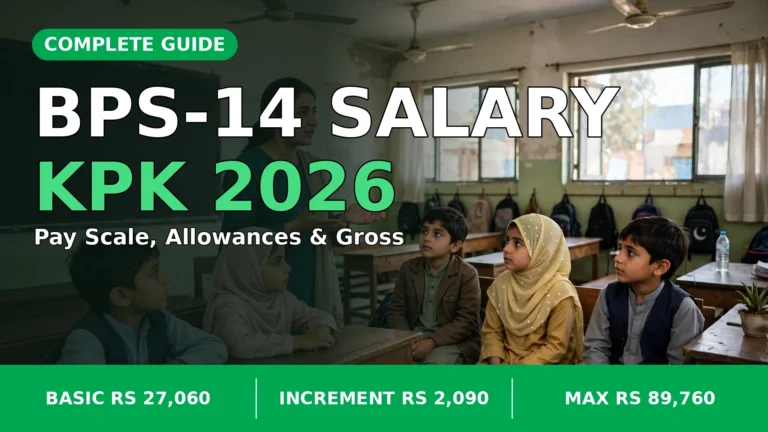
The annual increment is the yearly step up the pay scale, and under the current notification it falls due on 1 December. It is small each month — Rs. 2,090 on BPS-14 under RBPS-2026 — but if it is missed in the December pay roll, every month at the old stage is short by that amount. The arrears period runs from 1 December until the month the increment is applied. The monthly difference is the increment itself, so the total is that figure multiplied by the months missed.
### 5. After an ad-hoc relief allowance
An ad-hoc relief allowance (ARA) is a percentage of running basic pay, granted from a fixed date. A new ARA is usually effective from 1 July but reaches the pay roll later, and the months in between create arrears equal to the allowance for each month. ARA-2026 is 7% of running basic pay: on BPS-14 basic pay of Rs. 27,060, that is Rs. 1,894 a month, so three months late means about Rs. 5,683 in arrears on the allowance alone. It is taxable and not counted for pension or gratuity.
How an Arrears Claim Is Calculated
For each month, subtract the pay actually drawn from the pay due. Add the monthly differences, and the total is the arrears.
Arrears for one month = pay due for the month − pay drawn for the month.
Split the calculation wherever the rate changes — for example at the 1 December increment or a mid-period promotion. A claim that averages different rates into one figure is likely to be sent back.
Example: a BPS-14 teacher on basic pay Rs. 27,060. ARA-2026 at 7% is Rs. 1,894.20 a month. Suppose the revised basic pay was already being drawn, but the allowance was not paid for July, August, and September 2026:
| Month | ARA due | ARA drawn | Difference | | — | — | — | — | | July 2026 | Rs. 1,894.20 | Rs. 0 | Rs. 1,894.20 | | August 2026 | Rs. 1,894.20 | Rs. 0 | Rs. 1,894.20 | | September 2026 | Rs. 1,894.20 | Rs. 0 | Rs. 1,894.20 | | Total | | | Rs. 5,683 |
This illustrates the method; it is not a promise of any particular amount. Your arrears depend on your scale, stage, the effective date, and the date your pay was corrected. A full claim after a pay revision includes both the basic pay shortfall and the allowance shortfall, with percentage allowances worked out on the revised basic pay, not the old one. Arrears are taxable in the year received, and the deduction usually appears on that month’s slip.
The Current Pay Context: RBPS-2026
The KP Finance Department notified the Revised Basic Pay Scales 2026 on 22 July 2026, effective from 1 July 2026, replacing BPS-2022. ARA-2022 (15%) and ARA-2025 (10%) were merged into the new basic pay and ceased from 1 July 2026, and a new allowance, ARA-2026 at 7% of the running basic pay under BPS-2026, was granted from the same date.
The table below gives the RBPS-2026 figures for the scales most school employees are on — check your claim’s basic pay against it.
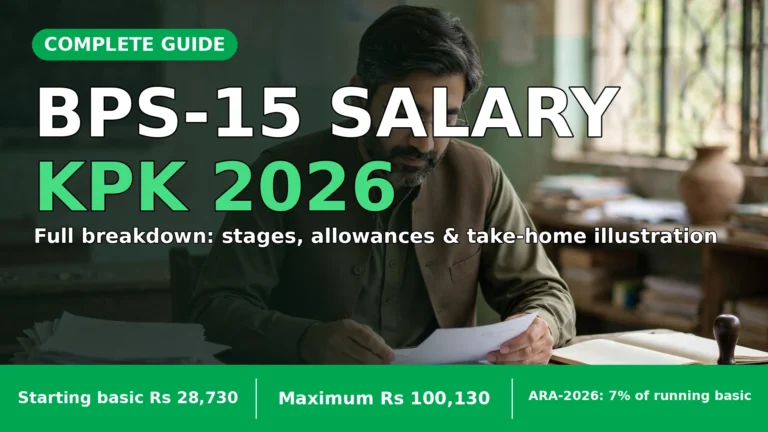
| Scale | Minimum basic pay | Annual increment | Maximum basic pay | | — | — | — | — | | BPS-12 | Rs. 23,750 | Rs. 1,720 | Rs. 75,350 | | BPS-14 | Rs. 27,060 | Rs. 2,090 | Rs. 89,760 | | BPS-15 | Rs. 28,730 | Rs. 2,380 | Rs. 100,130 | | BPS-16 | Rs. 33,720 | Rs. 2,720 | Rs. 115,320 | | BPS-17 | Rs. 54,140 | Rs. 4,110 | Rs. 136,340 |
For the full chart, see the [KPK Pay Scale Chart 2026](/kpk-pay-scale-chart-2026/); to check your monthly pay including the 7% ARA, use the [KPK Salary Calculator 2026 guide](/kpk-salary-calculator-2026/).
Documents That Support an Arrears Claim
The Accountant General Khyber Pakhtunkhwa is clear: no claim is admitted without the supporting documents prescribed in the rules, and for arrears of pay and allowances the Source-II form is one of them.
Source-II is the payroll input form used when any arrears occur. It is part of the set of payroll input forms (Source I to VI) issued by the Accountant General KP. Source-I covers joining; Source-II covers a change that produces arrears. Your DDO’s office prepares it — check its figures and period against your own record. See the [Source Forms 1-2-3 guide](/source-1-2-3-forms-in-kpk/) and the [Payroll Forms Generator — PAYO1/FO2/FO3](/payroll-forms-generator/).
Also gather:
- The order that caused the change — revision notification, promotion, transfer, or increment order. It fixes the effective date, hence the start of the period.
- Your pay slips for the period, showing what was actually drawn. Keep the slip for the month before the change too.
- The pay fixation statement — your basic pay in the new scale, with stage and effective date.
- The Last Pay Certificate (LPC) if the arrears follow a transfer.
- Service book entries recording the promotion, transfer, or increment.
- The arrears bill: pay due, pay drawn, and the difference per month, split where the rate changed.
Get any missing item before the claim goes in — a return costs more time than the document.
The Claim Route, Step by Step
A claim goes through the Drawing and Disbursing Officer (DDO) — normally your school or office head — who prepares and forwards it.

Step 1: Check your own record. Compare your pay slips with what you should have been paid. Note the effective date of the change, the month your pay was corrected, and the months in between.
Step 2: Ask for the arrears-release letter. The claim needs a covering request asking the accounts office to release the outstanding arrears. EduDesk’s Letter Bank has a template for this, the “Release of Outstanding Arrears” letter. The DDO’s office adapts it to your case and signs it.
Step 3: The DDO prepares the claim. The DDO’s office prepares the Source-II form and the arrears bill, attaches the supporting orders, slips, and fixation statement, and certifies the claim. Check the period and figures before it is forwarded — an error here repeats at every later stage.
Step 4: The accounts office pre-audits the claim. The DDO submits the claim to the District Accounts Office (or the Accountant General’s office, for provincially paid staff). Under pre-audit, the accounts office checks the documents, the calculation, and whether funds are available under the relevant budget head. The bill is entered in SAP and examined by the auditor concerned. A claim that passes is certified and authorised; one that fails returns to the DDO with an objection to answer.
Step 5: Payment and the pay slip. Once authorised, the arrears are paid, usually with the salary of a following month. That month’s pay slip proves the claim is closed — check it at once and keep it with the earlier slips. If a claim seems stuck, ask whether it was returned with an objection. Most delays are objections about a missing document, a wrong period, or a figure that does not match the slip.
Old Claims and Time Limits
Claim promptly: the rules limit how old a claim can be before a higher authority must sanction it. Under the Khyber Pakhtunkhwa Delegation of Financial Powers Rules 2018, officers in Category-I have full powers for claims other than travelling allowance that are not more than seven years old. Officers in Categories II, III, and IV have full powers for claims not more than three years old. A claim for arrears of pay and allowances, other than travelling allowance, that is more than six years old requires the sanction of the Finance Department after investigation by Audit.
A recent claim goes through the normal route. One over six years old needs the Finance Department, after Audit has investigated it. Raise it with your DDO in writing and follow up until the claim is submitted.
What to Check on Your Pay Slip Afterwards
The month arrears are paid, the pay slip proves the claim was settled correctly. Check four things: the arrears appear as a separate entry, not buried in the month’s basic pay; your basic pay is now at the correct rate and stage under RBPS-2026 (if it is still at the old rate, arrears will build up again); ARA-2026 is 7% of the basic pay on the same slip; and the period covers every month from the effective date to the month before your pay was corrected.
See the [Salary Slip Download guide](/kpk-salary-slip-download/) and keep that slip with the period’s slips.
Quick Checklist
- Find the effective date; list the months to the correction date, noting pay due, pay drawn, and the difference per month.
- Check basic pay against the RBPS-2026 table; check ARA-2026 is 7% of running basic pay.
- Gather the order, pay slips, fixation statement, and LPC if transferred; ask the DDO for the “Release of Outstanding Arrears” letter and Source-II.
- Check the claim bill month by month before it is forwarded; when paid, check the slip for a separate arrears entry, correct pay, correct allowance, and full period.
- Keep the slips and the orders together.
Arrears are money already earned. Prove the claim with the right date, the right figures, and the right documents, and the route through the DDO and the accounts office is routine.
Sources
- KP Finance Department — Revision of Basic Pay Scales & Allowances 2026, notification dated 22 July 2026, effective 1 July 2026: BPS-2026 replaces BPS-2022; ARA-2022 (15%) and ARA-2025 (10%) merged into basic pay; ARA-2026 at 7% of running basic pay; increment on 1 December.
- KP Finance Department — Delegation of Financial Powers Rules 2018, Notification No. SO(FR)/FD/9-1/2018/DOP/17441, effective 1 July 2018: sanctioning powers for claims, including the six-year rule for arrears (finance.gkp.pk).
- Auditor General of Pakistan — Compliance Audit Report 2025-26 (KP), para 1.2.2: Source-II required for arrears claims; no claim admitted without the prescribed supporting documents (agp.gov.pk).
- Accountant General KP — Downloads: Payroll Input Forms (Source I–VI) under HR Forms (agkhyberpakhtunkhwa.gov.pk).
- PIPFA — Model Solutions, Pay, Pension & TA Rules, May 2026: arrears as pay due minus pay drawn, month by month (pipfa.org.pk).
- Guide Book for Drawing & Disbursing Officers, Ch. 17 (Pre-Audit System, APPM 4.2): DDOs submit claims for pre-audit and authorisation.