KP Enrolment Campaign 2026-27: 1.33m Target Explained
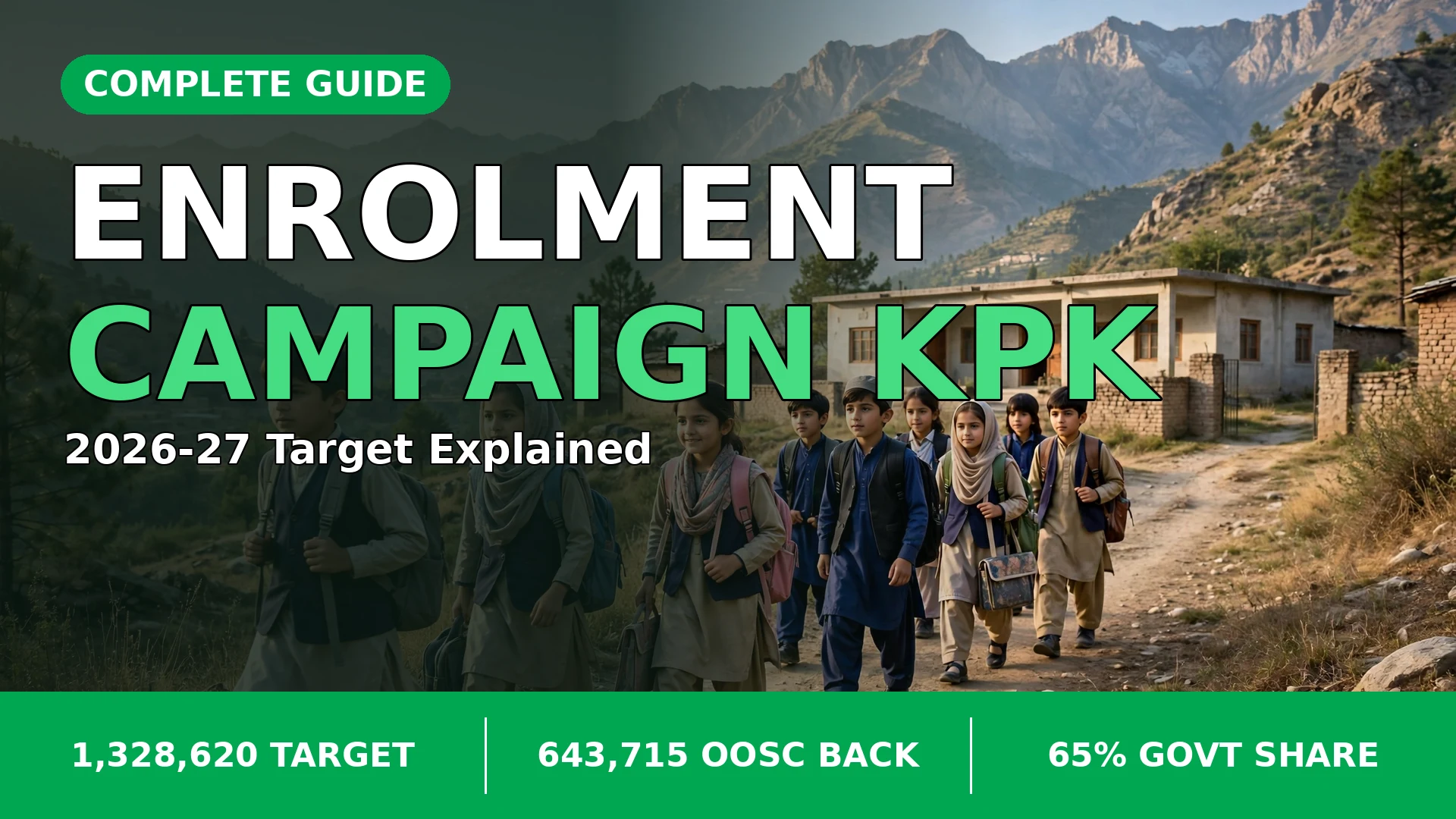
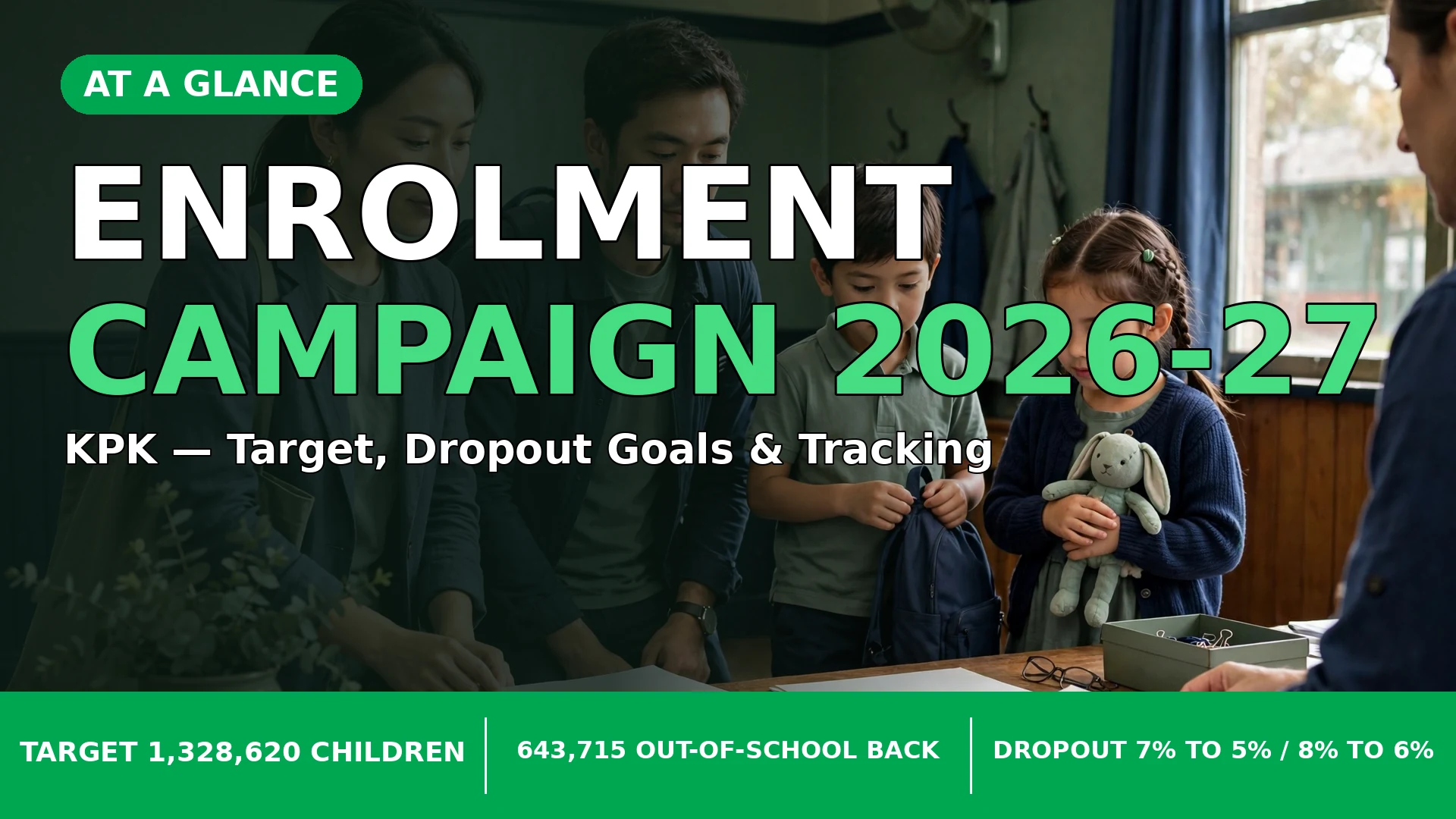
Enrolment campaign KPK: Khyber Pakhtunkhwa’s enrolment campaign for 2026-27 sets an overall enrolment target of 1,328,620 children — 684,363 boys and 644,259 girls — and, alongside that overall target, a target of bringing 643,715 out-of-school children back into school: 261,435 boys and 382,280 girls. The campaign also sets dropout-rate goals of reducing the primary dropout rate from 7% to 5% and the secondary dropout rate from 8% to 6%, with enrolment shares of 65% in government schools, 30% in private schools and 5% in Alternative Learning Programme (ALP) and non-formal education (NFE) settings. Progress is tracked through a digital dashboard, with Deputy Commissioners monitoring the campaign at district level.
These figures come from Business Recorder’s reporting of the campaign in March 2026. This guide explains each figure exactly as reported, what it does and does not mean, and what is not published — including the fact that no campaign start or end date and no district-wise targets are in the reporting this guide is based on, so none are stated here.
The Campaign at a Glance: Enrolment Campaign KPK
| Item | Figure as reported |
|---|---|
| Overall enrolment target, 2026-27 | 1,328,620 children |
| Boys in the overall target | 684,363 |
| Girls in the overall target | 644,259 |
| Out-of-school children to be brought back | 643,715 children |
| Out-of-school boys to be brought back | 261,435 |
| Out-of-school girls to be brought back | 382,280 |
| Primary dropout-rate goal | From 7% to 5% |
| Secondary dropout-rate goal | From 8% to 6% |
| Enrolment share — government schools | 65% |
| Enrolment share — private schools | 30% |
| Enrolment share — ALP and non-formal education | 5% |
| Monitoring | Digital dashboard; Deputy Commissioners monitoring at district level |
Read the table as a set of targets, not as results. A target is what the campaign aims to reach. The reporting this guide is based on states the targets; it does not state how many children had been enrolled when the report was published, and this guide does not claim any result. If you see a message or post claiming the 1,328,620 target has already been met, that claim is not in the reporting used here, and it should be checked against an official update before it is believed or shared.
The Overall Target: 1,328,620 Children
The headline figure of the enrolment campaign kpk is 1,328,620 children to be enrolled in 2026-27. The reported breakdown is 684,363 boys and 644,259 girls, and those two figures add up exactly to the headline total: 684,363 plus 644,259 equals 1,328,620. That exact match matters, because it shows the headline figure is the sum of its two parts, not a rounded estimate with the parts added afterwards.
The boys’ figure is larger than the girls’ figure by 40,104, which is a difference worth noting without overstating it: the overall target enrols more boys than girls in absolute numbers, even though, as the next section shows, the out-of-school figure the campaign is trying to reverse is larger for girls than for boys.
The two pictures sit side by side and both are true at once, because they measure different things — one is the total number of children the campaign aims to enrol, and the other is the number of children who are currently out of school and whom the campaign aims to bring back.
Parents and teachers sometimes ask whether a figure like 1,328,620 means that many new children, or that many children in total including children who were already in school. The reporting used for this guide does not spell out that distinction in words, and this guide will not invent an answer to it. What can safely be said is that the figure is presented as the campaign’s enrolment target for 2026-27, broken down by boys and girls as above.
It should be quoted with its breakdown, not on its own, because the breakdown is what lets a reader see who the campaign is aiming to reach. A school, a parent, or a district officer reading only the headline number cannot tell from it alone how many of the places are for boys and how many for girls; the breakdown answers that question, and it is given here in full for that reason.
The scale of the target is also worth pausing on. More than 1.3 million children is a very large number for a single campaign year, and it is the reason the campaign is organised at district level with Deputy Commissioners involved in monitoring, rather than being left to individual schools alone. A target of this size cannot be reached by one school, one district, or one kind of school. That is part of why the campaign’s own design spreads the enrolment across government schools, private schools, and ALP and non-formal settings, as set out in the section on enrolment shares below.
The size of the number is not, on its own, a reason to doubt it or to accept it uncritically; it is a reason to read the rest of the campaign’s figures — the out-of-school figure, the dropout goals, and the shares — together, because each one qualifies the others.
Bringing 643,715 Out-of-School Children Back
The second headline figure is 643,715 out-of-school children (often shortened to OOSC) whom the enrolment campaign kpk aims to bring back into school. The reported breakdown is 261,435 boys and 382,280 girls, and again the parts add up exactly: 261,435 plus 382,280 equals 643,715. In this figure the balance is the other way round from the overall target. Girls make up the larger share of the out-of-school children the campaign aims to bring back — 382,280 girls against 261,435 boys, a difference of 120,845.
That difference is the clearest single sign in the campaign’s figures of where the out-of-school problem is concentrated: more girls than boys are out of school and need to be brought back, and the campaign’s return-to-school figure reflects that.
| Group | Children to be brought back |
|---|---|
| Boys | 261,435 |
| Girls | 382,280 |
| Total out-of-school children | 643,715 |
“Out-of-school” in this context means children who are not enrolled in school and whom the campaign aims to enrol. This guide does not add an age range, a definition of how long a child must have been out of school, or a list of reasons why children are out of school, because none of those details is in the reporting this guide is based on.
Readers who need those details — for example, a parent wondering whether a child who left school two years ago counts, or a teacher wondering whether a child who never enrolled counts — will need to ask their school or their District Education Officer, because the published campaign figures do not answer those questions. What the figures do answer is the scale of the return the campaign is aiming for, and the fact that the majority of that return, in numbers, is girls.
It is also important not to confuse the two headline figures. The overall enrolment target is 1,328,620 and the out-of-school return target is 643,715. The reporting presents them together as the campaign’s figures, and this guide presents them together in the same way. This guide does not state a mathematical relationship between them beyond what is reported — it does not say that one figure is a part of the other, and it does not subtract one from the other to produce a third figure — because the reporting does not state that relationship, and inventing it would add a claim the source does not make.
Keep the two figures separate in your mind: one is the overall enrolment target for the year, and the other is the number of out-of-school children the campaign aims to bring back. Both are targets. Neither is a reported result.
For families, the practical meaning of the 643,715 figure is straightforward, even without further detail. If a child in your household is out of school, the campaign is aimed at children like that child, and the campaign’s design — district-level monitoring and a digital dashboard — is meant to make that child’s return visible to the system, rather than dependent on a single visit or a single school. For teachers and school heads, the figure means the campaign will be judged, in part, on whether children who were out of school are actually back in classrooms, not only on whether total enrolment numbers rise.
That distinction is why the campaign reports the out-of-school figure separately instead of folding it silently into the overall total.
The Dropout Goals: 7% to 5%, and 8% to 6%
Enrolling children is only half of the campaign’s task. Keeping them in school is the other half, and the campaign states that second task as two dropout-rate goals. The primary dropout rate is to fall from 7% to 5%, and the secondary dropout rate is to fall from 8% to 6%. Each goal is a fall of two percentage points. A dropout rate is the share of enrolled children who leave school before completing the level, so a fall from 7% to 5% means that, out of every 100 primary children, two fewer are to drop out than before; the same reading applies to the secondary fall from 8% to 6%.
Two percentage points may sound small next to figures in the hundreds of thousands, but it is not small in practice. Dropout is measured across every enrolled child, so a two-point fall applied across a whole province’s enrolment represents a large number of individual children staying in school who would otherwise have left. This guide does not convert the two-point falls into numbers of children, because that conversion would need a total enrolment base that the reporting does not give in the same place, and guessing the base would produce a number that looks precise but is not sourced.
The honest way to state the goals is as the campaign states them: rates, from and to, for primary and for secondary separately.
The two goals should also be read separately. The primary goal starts lower (7%) and ends lower (5%); the secondary goal starts higher (8%) and ends higher (6%). Secondary dropout is higher than primary dropout at both the starting point and the target point, which matches the well-known pattern that children are more likely to leave school as they get older. The campaign does not, in the reporting used here, give reasons for dropout or measures specific to keeping older children in school, and this guide does not add reasons or measures of its own. The goals stand as stated: two rates, two falls, two percentage points each.
Where Children Are to Be Enrolled: 65%, 30% and 5%
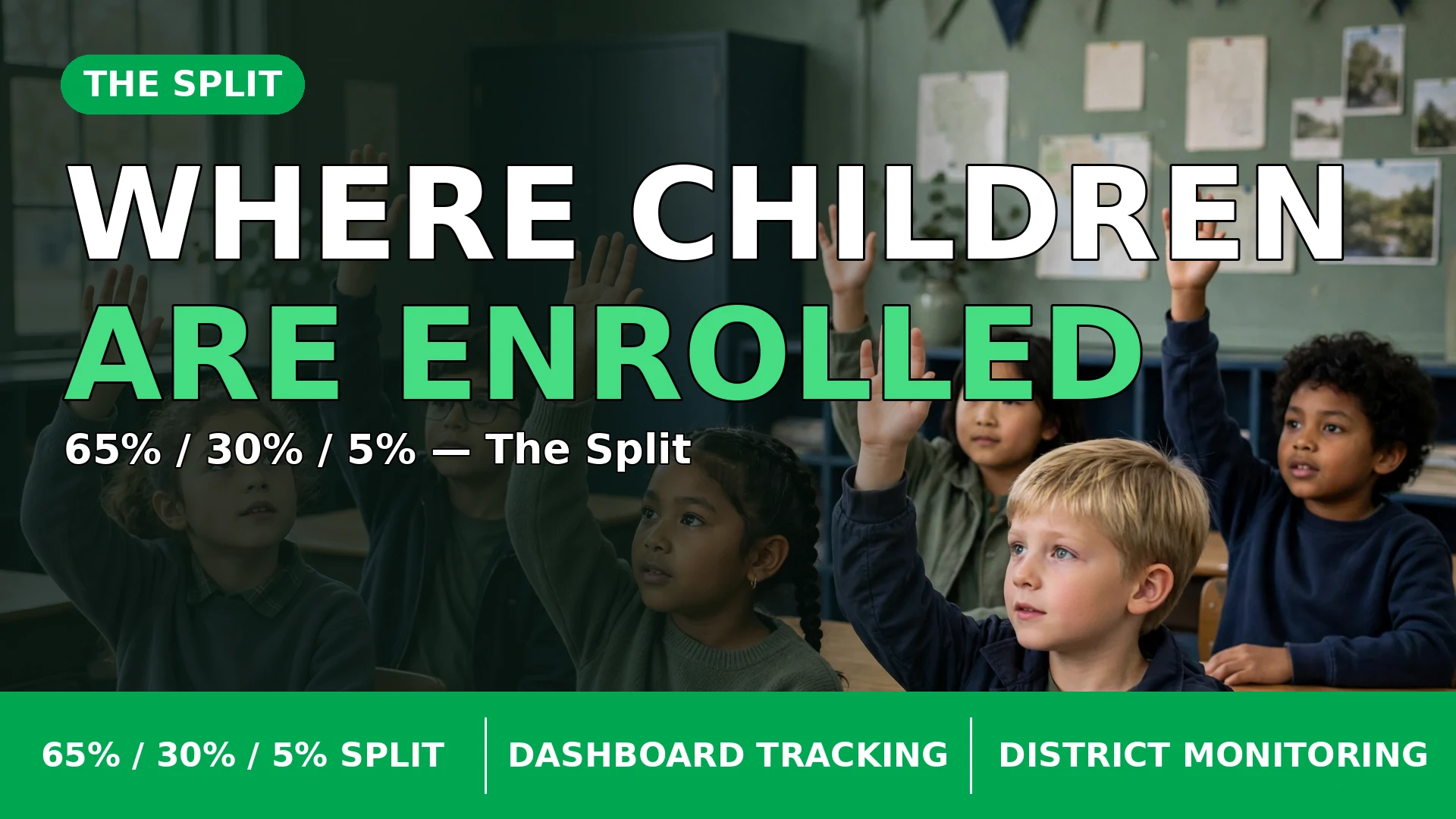
The enrolment campaign kpk also states how the enrolment is to be shared across different kinds of provision: 65% in government schools, 30% in private schools, and 5% in Alternative Learning Programme (ALP) and non-formal education (NFE) settings. The three shares add up to 100%, which is a useful check that they are shares of one whole — the campaign’s enrolment — and not three separate targets that happen to sit near each other.
| Setting | Share of enrolment | What it means |
|---|---|---|
| Government schools | 65% | Nearly two-thirds of the campaign’s enrolment |
| Private schools | 30% | Just under one-third of the campaign’s enrolment |
| ALP and non-formal education (NFE) | 5% | One in twenty children, through alternative and non-formal routes |
| Total | 100% | All three shares together |
The 65% government-school share is the largest by a wide margin, which is consistent with government schools being the main provider of schooling in the province. The 30% private-school share is substantial — just under one-third — and it means the campaign is not a government-schools-only effort; private schools are counted as part of reaching the target.
The 5% ALP and NFE share is the smallest, but it matters out of proportion to its size, because alternative and non-formal routes are the routes most likely to reach children whom ordinary school admission process has not reached: children who are over-age for their grade, children in areas without a nearby school, and children whose circumstances make regular school attendance difficult.
This guide does not add examples of ALP or NFE provision beyond that general explanation, because the campaign reporting does not list them.
As with the other figures, the shares are targets, not results, and they are shares, not numbers of children. This guide does not convert 65%, 30% and 5% into numbers of children by applying them to the 1,328,620 total, because the reporting does not state that the shares apply to that total in that way, and the conversion would be this guide’s arithmetic rather than the campaign’s stated figure. If an official update later gives the shares as numbers of children, those numbers should be quoted from that update, not calculated here. For now, quote the shares as shares: 65, 30 and 5.
How Progress Is Tracked: Dashboard and District Monitoring
The campaign’s monitoring is described in the reporting in two parts: a digital dashboard, and monitoring by Deputy Commissioners at district level. A dashboard, in this context, is a system that brings enrolment figures together in one place so that progress can be seen as it happens, rather than only at the end of the campaign. Deputy Commissioners are the district-level officers responsible for monitoring in their districts. Together, the two parts mean the campaign is tracked both centrally, through the dashboard, and locally, through the officer responsible for each district.
What the reporting does not give is any detail about the dashboard itself: it does not state a web address, it does not say whether the dashboard is public or for officials only, and it does not describe what a parent or teacher would see on it. This guide therefore does not link to a dashboard, does not describe dashboard screens, and does not tell readers to check a dashboard that has not been shown to be public. If a dashboard address is officially published later, it should be added from that publication. Until then, the accurate statement is the general one: progress is tracked through a digital dashboard, and Deputy Commissioners monitor at district level.
For a parent or a teacher, the district-level part is the more practical of the two. A Deputy Commissioner monitoring at district level means there is a named district-level responsibility for the campaign, and district education offices are the natural point of contact for questions about how the campaign is running in a particular district. This guide does not name individual Deputy Commissioners or give district office contact details, because those change and are not in the campaign reporting. The point of contact to use is the one a reader already has: their double-shift school, or their District Education Officer.
What Is Not Published: Dates and District Targets
Two things readers most often want from a campaign announcement are absent from the reporting this guide is based on, and they are absent here for that reason. First, no campaign start date and no campaign end date are stated. This guide therefore gives no dates for the campaign itself, and no reader should take a date from a forwarded message or a social media post as the campaign’s dates unless it comes from an official announcement.
Second, no district-wise targets are stated. The campaign’s figures are province-level figures — one overall target, one out-of-school figure, two dropout goals, three shares — and this guide does not divide them by district, by division, or by school, because any such division would be invented.
The absence of district targets also means this guide cannot tell a reader what their own district’s target is, or whether their district is ahead or behind. That is a limit of the published material, not an oversight in this guide, and stating the limit plainly is better than filling it with estimates. If district-wise figures are published later by the department or by a district administration, they should be read alongside the province-level figures here, and any conflict between a later district figure and the province figures here should be resolved in favour of the later official publication for that district.
The same honesty applies to anything else a reader might expect a campaign guide to contain. The reporting used here does not describe an enrolment procedure step by step, does not list documents a parent must bring, does not state an age limit, and does not describe incentives for enrolling. None of those things is stated in this guide, because none is in the source. A parent who needs the procedure for enrolling a child should ask the school where the child is to be enrolled, or the District Education Officer, and should treat any procedure quoted from an unofficial source as unconfirmed until the school or the district office confirms it.
How This Campaign Connects to the Girls and Out-of-School Package
The enrolment campaign does not stand alone. The same period’s government announcements, reported in the press, describe a related package for girls’ education and out-of-school children: a stipend for girl students in the merged districts, learning centres, and the conversion of mosques for use as primary schools, set against a much larger picture of 4.9 million out-of-school children in the province.
That package is the subject of a separate guide on this site, and it is referred to here in plain text only, because the two subjects overlap — the campaign’s 643,715 return figure and the package’s measures are both aimed at the same out-of-school problem, and the campaign’s girls’ figure of 382,280 is part of the same picture as the package’s focus on girls.
Readers should keep the two subjects distinct even while reading them together. The enrolment campaign kpk is the province-wide set of targets explained in this guide: 1,328,620 overall, 643,715 out-of-school children to be brought back, dropout goals, and enrolment shares. The girls and out-of-school package is a set of specific measures — a stipend, centres, and school places — with its own figures and its own status, including the important point that the stipend rise is described as work underway rather than as money already being paid.
Neither subject’s figures should be quoted as the other’s. The campaign’s figures belong to the campaign, and the package’s figures belong to the package, and the separate guide on this site sets the package out in full.
Together, the two subjects tell a coherent story without needing any figure to be stretched. The province has a large out-of-school population, girls form the larger part of the return the campaign aims for, and the government has announced both a campaign with province-wide targets and a package of measures aimed particularly at girls and at children outside the ordinary school semester system. That is the whole of the connection this guide claims. Anything more specific — which measure delivers how many of the 643,715, or which district benefits first — is not stated in the reporting, and is not claimed here.
What Parents and Teachers Should Do With These Figures
For parents, the figures are useful in one practical way: they show that the system is actively looking for out-of-school children, and that a child who is out of school is part of a counted, province-wide effort to bring children back. A parent whose child is out of school does not need to quote any figure in this guide to enrol the child; the figures are context, not a requirement. What the parent needs is the school or the district office, and the honest advice of this guide is to go to the school first.
If the school cannot answer a question about the enrolment campaign kpk in that district, the District Education Officer is the next point of contact, because district-level monitoring sits with the Deputy Commissioner and the district education administration.
For interim teachers and school heads, the figures are useful as a check on what the campaign will ask of schools. Enrolment will be counted, dropout will be counted, and the shares across government, private, and ALP/NFE settings will be counted. Keeping accurate enrolment and attendance records is therefore not paperwork for its own sake during this campaign; it is the material the dashboard and the district monitoring will be built from. This guide does not add record-keeping instructions, because the campaign reporting does not give them, but the general point stands: the figures that are counted are the figures that must be recorded carefully.
For everyone reading about the campaign online, the figures are also a check against exaggeration. Any claim about the campaign that goes beyond this guide — a district target, a date, a result, a new incentive — should be treated as unconfirmed until it appears in an official announcement or in reputable press reporting of one. The figures in this guide are the figures as reported by Business Recorder in March 2026. Later official updates may add to them or revise them, and if they do, the later official word governs. Until then, these are the figures to quote, with their breakdowns, and with the word “target” attached to them.
FAQs
What is the KP enrolment campaign 2026-27 target?
The overall enrolment target is 1,328,620 children: 684,363 boys and 644,259 girls. It is a target for the 2026-27 campaign as reported by Business Recorder in March 2026, not a reported result.
How many out-of-school children is the campaign aiming to bring back?
643,715 out-of-school children: 261,435 boys and 382,280 girls. Girls form the larger share of this return figure, by 120,845.
What are the campaign’s dropout-rate goals?
The primary dropout rate is to fall from 7% to 5%, and the secondary dropout rate is to fall from 8% to 6%. Each goal is a fall of two percentage points.
How is the enrolment shared between government, private and ALP/NFE settings?
65% in government schools, 30% in private schools, and 5% in Alternative Learning Programme (ALP) and non-formal education (NFE) settings. The three shares add up to 100%.
How is the campaign monitored?
Progress is tracked through a digital dashboard, with Deputy Commissioners monitoring the campaign at district level. No public dashboard address is given in the reporting used for this guide, so none is linked here.
When does the campaign start and end, and what is my district’s target?
Neither a start or end date nor any district-wise targets are stated in the reporting this guide is based on, so this guide states none. For district-level questions, ask your school or your District Education Officer, and treat any date or district figure from an unofficial source as unconfirmed.
Sources: Business Recorder — enrolment campaign 2026-27 targets.