KP Death in Service Financial Assistance: Rates & Procedure
When a Khyber Pakhtunkhwa government employee dies while still in service, the family does not have to depend only on pension. The KP Finance Department runs a separate, one-time Financial Assistance Package for exactly this situation: a lump sum paid to the family of a civil servant who expires during service. The rates were last revised on 20 July 2017, and they are still the rates in force on the Finance Department’s own notifications list. This guide sets out those rates BPS by BPS, explains which office sanctions and pays the amount, and clears up the three-way confusion between this package, the Retirement Benefit and Death Compensation Fund, and the Benevolent Fund, because families often mix up all three and chase the wrong office.
One thing to understand at the start: this package is a lump sum only. It does not replace pension, GP Fund, or Benevolent Fund benefits. The 2017 letter says so in plain words: the assistance is in addition to other benefits admissible to the family under any other rules. So a family can receive this lump sum and still receive family pension and the GP Fund balance under their own rules. The sections below take each part in turn: the rates, a worked example for a teacher, who is covered, the two sanction routes, what “family” means, the one exclusion, and where the form lives.
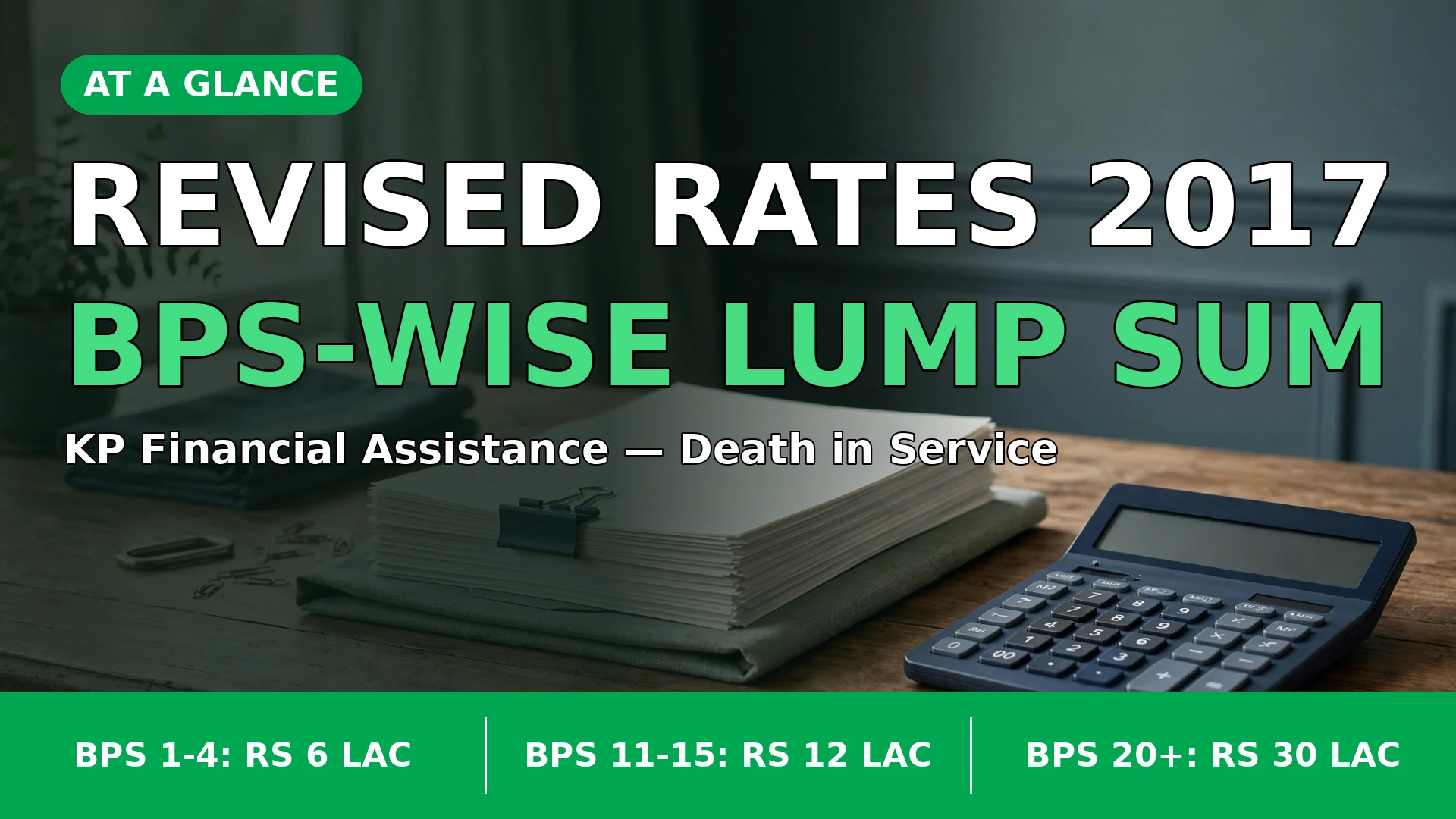
The Revised Rates (20 July 2017)
The governing letter is Finance Department (Regulation Wing) No. FD/SOSR-II/8-52/2017, dated Peshawar the 20th July 2017. It revises, with immediate effect, the rates that had stood since the original 2006 letter, and it gives both columns side by side so the increase is visible at a glance. Every slab roughly tripled.
| BPS | Before 2017 (Existing Package) | Revised Package (20 July 2017) |
|---|---|---|
| 1–4 | Rs. 2,00,000 | Rs. 6,00,000 |
| 5–10 | Rs. 3,00,000 | Rs. 9,00,000 |
| 11–15 | Rs. 4,00,000 | Rs. 12,00,000 |
| 16–17 | Rs. 5,00,000 | Rs. 15,00,000 |
| 18–19 | Rs. 8,00,000 | Rs. 24,00,000 |
| 20 and above | Rs. 10,00,000 | Rs. 30,00,000 |
The rate depends on the BPS of the deceased employee, not on length of service or on the cause of death. The letter draws no distinction between a natural death and any other kind of death in service: the condition is that the civil servant expired during service. That is the whole test for this package. There is no separate Shaheed slab in this letter, which is one reason it must not be confused with the police Shuhada Package or with the federal assistance package, both of which do have separate security-related slabs.
A Worked Example: A BPS-14 Teacher
Take a school teacher in BPS-14 working in a government school in a district. Education is a devolved department, and the teacher is a district-cadre civil servant. If that teacher dies while in service, the family is entitled under the 2017 letter to a lump sum of Rs. 12,00,000, because BPS-14 falls in the 11–15 slab. That amount is paid in addition to, not instead of, the family’s other entitlements: the family pension continues under the pension rules, the payable GP Fund balance is paid under the GP Fund rules, and any Benevolent Fund grant the family qualifies for follows its own rules. A BPS-16 SST in the same situation would fall in the 16–17 slab and receive Rs. 15,00,000 on the same basis. The slab is fixed by the BPS; the family does not have to argue the amount.
The example also shows why the sanction route matters. A BPS-14 teacher’s case does not go to Peshawar for approval. As the next sections explain, it is sanctioned and paid in the district itself. Families who send a BPS 1–16 district case to the Finance Department, or who wait for a Peshawar approval that is never needed, lose months for no reason.
Who Is Covered
The package covers the families of provincial civil servants who expire during service. The 2017 letter is addressed to every Administrative Secretary, every Head of Attached Department, all Commissioners and Deputy Commissioners, and the other top offices of the province, which is the Finance Department’s way of saying the scheme runs across the whole provincial government. It contains no department-wise exclusion. Teachers are covered as provincial civil servants, through the Elementary and Secondary Education Department, exactly like any other department’s employees. The only condition in the letter itself is the death itself: the civil servant must have expired during service. Retirement cases do not fall under this letter at all; a retired employee’s family looks to the retirement-benefit side, not to this package.
Two clarifications from the Finance Department’s 15 April 2016 letter (No. FD(SOSR-II)4-199/2016) pin down how coverage works in practice. First, the letter distinguishes devolved departments from non-devolved (provincial government) departments, and BPS 1–16 from BPS-17 and above, because the sanctioning authority is different for each group. Second, it confirms that the scheme’s earlier letters, going back to 16 February 2006, already laid down the fundamental rates, the relevant rules, the procedure, and the funding, and the 2016 letter only settles who sanctions what. The rates themselves were revised by the 2017 letter quoted above.
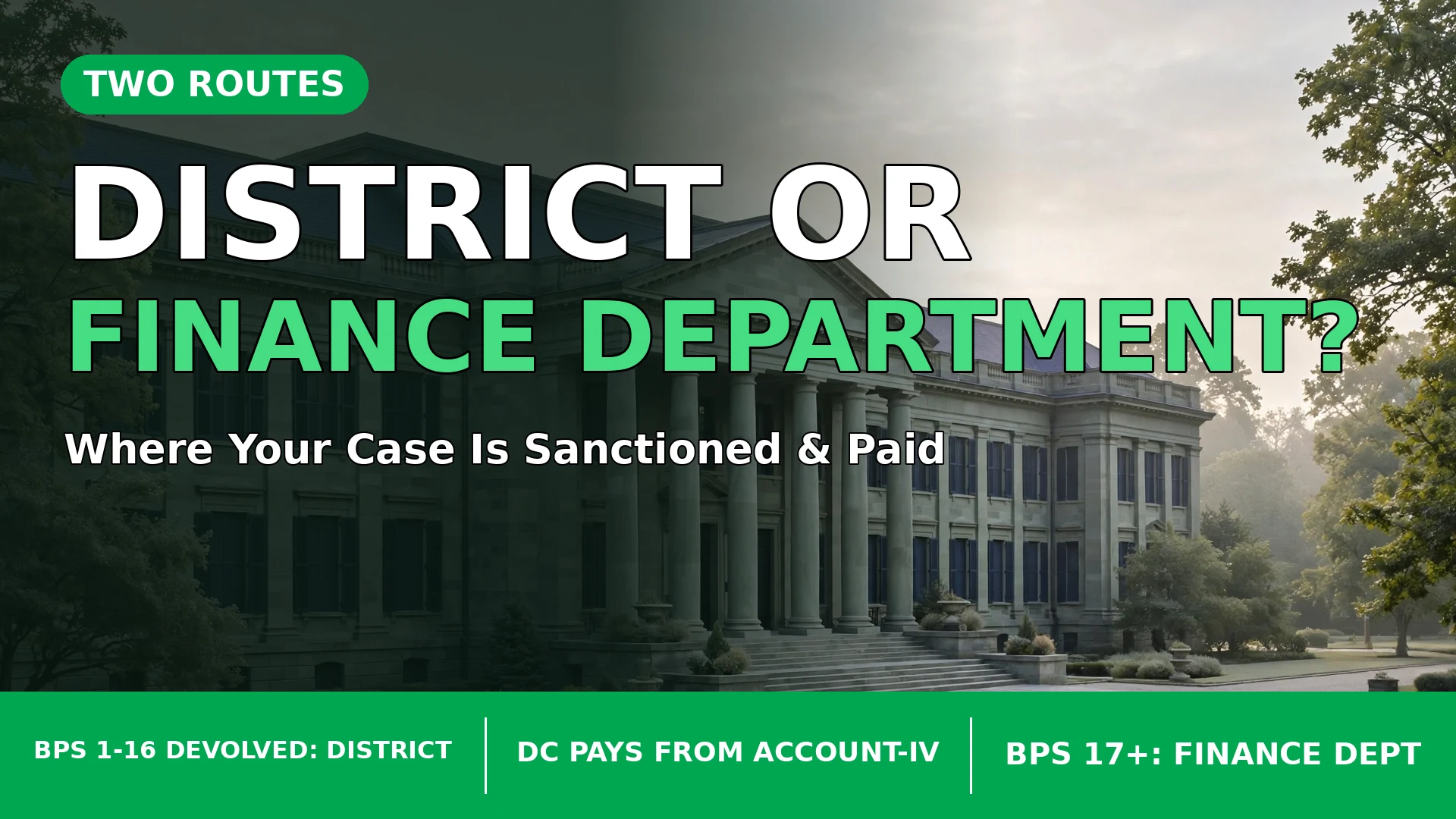
The Two Sanction Routes: District or Finance Department
This is the part families most often get wrong, and it decides how fast the money arrives.
Route 1 — District Government (BPS 1–16, devolved departments). Financial assistance to the families of civil servants in BPS 1–16 of devolved departments who die while in service is sanctioned and paid by the District Government. The Deputy Commissioner processes these cases on a priority basis and ensures payment as early as possible, from District Account-IV. The District Government arranges the payment out of District Account-IV after observing all codal formalities and giving proper budgetary cover in its district budget. For a BPS 1–16 teacher, this is the route: the case is prepared in the district, sanctioned in the district, and paid from the district account. There is no Finance Department approval step for this group.
Route 2 — Finance Department (everyone else). The cases of the remaining civil servants in BPS 1–16 of non-devolved departments (that is, Provincial Government Departments) and of BPS-17 and above are sent to the Finance Department for approval and sanction. The Budget Officer (Finance Department) sanctions these cases and the amount is paid from the relevant head of account. The Budget Officer also watches the budget allocation for these payments and asks the Administrative Departments to check that no case is left pending. But even here, the family does not wait for a separate provincial approval: the case is forwarded to the Finance Department by the Administrative Department, and the Finance Department sanctions it.
What “Family” Means
For this package, the “family” is the family that would be entitled to the deceased employee’s pension: widow/widower, children, and dependent parents, in that order. The nomination on the employee’s pension papers is the first place to look: if the employee nominated a family member for pension, that person is normally the one who receives this assistance. If no nomination exists, the family members share it in the same way as the pension. The office will ask for the family certificate and the nomination papers, so a family that cannot produce them will be asked to get them from the district administration first.
For the family, the practical point is simple: do not let the case be filed in the name of a relative who is not a pension-family member. The office will return it, and the family will lose the time it took to file it.
Three Different Things — Do Not Mix Them Up
Three schemes are often confused, and each has its own office and its own form:
- Financial Assistance Package (this guide). A one-time lump sum, paid on death in service, under the Finance Department’s 2017 letter. It is paid in addition to pension and GP Fund.
- Retirement Benefit and Death Compensation (RB&DC) Fund. A separate fund for government employees, with its own rates and its own grant. A family can receive both this assistance and an RB&DC grant, because they are different schemes.
- Benevolent Fund. A welfare fund that pays grants to employees and their families, including on death, on retirement, and for children’s education. It is run by the Benevolent Fund Cell, not by the Finance Department, and it has its own application form.
If a family files only one of these three and thinks it has filed all three, it will miss money it is entitled to. The three are claimed separately, from three different offices.
The One Exclusion
There is one exclusion in the scheme, and it is easy to miss: the package does not apply to a civil servant who dies after retirement. Retirement cases are not death-in-service cases, even if the death happens soon after retirement. The family of a retired employee looks to the pension and retirement-benefit side, not to this package. The 2017 letter is clear on this point: it covers only employees who die while in service.
Where the Form Lives
The application form for this package is the Finance Department’s “Application Form for Grant of Financial Assistance to the Family of a Civil Servant Who Dies While in Service”. It is available on the Finance Department’s website, under Downloads, and it is also available at the District Accounts Office and at the office of the Deputy Commissioner. The form asks for the deceased employee’s name, BPS, department, date of death, and the family member’s details, and it must be signed by the head of the deceased employee’s office. The family should attach the death certificate, the family certificate, and the pension nomination papers, and should keep a copy of the signed form.
For a BPS 1–16 teacher, the form goes to the District Education Office, which forwards it to the Deputy Commissioner for sanction and payment from District Account-IV. For a BPS-17 and above employee, or for a BPS 1–16 employee of a non-devolved department, the form goes to the Administrative Department, which forwards it to the Finance Department for sanction. For the family pension side of the case, see the pension and retirement rules, and for the GP Fund side, see the GP Fund guide.
Frequently Asked Questions
How much financial assistance is paid if a KP government employee dies while in service?
The amount depends on the employee’s BPS under the 20 July 2017 rates: BPS 1–4: Rs. 6,00,000; BPS 5–10: Rs. 9,00,000; BPS 11–15: Rs. 12,00,000; BPS 16–17: Rs. 15,00,000; BPS 18–19: Rs. 24,00,000; BPS 20 and above: Rs. 30,00,000.
Does this assistance replace family pension or GP Fund?
No. The 2017 letter says the assistance is in addition to other benefits. The family still receives family pension under the pension rules and the payable GP Fund balance under the GP Fund rules, and any Benevolent Fund grant it qualifies for follows its own rules.
Does a BPS-14 teacher’s case go to Peshawar for approval?
No. A BPS-14 teacher is a BPS 1–16 employee of a devolved department (Education), so the case is sanctioned and paid by the District Government, from District Account-IV, through the Deputy Commissioner. It does not need Finance Department approval.
Who is covered by this package?
The families of provincial civil servants who expire during service. It covers all provincial departments, including teachers through the Elementary and Secondary Education Department. Retirement cases are not covered.
What is the difference between this package and the RB&DC Fund?
They are separate schemes. This package is a one-time lump sum on death in service, paid under the Finance Department’s 2017 letter. The RB&DC Fund is a separate fund with its own rates and grant, and a family can receive both.
Where is the application form?
The Finance Department’s application form is available on its website under Downloads, and at the District Accounts Office and the Deputy Commissioner’s office. It must be signed by the head of the deceased employee’s office, with the death certificate, family certificate, and pension nomination papers attached.