CP Fund KPK: Contributory Pension Guide 2026
CP Fund KPK is the contributory pension scheme for Khyber Pakhtunkhwa government servants appointed on or after 7 June 2022. Instead of the classic pension, these employees build a personal pension account: the employee contributes 10% of pensionable pay and the government contributes 12%, giving a combined 22% of pensionable pay every month. This guide explains who is covered, how the 22% is worked out, how the money is managed, and how CP Fund differs from GP Fund and from the classic pension — and it states plainly, at the end, which retirement-stage details are not published in the public sources checked for this guide, so that no procedure is guessed at.
Who Is on CP Fund — and Who Is Not
The cutoff date is the whole story. A government servant who joined service, or was regularised as a civil servant, on or after 7 June 2022 falls under the CP Fund scheme. The scheme was created through the Khyber Pakhtunkhwa Civil Servants (Amendment) Act, 2022, and the Khyber Pakhtunkhwa Contributory Provident Fund Rules, 2022, which the Finance Department notified on 19 August 2022. A Finance Department notification dated 25 October 2023 then confirmed that the Contributory Provident Fund 2022 Scheme stands established for the employees described in the CP Fund Rules, 2022, who join service or are regularised on or after 7 June 2022. If your appointment letter is dated before 7 June 2022, you are not on CP Fund; you remain under the pension system that applied when you joined. If it is dated on or after that day, CP Fund is your pension system, and the deductions on your payslip should reflect it.
Two edge cases are worth stating because they cause the most confusion in offices. First, regularisation counts: an employee regularised as a civil servant through a legal instrument issued after the Amendment Act came into force is covered, even if the person’s earlier service began in another capacity. Second, ad-hoc and contract employees are not covered by the scheme. A contract employee who is later regularised moves into coverage from regularisation, not from the original contract date. Anyone unsure which side of the line they fall on should check the appointment or regularisation order itself, because the date on that order, not the date of joining a particular posting, decides coverage. The department or the AG office can confirm the position from the service record where the order is ambiguous.
For teachers and other provincial employees, the practical consequence is simple: every fresh recruit since June 2022 is a CP Fund employee. That is why the scheme matters to so many serving staff despite being only a few years old. It also means that a school staff room now holds two pension generations side by side — colleagues appointed before June 2022 on the classic pension, and colleagues appointed after it on CP Fund — and advice that is correct for one group can be wrong for the other. Never carry a classic-pension rule, or a GP Fund rule, across to a CP Fund colleague without checking whether it applies to the contributory scheme at all.
The 22% Rule: 10% From You, 12% From the Government
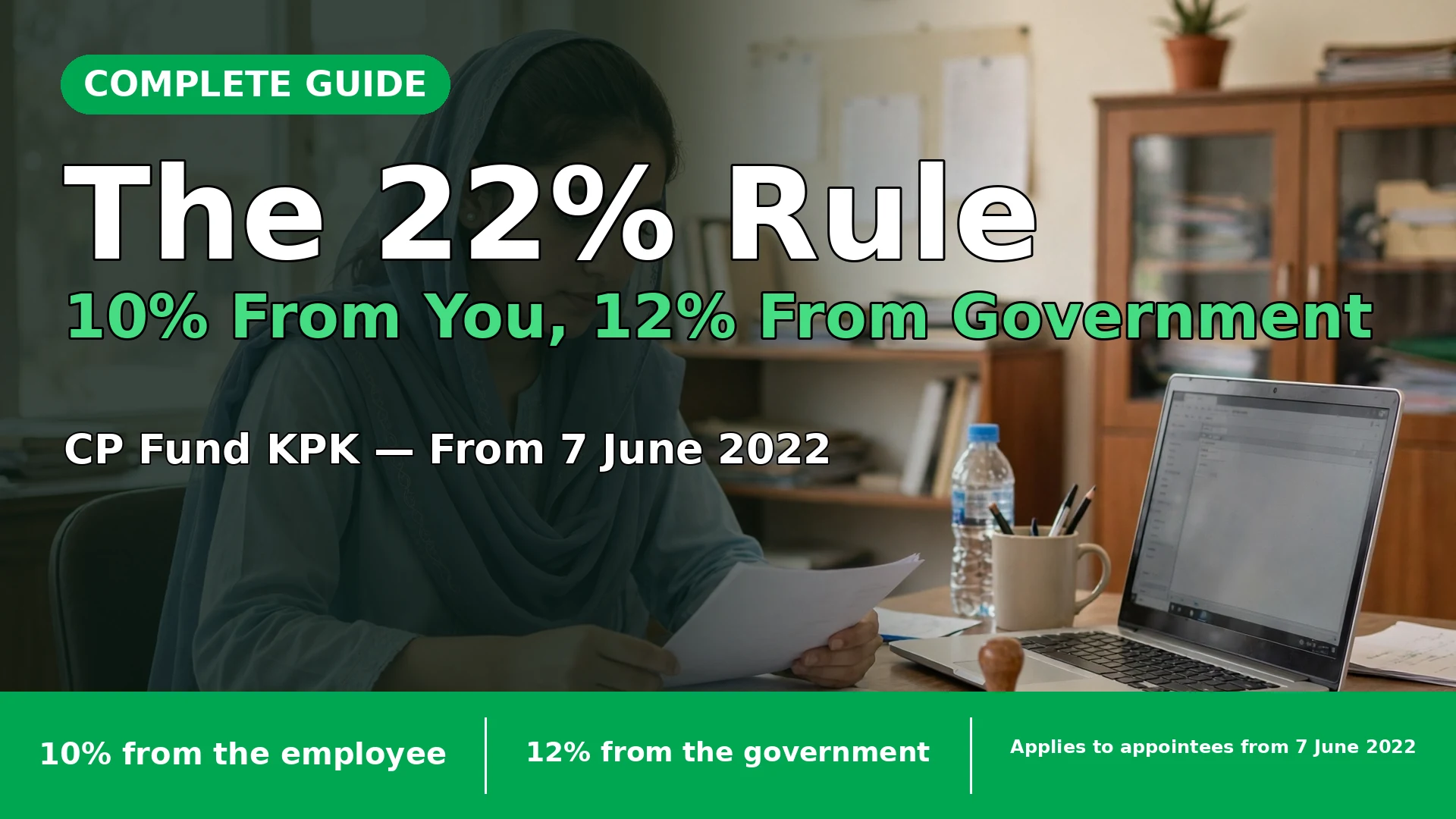
The contribution rule is short and exact. The employee contributes 10% of pensionable pay and the government contributes 12% of pensionable pay, making 22% in total each month. Pensionable pay, for this purpose, means running basic pay plus personal pay. Allowances that are not part of pensionable pay do not enter the calculation, which is why the CP Fund deduction on a payslip is smaller than 22% of gross salary: it is 10% of pensionable pay from the employee, with the government’s 12% paid separately and not deducted from the employee’s salary. An employee who wants to check a payslip should therefore apply the 10% to basic pay plus personal pay, not to the gross total, and should expect the government’s share to appear as an employer contribution rather than as a deduction.
| Contribution | Rate | Paid by |
|---|---|---|
| Employee contribution | 10% of pensionable pay | Deducted from the employee’s salary |
| Government contribution | 12% of pensionable pay | Paid by the government, not deducted from salary |
| Total monthly contribution | 22% of pensionable pay | Both shares combined into the pension account |
| Optional additional employee contribution | Employee’s choice | Voluntary top-up where the chosen fund allows it |
The table carries one detail that is easy to miss: the employee’s 10% is a minimum, described in fund material as “at least 10%”, and an employee may choose to contribute more on a voluntary basis. The government’s 12% does not rise to match a voluntary top-up; it stays at 12% of pensionable pay. The arithmetic of the compulsory part is nevertheless fixed, and it is worth working through once, because every later question about the account balance comes back to it. On pensionable pay of Rs. 50,000 a month, the employee contributes Rs. 5,000 and the government contributes Rs. 6,000, for Rs. 11,000 a month into the account. On pensionable pay of Rs. 100,000, the figures are Rs. 10,000 and Rs. 12,000, for Rs. 22,000 a month. Those are illustrations of the 10/12/22 rule on stated figures, not statements about any real person’s pay, and they exclude investment returns, which depend on the fund chosen and on market performance over time.
A second point about the 22% deserves emphasis because it is the most common misunderstanding about CP Fund. The 22% is a contribution rate, not a pension rate. It does not mean the employee will receive 22% of pay as pension, and it does not mean the pension will equal any fixed percentage of final pay. What the employee eventually receives depends on how much was contributed over the whole career, how the chosen fund performed, and the payout arrangement at retirement. That is the fundamental difference between a defined-contribution scheme like CP Fund and the defined-benefit classic pension, and it is set out in the comparison below.
CP Fund vs GP Fund vs Classic Pension
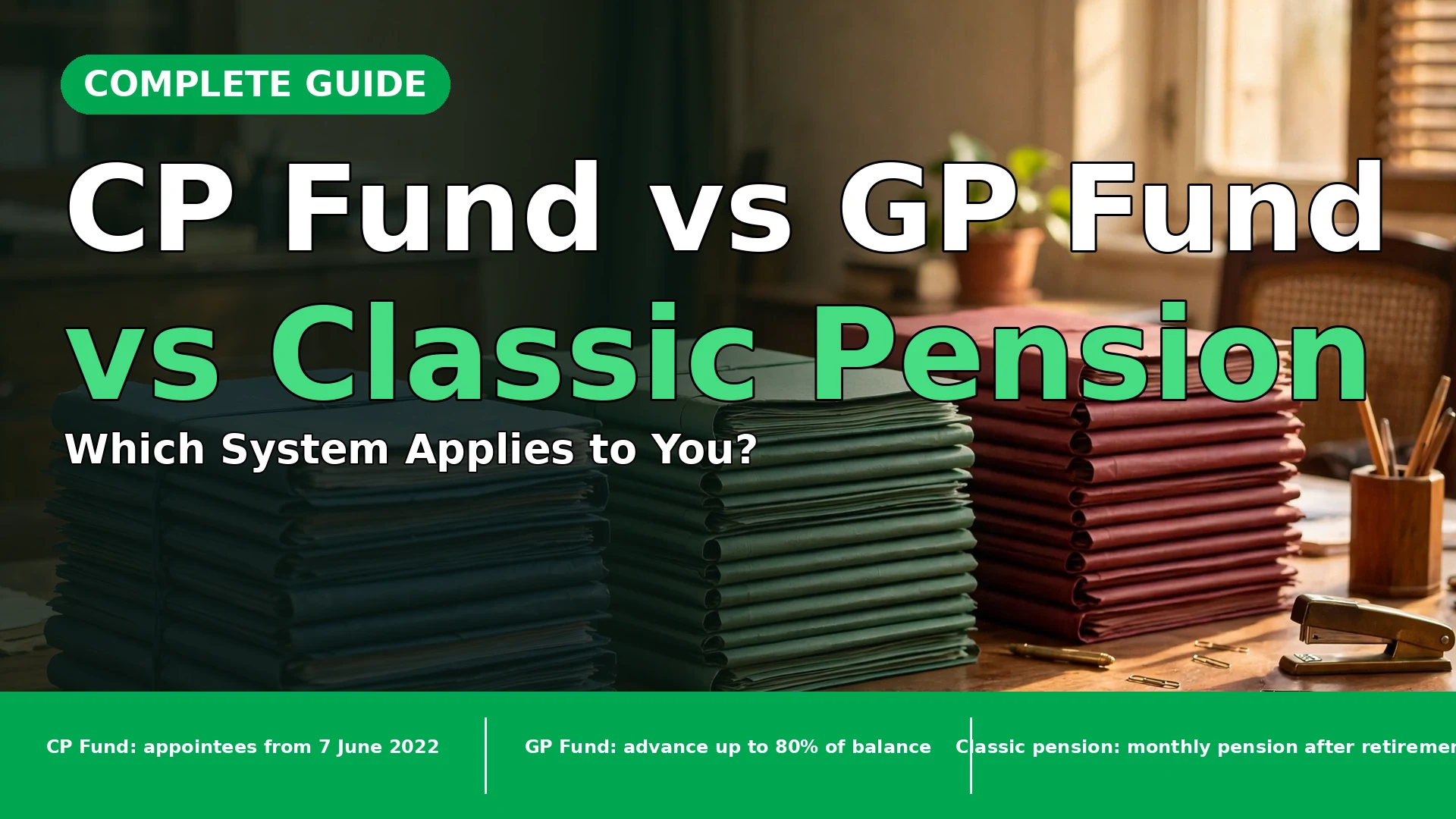
Three funds and pension arrangements circulate in KP government offices, and their names sound alike enough to confuse. CP Fund is the contributory pension scheme for post-7 June 2022 appointees, described above. GP Fund, the General Provident Fund, is the older savings fund to which government servants subscribe during service and from which they can take advances and, at retirement, a final payment; it is a provident fund, not a pension, and it operates on different rules. The classic pension is the monthly pension paid after retirement to pre-June 2022 appointees, worked out from service and pay under the pension rules, and paid by the government rather than drawn from a personal investment account. A single employee may have a relationship with more than one of these — for example, a pre-2022 appointee has GP Fund and a classic pension, while a post-2022 appointee has CP Fund — but the rules of one do not transfer to another.
| Feature | CP Fund | GP Fund | Classic pension |
|---|---|---|---|
| Who it covers | Appointed or regularised on or after 7 June 2022 | Government servants subscribing during service | Appointees before the CP Fund cutoff |
| What it is | Defined-contribution pension account | Provident fund savings account | Defined-benefit monthly pension |
| Employee payment | 10% of pensionable pay | Monthly subscription under GP Fund rules | No pension contribution of this kind |
| Government payment | 12% of pensionable pay | Profit credited under GP Fund rules | Pension paid by the government |
| What you get at retirement | Accumulated account value under the payout arrangement | Final GP Fund payment | Monthly pension under the pension rules |
One transfer error must be avoided explicitly. The familiar GP Fund advance — up to 80% of the GP Fund balance — is a GP Fund facility, and it belongs to GP Fund only. It is not a CP Fund facility, and this guide does not present it as one. A CP Fund employee who needs money during service cannot simply claim a GP Fund-style advance against the pension account, because the account is a retirement account governed by the CP Fund Rules, 2022, and the Voluntary Pension System Rules, 2005, not by GP Fund advance rules. Employees who hold both a GP Fund subscription and a CP Fund account should keep the two balances, statements, and procedures entirely separate, and should ask which fund a form or a clerk is referring to before signing anything. The GP Fund advance guide on this site explains the GP Fund side in full, and it should be read as a GP Fund guide, not as a CP Fund guide.
The classic pension comparison matters for a different reason: expectations. Under the classic pension, the retirement benefit is defined by rule — service and pay determine the pension — and the government bears the investment and longevity risk. Under CP Fund, the benefit is defined by what was contributed and how it grew, and the employee bears the investment risk in the sense that fund performance affects the final value. That is why the choice of fund manager and investment mode, dealt with next, is a real decision for a CP Fund employee, while a classic-pension employee never had to make it. It is also why two CP Fund employees with identical pay histories can retire with different account values if they chose different funds.
How the Money Is Managed: Fund Managers and Your Choice
CP Fund money is not held by the employee’s department and it is not left in a government account. It is invested through licensed pension fund management companies — asset management companies approved under the Voluntary Pension System — and the employee has the right to choose the company and the investment mode. The two investment modes offered are conventional and Shariah-compliant, and the employee selects one when setting up the account. The governing framework is twofold: the Khyber Pakhtunkhwa Contributory Provident Fund Rules, 2022, and the Voluntary Pension System Rules, 2005, issued by the Securities and Exchange Commission of Pakistan, with the VPS Rules prevailing in case of any conflict between the two. That dual framework is why fund material sometimes calls the scheme the Contributory Provident Fund and sometimes the Contributory Pension Scheme: they are the same scheme described from two sides, the provincial rules and the securities regulator’s pension system.
Setting up the account follows a defined route. The employee completes a profile on the KP Finance Department’s CP Fund portal, known as DCMS, and the profile is verified and passed to the pension or asset fund management company chosen by the employee for account opening. Registration with an approved asset management company has been treated by the Finance Department as compulsory and linked to the salary payment system, so an employee who has not completed registration risks a salary-processing problem, and the department has run compliance windows requiring unregistered employees to complete the process. The practical lesson is to complete registration promptly after appointment or regularisation, keep the acknowledgement, and check that the monthly 10% deduction actually starts appearing on the payslip. A deduction that never starts is a problem to raise with the DDO office at once, because every missed month is a month in which neither the employee’s 10% nor the government’s 12% entered the account.
Choosing a fund manager is a decision worth taking slowly. The approved companies include well-known bank-backed and independent asset managers, and each offers its own pension fund with its own past performance, charges, and investment mix. Past performance does not guarantee future returns, and this guide names no company as the best choice, because the right choice depends on the employee’s age, risk appetite, and preference for conventional or Shariah-compliant investment. What can be said generally is that a younger employee has more years for market fluctuations to even out, that charges compound over a career just as returns do, and that switching options exist within the system — fund material notes, for example, an option connected with leaving service before retirement. An employee who is unsure should compare the published fund factsheets of two or three approved companies and, if needed, seek advice from the Finance Department’s Pension Cell rather than following a colleague’s choice blindly.
What CP Fund Means Month by Month: Worked Illustrations
The monthly arithmetic is best shown on stated figures so that any reader can check it. The illustrations below use round basic-pay figures and assume, for simplicity, that pensionable pay equals basic pay in each case, with no personal pay added. They show only the compulsory 10% and 12% contributions, not voluntary top-ups and not investment returns. They are illustrations of the rule, not records of any real employee’s account.
| Monthly pensionable pay (illustration) | Employee 10% | Government 12% | Total monthly contribution | Total over 12 months |
|---|---|---|---|---|
| Rs. 40,000 | Rs. 4,000 | Rs. 4,800 | Rs. 8,800 | Rs. 105,600 |
| Rs. 60,000 | Rs. 6,000 | Rs. 7,200 | Rs. 13,200 | Rs. 158,400 |
| Rs. 80,000 | Rs. 8,000 | Rs. 9,600 | Rs. 17,600 | Rs. 211,200 |
| Rs. 100,000 | Rs. 10,000 | Rs. 12,000 | Rs. 22,000 | Rs. 264,000 |
Each row checks out by simple multiplication: 10% of Rs. 80,000 is Rs. 8,000, 12% of Rs. 80,000 is Rs. 9,600, and the two together are Rs. 17,600 a month, or Rs. 211,200 over twelve months. Over a career, those monthly amounts are joined by two other forces: annual increments and pay revisions, which raise pensionable pay and therefore raise both contributions, and investment growth, which compounds inside the fund. A teacher who starts on modest pay and serves thirty years will therefore contribute far more in later years than in early years, and the final account value will reflect that rising path, not the starting salary multiplied by the years of service. That rising path is also the reason to check the deduction after every increment and pay revision: if the deduction stays frozen at an old figure while basic pay has risen, the account is being short-changed.
Two payslip checks follow from the rule and should become habit. First, confirm that the deduction equals 10% of running basic pay plus personal pay, and query any figure that matches neither that base nor the gross salary. Second, confirm that the deduction appears every month without a gap, including after a transfer, because a transfer changes the DDO and the payroll station, and deductions have been known to stall across a move. The last pay certificate guide on this site explains the certificate that carries pay details from one station to the next, and a CP Fund employee should make sure the certificate process does not interrupt the contribution. A gap of even a few months, repeated across transfers, reduces the final account value by more than the missed contributions alone, because the missed money also misses its years of growth.
At Retirement: What Is Settled and What Is Not Published
What is settled about CP Fund at retirement is the shape of the benefit: the employee’s accumulated account value, built from the 10% and 12% contributions plus investment returns, is paid out under the arrangement that applies under the CP Fund Rules, 2022, and the VPS Rules, 2005. What is not settled in the public sources checked for this guide is the detailed retirement-stage procedure — the exact payout options, the documents required, the timeline for settlement, and the statement format an employee should expect in the final year of service. Those details are not stated in the Finance Department notification or in the fund material reviewed here, and this guide will not invent them. An employee approaching retirement on CP Fund should therefore seek the current procedure from the Finance Department’s Pension Cell and from the chosen fund management company well before the retirement date, rather than relying on classic-pension retirement guidance, which describes a different system.
The same honesty applies to two other questions readers commonly ask. First, the precise rules for withdrawal or partial withdrawal during service are not published in the sources checked here, and no withdrawal percentage or procedure is stated in this guide. Second, the exact statement cycle — how often the fund company must issue an account statement and in what form — is described in fund material only in general terms, such as accounts being updated within a stated period after contributions, and this guide does not convert those general terms into a promised timetable. Stating those limits is not a gap in the guide; it is the guide refusing to present an unverified procedure as a rule. The verified core stands regardless: coverage from 7 June 2022, 10% plus 12% equals 22% of pensionable pay, employee choice of fund manager and investment mode, and governance under the CP Fund Rules, 2022, and the VPS Rules, 2005.
For employees still far from retirement, the useful action is not to chase a payout procedure that has not been published, but to protect the accumulation itself: stay registered, keep the deduction running, check the fund statement whenever it is issued, and keep the fund choice under review as age and circumstances change. For the broader retirement picture — pension papers, documents, and the steps that surround any retirement — the pension and retirement guide on this site remains useful background, but its classic-pension procedures must not be assumed to apply to a CP Fund retirement. Where the two guides appear to differ, the CP Fund rules govern a CP Fund employee.
Checks Every New Appointee Should Make
A new appointee’s CP Fund checklist is short, and each item can be verified from documents the employee already holds or can obtain. Confirm the appointment or regularisation date against the 7 June 2022 cutoff, and keep a copy of the order. Complete the DCMS profile and the fund-manager registration, and keep the acknowledgement. Check the first payslip for the 10% deduction on pensionable pay, and check again after every increment, promotion, and transfer. Note the chosen fund manager and investment mode, and keep the fund company’s account details with the service record. Finally, separate CP Fund mentally from GP Fund: a GP Fund statement is not a CP Fund statement, a GP Fund advance is not a CP Fund withdrawal, and a colleague’s classic-pension advice is not CP Fund advice. Those five checks cost little time and prevent the errors that are hardest to undo — missed contributions, unregistered accounts, and decisions taken under the wrong fund’s rules.
CP Fund is, in the end, a straightforward scheme with an unfamiliar shape. The government did not abolish the pension for new appointees; it replaced a defined benefit with a defined contribution, in which the monthly 22% — 10% from the employee and 12% from the government — is invested in the employee’s own name through a licensed fund manager. Employees who understand that shape, who register promptly, and who watch their deductions and statements will get the full value of the scheme. Employees who treat it as the old pension, or confuse it with GP Fund, risk missing contributions and misunderstanding the retirement benefit entirely. The cutoff date of 7 June 2022 and the 10/12/22 rule are the two facts to carry away; everything else in the scheme hangs from them.
FAQs
Who is covered by CP Fund KPK?
Government servants of Khyber Pakhtunkhwa appointed or regularised on or after 7 June 2022, under the Khyber Pakhtunkhwa Contributory Provident Fund Rules, 2022. Ad-hoc and contract employees are not covered until regularised as civil servants.
How much is contributed to CP Fund every month?
22% of pensionable pay in total: 10% contributed by the employee and 12% contributed by the government. Pensionable pay means running basic pay plus personal pay, and the employee may voluntarily contribute more than 10%.
Is CP Fund the same as GP Fund?
No. CP Fund is a defined-contribution pension account for post-7 June 2022 appointees, managed through licensed pension fund companies. GP Fund is a separate provident fund savings account with its own rules, and its advance of up to 80% of balance is a GP Fund facility only, not a CP Fund facility.
Can a CP Fund employee choose the fund manager?
Yes. The employee has the right to select an approved pension or asset fund management company of choice and to choose between conventional and Shariah-compliant investment modes when completing the profile on the KP Finance Department portal.
What happens to CP Fund money at retirement?
The accumulated account value, built from the 10% and 12% contributions plus investment returns, is paid out under the arrangement applying under the CP Fund Rules, 2022, and the Voluntary Pension System Rules, 2005. The detailed payout procedure is not published in the public sources checked for this guide and should be confirmed with the Pension Cell and the chosen fund company before retirement.
How can an employee check that CP Fund deductions are correct?
Apply 10% to running basic pay plus personal pay and compare it with the payslip deduction, and check that the deduction appears every month, including after increments, promotions, and transfers. Any gap or mismatch should be raised with the DDO office at once.
Sources: KP Finance Department — Notification establishing the Contributory Provident Fund 2022 Scheme (25 October 2023) · Pension and retirement guide · GP Fund advance guide. The CP Fund Rules, 2022 (notified 19 August 2022) and the SECP Voluntary Pension System Rules, 2005 are cited by name in the text.