KPK Pay Scale Chart 2026-27: BPS 1–22 Table
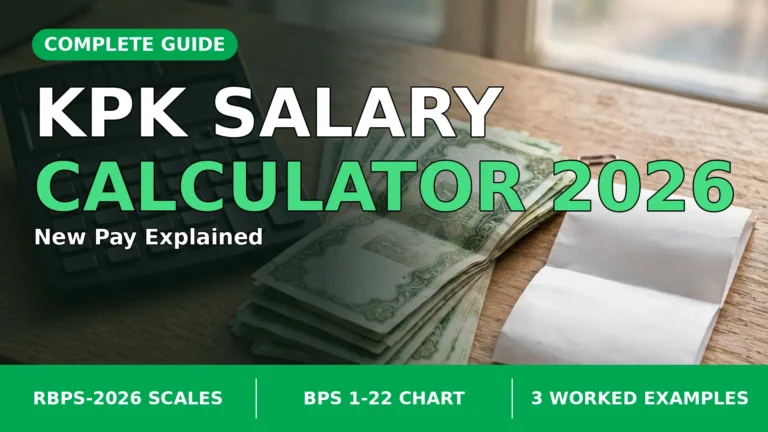
The kpk pay scale chart 2026 is the Revised Basic Pay Scale 2026, known as RBPS-2026, which replaced the 2022 scales for Khyber Pakhtunkhwa government employees with effect from 1 July 2026. It was introduced by the Khyber Pakhtunkhwa Finance Department notification FD (SOSR-1) 1-1/2026, dated 22 July 2026, and it covers every grade from BPS-1 to BPS-22.
This guide reproduces the full chart in one table, explains how to read it, sets out the 7% Ad-hoc Relief Allowance 2026 beside it, and gives the revised conveyance rates that took effect on the same date. Every figure in the chart below comes from the notification itself, as set out in the verified extract of that notification, and three small printing traps in circulating copies are flagged and corrected in a separate section below, so that a reader comparing this chart with another copy can see exactly where the differences come from.
The Full RBPS-2026 Chart: BPS 1 to 22
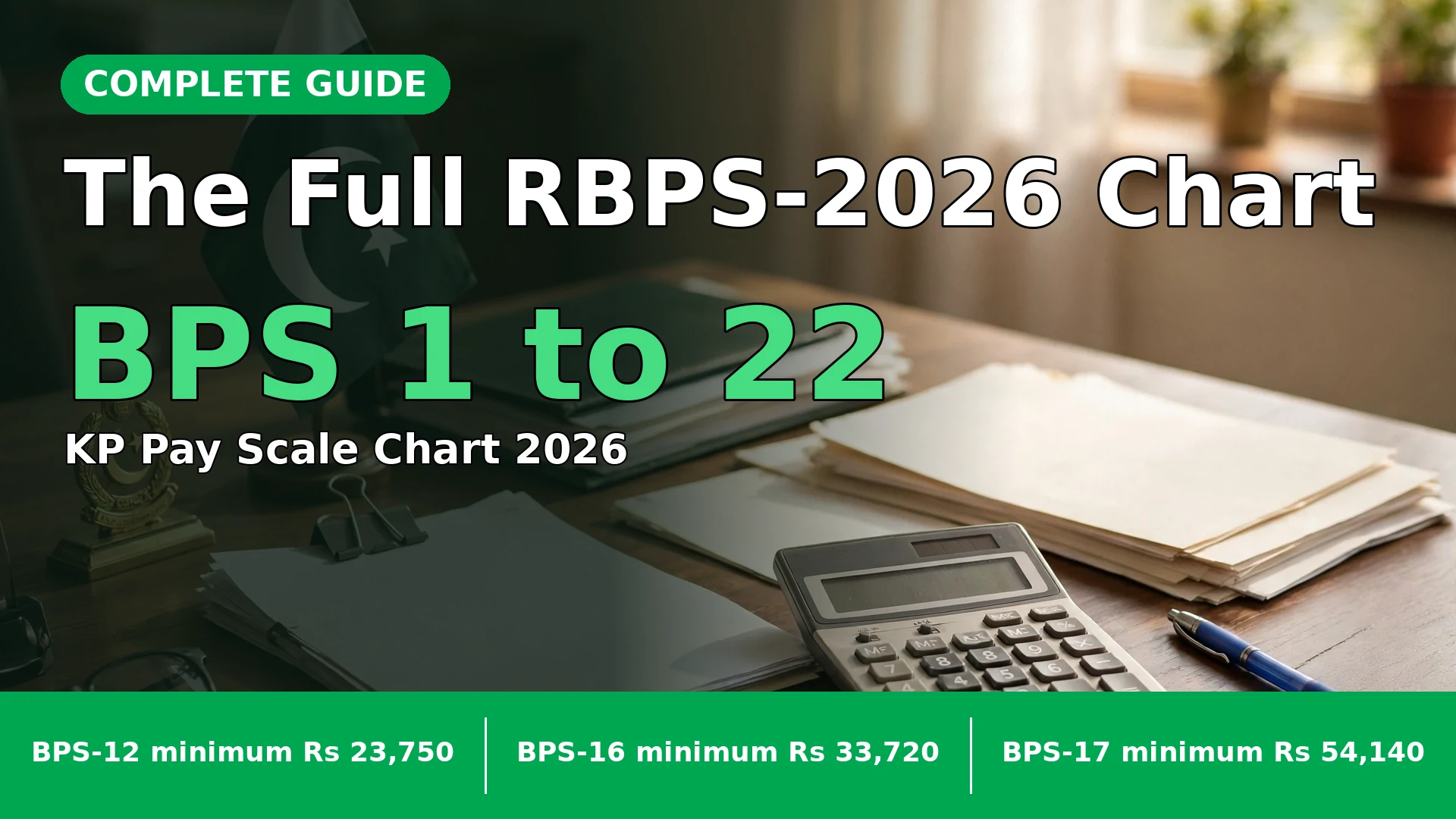
The table below gives, for each grade, the number of stages, the minimum basic pay, the annual increment, and the maximum basic pay under RBPS-2026, together with the Ad-hoc Relief Allowance 2026 at the minimum of the scale. The allowance column is simple arithmetic: 7% of the minimum basic pay, rounded to the nearest rupee. Grades BPS-1 to BPS-16 have 30 stages, grades BPS-17 to BPS-19 have 20 stages, and grades BPS-20 to BPS-22 have 14 stages. The maximum in each row can be checked by adding the increment multiplied by the number of stages to the minimum, and every row in this table passes that check.
| BPS | Stages | Minimum (Rs) | Increment (Rs) | Maximum (Rs) | ARA-2026 at minimum (Rs) |
|---|---|---|---|---|---|
| 1 | 30 | 16,280 | 520 | 31,880 | 1,140 |
| 2 | 30 | 16,600 | 590 | 34,300 | 1,162 |
| 3 | 30 | 17,130 | 700 | 38,130 | 1,199 |
| 4 | 30 | 17,650 | 800 | 41,650 | 1,236 |
| 5 | 30 | 18,300 | 910 | 45,600 | 1,281 |
| 6 | 30 | 18,930 | 1,010 | 49,230 | 1,325 |
| 7 | 30 | 19,590 | 1,100 | 52,590 | 1,371 |
| 8 | 30 | 20,290 | 1,210 | 56,590 | 1,420 |
| 9 | 30 | 20,990 | 1,310 | 60,290 | 1,469 |
| 10 | 30 | 21,680 | 1,430 | 64,580 | 1,518 |
| 11 | 30 | 22,410 | 1,580 | 69,810 | 1,569 |
| 12 | 30 | 23,750 | 1,720 | 75,350 | 1,663 |
| 13 | 30 | 25,420 | 1,880 | 81,820 | 1,779 |
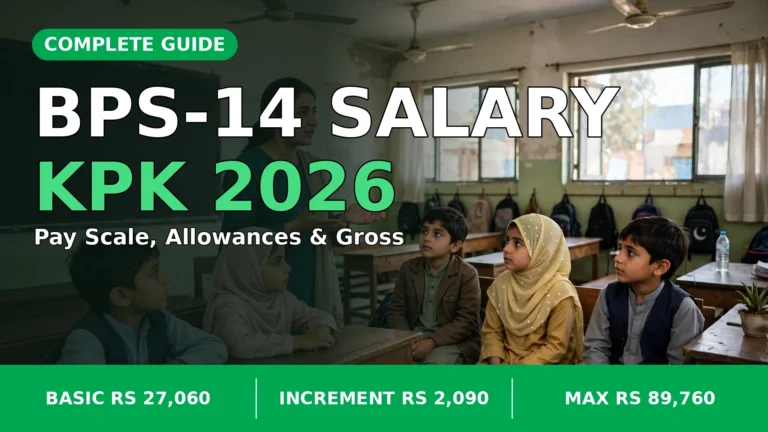
| 14 | 30 | 27,060 | 2,090 | 89,760 | 1,894 |
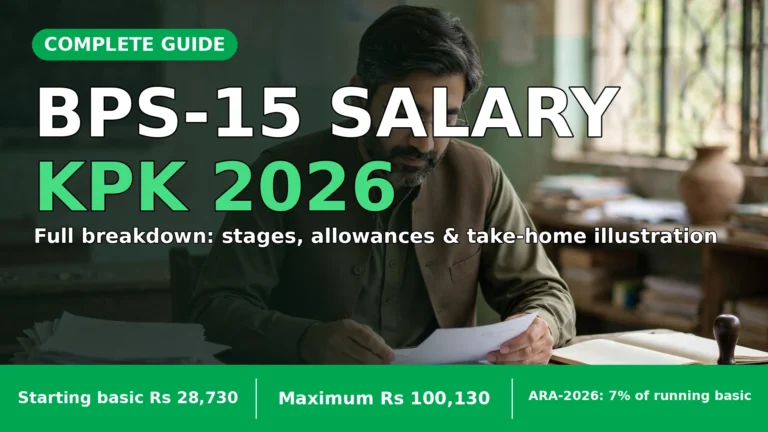
| 15 | 30 | 28,730 | 2,380 | 100,130 | 2,011 |
| 16 | 30 | 33,720 | 2,720 | 115,320 | 2,360 |
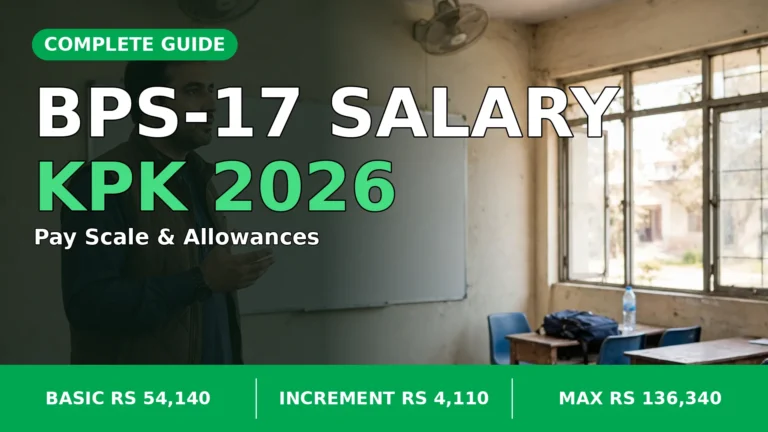
| 17 | 20 | 54,140 | 4,110 | 136,340 | 3,790 |
| 18 | 20 | 68,330 | 5,120 | 170,730 | 4,783 |
| 19 | 20 | 105,510 | 5,450 | 214,510 | 7,386 |
| 20 | 14 | 123,090 | 8,040 | 235,650 | 8,616 |
| 21 | 14 | 136,680 | 8,920 | 261,560 | 9,568 |
| 22 | 14 | 146,770 | 10,470 | 293,350 | 10,274 |
Two features of the chart are worth noticing before anything else. First, the jump between BPS-16 and BPS-17 is the largest single step in the whole scale: the minimum rises from Rs 33,720 in BPS-16 to Rs 54,140 in BPS-17. That gap reflects the structure of the service, in which BPS-17 is the entry grade for gazetted officers, while BPS-16 is the highest non-gazetted grade. Second, the stage counts narrow as the grades rise. A BPS-1 employee has 30 increments available before reaching the maximum, while a BPS-22 officer has only 14. That is why the increments grow so much larger at the top of the scale: fewer, bigger steps cover a wider range of pay. A reader who only compares minimums across grades will miss this, because the maximum of a lower grade can overlap the minimum of the grade above it. For example, the BPS-15 maximum of Rs 100,130 sits well above the BPS-16 minimum of Rs 33,720, but that does not make BPS-15 the better grade: the grade decides the post, the promotion channel, and the allowances that attach to it, not just the pay range.
How to Read the Chart: Stages, Increments and Fixation
Each grade is a ladder. The minimum is the first rung, the increment is the size of each step, and the maximum is the last rung. An employee at a given stage draws the minimum plus the increment multiplied by the number of increments earned. So a BPS-12 employee who has earned 10 increments draws Rs 23,750 plus 10 times Rs 1,720, which is Rs 23,750 plus Rs 17,200, giving Rs 40,950. The same arithmetic works for every grade and every stage, and it is the quickest way to check any figure quoted from this chart. If a quoted basic pay for a grade cannot be reached by adding whole increments to the minimum, it is not a stage pay in RBPS-2026, and it should be questioned.
The annual increment continues to be admissible on 1 December each year, subject to the existing conditions. That date matters for anyone working out when their pay will next move: an increment is not added on the anniversary of joining, but on the common date of 1 December. Employees already in service on 30 June 2026 were fixed point to point, which means that an employee’s basic pay in BPS-2026 was fixed at the stage corresponding to the stage occupied above the minimum of BPS-2022. In plain terms, the number of increments already earned was preserved across the revision, rather than everyone restarting at the new minimum. An employee whose basic pay stood beyond the maximum of the old scale continues to draw personal pay at the revised rates, and the notification also provides for an irrevocable written option, to be given within 30 days of issuance, for an employee to continue in BPS-2022 instead of opting for BPS-2026. An employee who did not opt in time was deemed to have opted for BPS-2026. The option window is therefore long closed for the 2026 revision, but the point-to-point rule still explains why two employees in the same grade can draw different basic pay today: they carried different numbers of increments into the new scale.
For a new appointee, the position is simpler. A new appointee starts at the minimum of the grade, and the first increment arrives on the following 1 December subject to the conditions that govern increments. From there, each 1 December adds one increment until the maximum is reached. Once the maximum is reached, no further annual increment is admissible in that grade, and further movement in pay depends on promotion to a higher grade or on allowances. That is the whole mechanics of the chart, and everything else in this guide — allowances, conveyance, and the worked checks — sits on top of these three numbers per grade: minimum, increment, and maximum.
What Changed in 2026: The Merger Behind the New Minimums
RBPS-2026 was introduced by merging two earlier ad-hoc relief allowances into basic pay. Ad-hoc Relief Allowance 2022, at 15% of BPS-2017 basic pay, and Ad-hoc Relief Allowance 2025, at 10% of BPS-2022 basic pay, both ceased to exist with effect from 1 July 2026, and their value was folded into the new basic pay scales. That is why the 2026 minimums are so much higher than the 2022 minimums: the increase is not a fresh raise on top of everything that came before, but largely the absorption of allowances that were previously paid separately. The table below shows the change at the minimum and the maximum for a selection of grades, using the 2022 columns printed alongside the 2026 chart in the notification itself.
| BPS | 2022 minimum (Rs) | 2026 minimum (Rs) | 2022 maximum (Rs) | 2026 maximum (Rs) |
|---|---|---|---|---|
| 1 | 13,550 | 16,280 | 26,450 | 31,880 |
| 5 | 15,230 | 18,300 | 37,730 | 45,600 |
| 10 | 18,050 | 21,680 | 53,750 | 64,580 |
| 12 | 19,770 | 23,750 | 62,670 | 75,350 |
| 15 | 23,920 | 28,730 | 83,320 | 100,130 |
| 16 | 28,070 | 33,720 | 95,870 | 115,320 |
| 17 | 45,070 | 54,140 | 113,470 | 136,340 |
| 22 | 122,190 | 146,770 | 244,130 | 293,350 |
Understanding the merger prevents a common double-counting error. Because ARA-2022 and ARA-2025 are merged into the new basic pay, they must not be added again on top of a BPS-2026 basic pay. An employee who adds 15% and 10% to a 2026 basic pay will overstate the salary by a large margin. What continues to be paid separately, in addition to the new basic pay, are the allowances that were not merged. The two most important of those are Ad-hoc Relief Allowance 2023 and Ad-hoc Relief Allowance 2024, which were not merged and remain payable, and the fresh Ad-hoc Relief Allowance 2026, which is dealt with in the next section. The merger also has a knock-on effect that employees should understand: because allowances that are calculated as a percentage of basic pay now apply to a larger basic pay, their rupee amounts rise even where their percentage rates are unchanged. That is part of the design of a merger, not an error in a payslip.
There is a second, quieter consequence of the merger. Special pays and special allowances admissible as a percentage of pay, where they are equal to or more than one month’s initial or basic pay, stand frozen at the level of their admissibility as on 30 June 2026, subject to the exceptions the notification lists for allowances held unfrozen under earlier Finance Department letters. The practical meaning is that not every percentage-based amount rises automatically with the new basic pay. House Rent Allowance is the best-known example of a frozen amount, and it is dealt with separately below, because it is the allowance most often miscalculated by applying a percentage to the new basic pay.
Ad-hoc Relief Allowance 2026: 7% of Running Basic Pay
Ad-hoc Relief Allowance 2026, or ARA-2026, is payable at 7% of the running basic pay of BPS-2026, with effect from 1 July 2026 and until further orders. The key word is running: the allowance is calculated on the employee’s actual basic pay at the employee’s current stage, not on the minimum of the scale. A BPS-15 employee at the minimum draws 7% of Rs 28,730, which is Rs 2,011, as shown in the main chart. The same employee at stage 10, drawing Rs 52,530, would draw 7% of Rs 52,530, which is Rs 3,677. The allowance therefore grows with every increment, and the chart’s allowance column, which is fixed at the minimum, should never be quoted as the allowance for an employee above the minimum. The KPK salary calculator tool on this site works the allowance out stage by stage, which is the reliable way to check it for a particular employee.
Three conditions of ARA-2026 matter for household budgeting. First, it is subject to income tax. Second, it is admissible during leave and during the entire period of leave preparatory to retirement, except during extraordinary leave. Third, and most important for long-term planning, it is not treated as part of emoluments for the purpose of calculating pension or gratuity, and it is not counted for the recovery of house rent. An employee who includes ARA-2026 in a pension estimate will overstate the pension, because pension is calculated on emoluments that exclude this allowance. The same exclusion applies to the older ad-hoc allowances that remain payable: they are current income, not pensionable pay. This distinction between pay in hand and pensionable pay is one of the most consequential details in the whole 2026 package, and it is worth stating plainly, because a payslip total and a pension calculation are built from different sets of components.
Alongside ARA-2026, Ad-hoc Relief Allowance 2023 and Ad-hoc Relief Allowance 2024 remain payable. In the verified compilation of allowance rates at the minimum of each scale, the 2023 allowance is shown at 35% for grades BPS-1 to BPS-16 and 30% for the higher grades, and the 2024 allowance at 25% for grades BPS-1 to BPS-16 and 20% for the higher grades. For a BPS-12 employee at the minimum, that gives Rs 8,313 for 2023 and Rs 5,938 for 2024, and for a BPS-15 employee at the minimum, Rs 10,056 for 2023 and Rs 7,183 for 2024. These are large amounts relative to basic pay, and together with ARA-2026 they explain why a salary slip total is far above basic pay alone. They are, however, allowances, and like ARA-2026 they do not form part of pensionable emoluments.
Conveyance Allowance 2026: The Revised Rates
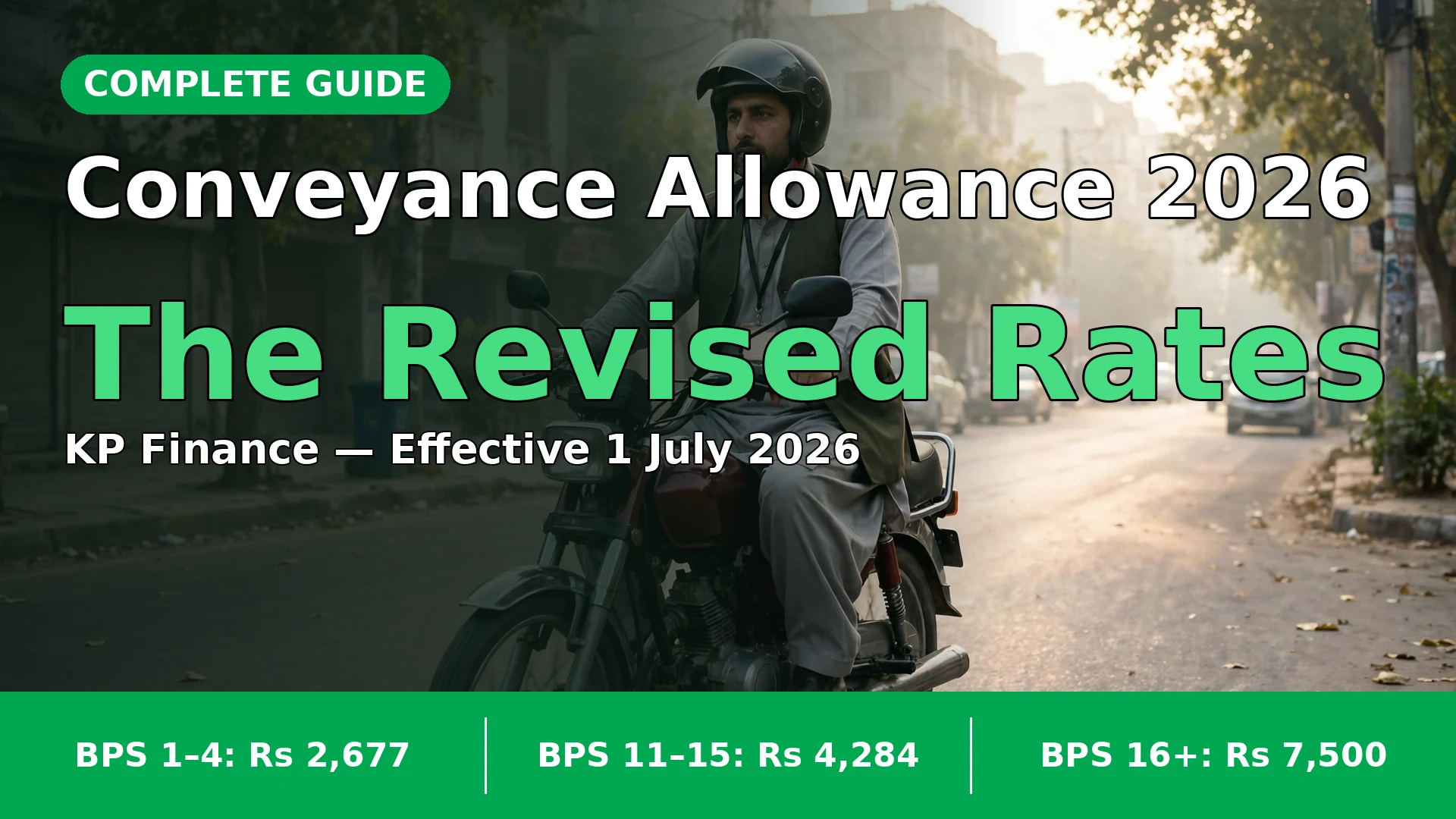
Conveyance Allowance was revised separately, by the Finance Department notification FD (SOSR-I) Conveyance Allowance/2026, dated 22 July 2026, which raised the existing rates by 50% with effect from 1 July 2026. The revised monthly rates are flat amounts by grade band, not percentages of basic pay, so they are the same for every employee in the band regardless of stage. The table below gives the old and new rates for each band.
| BPS band | Old rate per month (Rs) | Revised rate per month (Rs) |
|---|---|---|
| 1 to 4 | 1,785 | 2,677 |
| 5 to 10 | 1,932 | 2,898 |
| 11 to 15 | 2,856 | 4,284 |
| 16 and above | 5,000 | 7,500 |
The 50% revision is exact for three of the four bands, and the fourth shows why rounding matters. Half of Rs 1,785 is Rs 892.50, so a straight 50% increase would give Rs 2,677.50, and the notification prints Rs 2,677. Some unofficial compilations round that figure up to Rs 2,678, and a reader who meets Rs 2,678 elsewhere is looking at a rounding difference, not a different rate. The notification figure of Rs 2,677 is the one used in this guide. One exclusion also applies: an employee who has availed an official vehicle or monetisation does not draw conveyance allowance at all. Conveyance is therefore not universal in the way basic pay is, and a salary estimate that adds it for an officer with an official vehicle will be wrong.
House Rent Allowance: Frozen, Not a Percentage of Current Basic
House Rent Allowance is the allowance most often miscalculated from this chart, so it deserves a direct warning. House Rent Allowance is computed on a frozen older-scale base, not as a percentage of current basic pay. It must never be presented as a percentage of the RBPS-2026 basic pay, and any calculator or article that takes, for example, 45% of a 2026 basic pay and calls the result the house rent allowance is wrong. The allowance was increased by 50% of the amount then being drawn under a 2018 notification, on a base of 30% of the minimum of the 2008 scale for other cities and 45% of that minimum for declared big cities, and the amounts in payment have since stood frozen rather than tracking each new pay revision. The verified compilation of rates at the minimum of each scale shows, for example, Rs 1,961 for BPS-12 and Rs 2,349 for BPS-15 in other cities, and Rs 2,940 for BPS-12 and Rs 3,524 for BPS-15 in big cities. Those are frozen-rate amounts at the minimum stage, not percentages to be applied to a running basic pay, and they do not rise when an employee earns an increment. These house-rent figures are frozen at 45% of an older pay scale’s minimum — Rs 1,961 in a small city and Rs 2,940 in a big city — not 45% of today’s basic pay. A reader who wants the exact house rent amount for a particular posting should check the amount actually drawn on the salary slip, because the big-city classification of the station decides which of the two amounts applies, and the notification itself does not list which cities are declared big cities.
Medical allowance follows a similar pattern of flat amounts rather than percentages of current basic pay. The verified compilation shows Rs 1,500 per month for grades BPS-1 to BPS-16 at the minimum, rising to Rs 1,847 for BPS-17, Rs 2,421 for BPS-18, and higher amounts for the senior grades. As with house rent, the figure should be taken as the standing flat amount for the grade, not recomputed from basic pay. Post-specific allowances, such as secretariat or special allowances that attach to particular posts rather than to every employee in a grade, are deliberately left out of this guide, because they are not part of the chart and they vary by posting. A chart that added them for every reader would mislead most readers, and a reader who draws one should add it from the salary slip, not from a general table.
Three Printing Traps in Circulating Copies: The Corrected Figures Used Here
Three discrepancies were found when the notification was cross-checked against the unofficial charts that circulate with it, and this guide uses the corrected figures in each case. First, the BPS-5 increment is Rs 910 and the BPS-5 maximum is Rs 45,600. One widely circulated chart prints an increment of Rs 900 and a maximum of Rs 45,300 for BPS-5, built on 900-rupee steps throughout its stage row. That chart is wrong on this grade: the notification, the federal original, and the stage annexure all give Rs 910, and Rs 18,300 plus 30 times Rs 910 is Rs 45,600, which confirms the figure by arithmetic. Second, the BPS-21 maximum is Rs 261,560, not Rs 261,500. The notification’s own summary table prints Rs 261,500, but the federal original, the stage rows, and the notification’s own arithmetic all give Rs 261,560, since Rs 136,680 plus 14 times Rs 8,920 is Rs 261,560. The printed Rs 261,500 is short by Rs 60 and is a typographical error. Third, the BPS-7 increment is Rs 1,100. One printing shows it as 11,00, with the comma misplaced, but the value is confirmed by the stage annexure and by every other source as Rs 1,100, and Rs 19,590 plus 30 times Rs 1,100 is Rs 52,590, the printed maximum. None of these three corrections changes any other row, and every other minimum, increment, and maximum in the chart agrees across all sources checked. A reader who finds a different figure for one of these three grades in another copy now knows which figure is correct and why.
The same discipline applies to the chart as a whole. The chart in this guide shows all 22 grades, because every grade’s figures are confirmed in the notification extract. No grade has been omitted, and no row has been filled by estimation. If a future revision publishes a grade differently, this guide should be corrected to the notification, not to a circulating chart. That rule — notification first, compilation second, and arithmetic as the tie-breaker — is the only safe way to publish a pay chart, because pay figures are acted on: they are used in budgets, in loan applications, and in fixation disputes, and a wrong row can cost a reader real money or a real argument with an accounts office.
How to Check Your Own Pay From This Chart
Checking a personal salary from this chart takes four steps. First, find the grade and read the minimum, increment, and maximum. Second, work out the number of increments earned, counting from the minimum, and add that many increments to the minimum to get the running basic pay. Third, calculate ARA-2026 at 7% of that running basic pay, and add the allowances that remain payable, including the 2023 and 2024 ad-hoc allowances at the rates for the grade, the conveyance rate for the grade band, the medical allowance for the grade, and the frozen house rent amount for the station. Fourth, subtract the deductions that apply to the individual, such as Benevolent Fund and Group Insurance, and remember that income tax and fund subscriptions vary by individual position and are not fixed by the chart. The KPK salary calculator tool and the salary calculator guide on this site carry out the same steps for a single grade at a time, and they are the practical companion to this chart. For neighbouring grades, the site also carries per-grade guides for BPS-12, BPS-14, BPS-15, BPS-16, and BPS-17, each following the same verified figures.
Finally, a chart is not an authority for payment. Pay fixation is subject to verification by the Drawing and Disbursing Officer and the District Accounts Office, and the salary slip remains the record of what is actually drawn. If a slip disagrees with this chart, the slip and the accounts office should be checked first, because an individual record can carry personal pay, deductions, recoveries, or a posting-specific allowance that no general chart can show. What this chart guarantees is narrower and still valuable: that the scale itself — the minimum, the increment, the maximum, and the allowance rates that sit beside it — is stated here exactly as the notification states it, with the three known printing traps corrected and named.
FAQs
What is the KPK pay scale chart 2026?
It is RBPS-2026, the Revised Basic Pay Scale introduced by KP Finance Department notification FD (SOSR-1) 1-1/2026, dated 22 July 2026, effective 1 July 2026. It gives the minimum, increment, and maximum basic pay for every grade from BPS-1 to BPS-22.
What is the minimum basic pay in BPS-1 and BPS-22 under RBPS-2026?
BPS-1 starts at Rs 16,280 with an increment of Rs 520 and a maximum of Rs 31,880, while BPS-22 starts at Rs 146,770 with an increment of Rs 10,470 and a maximum of Rs 293,350. Both grades are taken from the notification chart reproduced in this guide.
How much is ARA-2026?
ARA-2026 is 7% of the running basic pay of BPS-2026, not 7% of the minimum of the scale. It is subject to income tax, and it is not counted as part of emoluments for pension or gratuity, nor for the recovery of house rent.
Which ad-hoc allowances were merged into RBPS-2026?
Ad-hoc Relief Allowance 2022, at 15% of BPS-2017 basic pay, and Ad-hoc Relief Allowance 2025, at 10% of BPS-2022 basic pay, were merged into the new scales and ceased to exist from 1 July 2026. ARA-2023 and ARA-2024 were not merged and remain payable.
What are the conveyance allowance rates from 1 July 2026?
BPS 1 to 4 draw Rs 2,677 per month, BPS 5 to 10 draw Rs 2,898, BPS 11 to 15 draw Rs 4,284, and BPS 16 and above draw Rs 7,500. These are the rates after the 50% revision in notification FD (SOSR-I) Conveyance Allowance/2026.
Is house rent allowance a percentage of the 2026 basic pay?
No. House rent allowance is computed on a frozen older-scale base and must never be calculated as a percentage of current RBPS-2026 basic pay. The frozen-rate amounts at the minimum are Rs 1,961 for BPS-12 and Rs 2,349 for BPS-15 in other cities, and Rs 2,940 and Rs 3,524 respectively in big cities.
Sources: Government of Khyber Pakhtunkhwa, Finance Department, notification FD (SOSR-1) 1-1/2026, dated 22 July 2026, effective 1 July 2026 (Revision of Basic Pay Scales and Allowances 2026), as set out in the verified notification extract; Government of Khyber Pakhtunkhwa, Finance Department, notification FD (SOSR-I) Conveyance Allowance/2026, dated 22 July 2026, effective 1 July 2026 (50% revision of conveyance allowance). · Revision of Basic Pay Scales & Allowances 2026 (KP Finance Department, PDF)
, Revision of Conveyance Allowance 2026 (KP Finance Department, PDF)