
Published: October 22, 2026 • Updated: November 21, 2026
Leave Rules in KPK: A Simple Guide for Government Employees
Every government employee needs leave sometimes. Your child gets sick. A wedding comes up. You need surgery. You want to go for Hajj.
But then the questions start. How many days can I take? Will I still get my salary? Who has to sign my application? And what happens if I just don’t show up?
Most employees never get clear answers. They ask a colleague, who asks another colleague, and everyone guesses. This guide answers them all — the complete leave rules KPK employees and teachers work under, explained in plain language.
So let’s fix that. This guide explains the leave rules for Khyber Pakhtunkhwa in plain words — with the real day limits taken straight from the source: the leave rules KPK staff follow come from the Khyber Pakhtunkhwa Civil Servants Revised Leave Rules, 1981, which are still the rules your office follows today. Every number below carries its rule reference, so you can point to it.
The One Rule Everyone Forgets
Before anything else, understand this: leave is not your right.
Your competent authority can refuse it, or recall you, if the office genuinely needs you. This surprises people. They think, “I have 50 days saved, so I’ll just take them.” It doesn’t work that way. You earn the days, but the officer grants them.
So always apply properly. Never assume approval. And never leave the station before your leave is sanctioned — that’s how good employees end up in disciplinary trouble.
But — and almost nobody knows this — the 1981 Rules give you three protections that push back the other way.
Rule 13: “Leave applied for on medical certificate shall not be refused.” The sanctioning authority may, at its discretion, ask for a second medical opinion — a Civil Surgeon or a Medical Board can be asked to examine you — but a medical-certificate application is not simply refusable. (Rule 13, KP Civil Servants Revised Leave Rules, 1981)
Rule 17: “It shall not be necessary to specify the reasons for which leave has been applied, so long as that leave is due and admissible to a civil servant.” (Rule 17, Revised Leave Rules, 1981)
Rule 23: You may apply for whichever type of leave is due and admissible to you, and it “shall not be refused on the ground that another type of leave should be taken in the particular circumstances.” You can choose extraordinary leave or half-pay leave even when full-pay leave is available. (Rule 23, Revised Leave Rules, 1981)
So the honest position is this: ordinary leave is discretionary, but a medical-certificate case is protected, you don’t owe anyone the private reason, and nobody can force you to burn a different kind of leave than the one you applied for.
Are You a “Vacation” or “Non-Vacation” Employee?
This is the single biggest thing your old leave guide probably never told you — and it changes everything.
Vacation department means your department already gives you long holidays. Teachers are the clearest example: you get summer and winter vacations. Non-vacation department means you work all year — clerks, office staff, and most administrative employees.
Why does it matter? Because it decides how fast you build up your leave balance (Rule 2):
| Your situation | Leave earned on full pay |
|---|---|
| Non-vacation employee (clerk, office staff) | 4 days for every calendar month of duty |
| Vacation employee who avails the vacation (most teachers) | 1 day for every calendar month of duty |
| Vacation employee prevented from availing the full vacation | The non-vacation rate — 4 days a month — for that year |
| Vacation employee who avails only part of the vacation | 1 day a month plus a proportion of 30 days, in the ratio of vacation not taken to full vacation |
Read that again. A clerk builds leave four times faster than a teacher.
That’s not unfair — the teacher already got long vacations. But it explains something teachers often complain about: “I’ve served for years, why is my leave balance so small?” Now you know.
Two details worth money to you
- If your vacation was cut, say so. Rows three and four above are real entitlements. A teacher kept on duty through the vacation — summer camp, exam duty, a posting that wouldn’t release them — earns at the non-vacation rate for that year, or a proportion of 30 days if only part of the vacation was taken. Get it recorded in the leave account for that year, not five years later.
- There is no cap on accumulation. Rule 2 says plainly: “There shall be no maximum limit on the accumulation of such leave.” Your earned leave does not expire year by year — which is exactly why the 365-day LPR encashment at retirement is reachable.
One more detail: a “calendar month” only counts if you were actually on duty for more than 15 days of it. Fifteen days or less is ignored. And if you go on leave in one month and return in another with more than 15 days’ duty in each, you still get credit for only one month.
Also, from Rule 3: leave is earned by duty, not by leave. You don’t build up balance while you’re already sitting on leave.

Quick Translation: What You Call It vs What the Rules Call It
The name you use in the staff room is not the name in the rulebook. So when you search online, or when you write your application, you end up looking for the wrong thing.
| What you call it | What the rules call it | Rule |
|---|---|---|
| Earned leave | Leave on full pay | Rule 4 |
| Half pay leave | Leave on half pay | Rule 5 |
| Medical leave | Leave on full pay with medical certificate | Rules 4 & 13 |
| Leave without pay | Extraordinary Leave (EOL) | Rule 12 |
| Iddat leave | Special leave to female civil servants | Rule 9 |
| Advance leave | Leave not due | Rule 7 |
| Foreign / abroad leave | Leave Ex-Pakistan | Rule 16 |
| Retirement leave | Leave Preparatory to Retirement (LPR) | Rule 14 |
Keep this in mind, because on the leave form you must write the rule number — and now you know exactly which one.
Leave Rules KPK: The Full List of Leaves (With Real Day Limits)
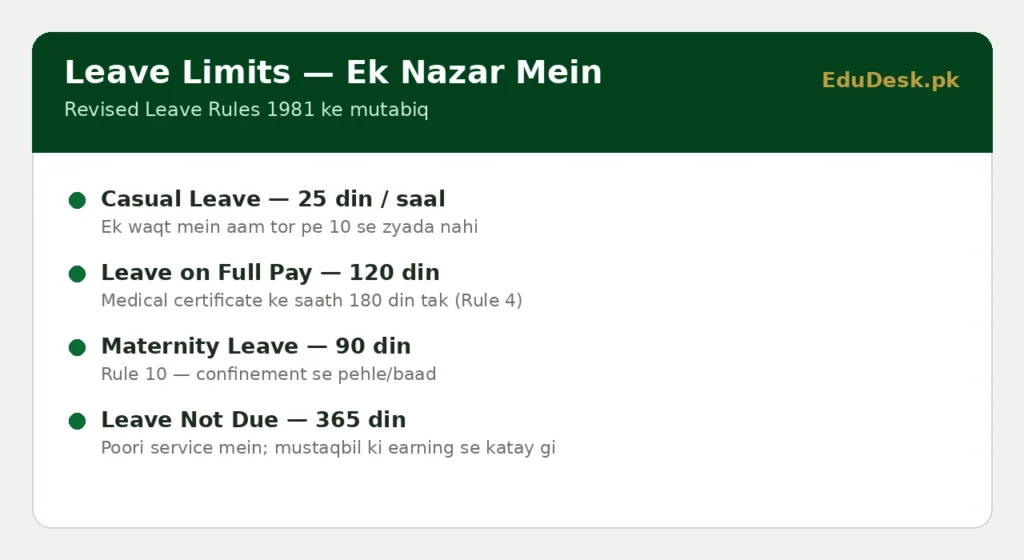
Here’s the complete picture. Read the last column carefully — it tells you whether the leave comes out of your saved balance or not.
| # | Kind of leave | Limit | Debited from balance? |
|---|---|---|---|
| 1 | Leave on full pay (Rule 4) | 120 days at a time without medical certificate; 180 days with MC. Plus a lifetime maximum of 365 days on medical certificate in your entire service. The 120 and 180 maxima are independent of each other | Yes |
| 2 | Leave on half pay (Rule 5) | No limit, as long as full-pay leave is available to convert — 1 day of full pay buys 2 days of half pay | Yes |
| 3 | Leave not due (Rule 7) | 365 days in the entire service; not more than 90 days during your first five years. Granted sparingly, and not to temporary civil servants | Offset against future earning |
| 4 | Special leave (Iddat) (Rule 9) | 130 days on full pay for a female civil servant on the death of her husband. Commences from the date of death; death certificate required | No |
| 5 | Maternity leave (Rule 10) | 90 days from the date it commences, or 45 days from the date of confinement — whichever is earlier | No |
| 6 | Paternity leave | 10 days on full pay, on or immediately before the birth of the child; up to 2 times in the entire service | No |
| 7 | Disability leave (Rule 11) | 720 days on each occasion — full pay for the first 180 days, half pay for the rest — for injury or disease contracted in the course of duty | No |
| 8 | Extraordinary leave (EOL) (Rule 12) | 5 years at a time if you have 10 years’ continuous service; 2 years if less. Permanent or temporary, either way; without pay and allowances; no effect on seniority; treated as non-qualifying service for pension and increments; cannot be converted into any other kind of leave. | No |
| 9 | LPR (Rule 14) | 365 days — full pay, or partly full and partly half, or entirely half pay, at your choice. Cannot extend beyond the age of superannuation | Yes |
| 10 | Recreation leave (Rule 15) | 15 days, once in a calendar year — but only 10 days debited. Not admissible in a vacation department (sorry, teachers) | 10 days debited |
| 11 | Leave Ex-Pakistan (Rule 16) | Leave pay for the actual period spent abroad, maximum 120 days at a time. Subject to the same limits as Rules 4, 5 and 12 | Yes |
| 12 | Encashment of LPR (Rule 20) | 365 days of leave pay if you opt not to avail LPR — raised from 180 days with effect from 1 July 2012, subject to the leave actually being at your credit | Yes |
| 13 | Death in service / invalidation (Rule 21) | 180 days — a lump sum equal to leave pay for up to 180 days out of the leave at credit, paid to the family (as defined for family pension) or to the civil servant declared permanently incapacitated by a Medical Board. Not 365. See the box below | Yes |
| 14 | Absence after expiry of leave (Rule 19) | No remuneration for the period, and double the period debited to your leave account | Double debit |
| 15 | Casual leave | 25 days in a calendar year, ordinarily not more than 10 at a time. Governed by separate government instructions, not by the 1981 Rules — see the next section | No |
| 16 | Study leave | Up to 2 years in the entire service; 12 months at one time is regarded as a suitable maximum; within or outside Pakistan; not ordinarily granted if service is less than 5 years; a study allowance is granted; on half pay; service counts for pension and promotion; if the civil servant applies for retirement without returning, the study leave is debited to the leave account — if there is no balance, the period is treated as EOL; ordinarily, the civil servant bears the expenses of travelling and fees. (Check the service bond with your department before planning.) | No |
| 17 | Quarantine leave | 21 to 30 days; in the nature of extra casual leave; leave is earned during this kind of leave; granted in consequence of an infectious disease; forced leave. (Under the Supplementary Rules rather than the 1981 Rules — ask your DDO for the current ceiling.) | No |
Note: some tables quote 30 days for paternity leave — that is the federal Maternity and Paternity Leave Act 2023, which applies to federal establishments only. Under the Revised Leave Rules 1981 it is 10 days, up to two times.
LPR stands for Leave Preparatory to Retirement — the 365 days of leave a government servant takes immediately before retirement (Rule 14). At retirement you take either LPR or leave encashment — never both — for up to 365 days. Full guide: Leave Encashment & LPR KPK: Full Guide 2026.
Notice which leaves don’t touch your balance
Maternity, disability, special (Iddat), extraordinary leave and casual leave are all outside the leave account. They don’t eat into your saved days at all. Most employees don’t realise this, and hold back from applying as if the days were coming out of their retirement encashment. They aren’t.
Maternity leave — three things the standard guides miss
1. In KP it is 90 days, not 180. You may have read about 180 days’ maternity leave. That is the federal entitlement for employees of the Federal Government. Under Rule 10 of the KP Rules, a provincial civil servant gets 90 days from commencement, or 45 days from the date of confinement, whichever is earlier. If you work for a KP department, 90 is your number.
2. There’s a three-times limit — with a big exception for teachers. Rule 10(2) says maternity leave may not be granted more than three times in your entire service — except for a female civil servant employed in a vacation department, who may be granted it “without this restriction.” So teachers are exempt from the cap. For a non-vacation employee, a fourth confinement means taking leave from the normal leave account.
3. It can be combined with anything. Rule 10(5) allows maternity leave in continuation of, or in combination with, any other kind of leave, including extraordinary leave. This is exactly what offices do in practice — real leave cases show 90 days’ maternity plus one or two days’ medical leave, sanctioned as a single 91- or 92-day spell.
Two more points: an increment falling during maternity leave doesn’t change the leave salary — it takes effect after the leave ends (Rule 10(7)). And in practice your office will ask for the medical certificate, fitness certificate and birth certificate, along with a leave admissibility report verified by the District Accounts Officer.
And what about Hajj and Umrah?
There is no separate Hajj or Umrah leave in the rules. People do go, of course — they take it out of earned leave, or apply for Leave Ex-Pakistan, or take extraordinary leave. Real district leave registers show exactly that: “Ex-Pakistan Leave for Umrah, 24 days.” Anyone telling you Hajj is a special extra paid leave category is guessing.
One catch that does exist: if you encashed your LPR and then take leave during that period for ill health or for the performance of Hajj, the cash compensation is reduced by the leave pay for those days (Rule 20(3)).
Casual Leave — The Rules Nobody Told You
Casual leave is the one you’ll use most. A sick child, a family emergency, a wedding — the short stuff. You get 25 days in a calendar year, and it doesn’t touch your earned leave balance.
Where casual leave actually comes from
Casual leave is not in the Revised Leave Rules, 1981. The only mention is a note under Rule 15 saying casual leave (as recreation leave) “shall continue to be granted for 10 days only subject to other conditions under Government instructions.” So casual leave lives in separate government instructions and delegation orders — which is precisely why the limits below are standard across offices but the signing powers differ from department to department. Where your own department’s order differs from what you read online, the order wins.
The holiday trap (read this one twice)
Here’s what nearly everyone gets wrong:
Public holidays that fall in the middle of your casual leave are debited to your casual leave account.
Take Friday off. Take Monday off. You think that’s 2 days.
It isn’t. The Saturday and Sunday sandwiched in between get debited too. That’s 4 days gone from your 25.
Employees do this all year, then wonder in December why their casual leave has run out.
The other casual leave rules
- Maximum at a time: ordinarily not more than 10 days in one stretch. The sanctioning authority may allow up to 15 days at a time in special circumstances.
- Total in a year: 25 days.
- Combining: casual leave may be granted along with public holidays only — never with any other kind of leave, and never with joining time. Combined with holidays, the total stretch must not exceed 15 days at a time.
- Station leave: you may not leave your headquarters during casual leave or during holidays without the permission of the sanctioning authority.
- You are not treated as absent from duty. Pay and allowances are not interrupted, because casual leave is not recognised regular leave — which is also why it isn’t in your leave account.
That station leave rule catches people out constantly. Going to another city over a long weekend? Technically, you need permission — and that is why so many offices keep a combined “Casual Leave / Station Leave” slip rather than two forms.
Who can approve yours?
This is the question that causes the most wasted trips. In the Elementary & Secondary Education Department, the answer depends on your school and how many days you’re asking for:
| School | Who can grant |
|---|---|
| Primary school | Head Teacher: 2 days · ASDEO: 3–5 days · SDEO: 6–10 days |
| Middle school | Head Teacher: 3 days · DDEO: 4–10 days |
| High & Higher Secondary | The HM / Principal may grant 1 to 10 days to teaching and non-teaching staff. |
Anything beyond 10 days of casual leave goes up to the DEO or the concerned authority. Your Head Teacher simply doesn’t have the power to sign it.
Check your own district’s order before you rely on this table
These figures come from an E&SED office order delegating casual leave powers. Because casual leave rests on government instructions rather than the 1981 Rules, delegation orders are revised, and districts issue their own. Ask your office to show you the current order — and keep a copy of it in your own file.
What Happens If You Stay Absent Without Permission
Let’s be direct about this, because the department is.
Unauthorised absence — just not showing up, without sanctioned leave — is treated seriously, and the action escalates each time:
- First time: salary deducted, and a warning letter.
- Second time: salary deducted, plus a show cause notice that can lead to withholding of two increments.
- Third time: salary deducted, plus a show cause notice that can lead to removal from service.
In the education department the DEO of each district is authorised to order salary deduction for staff from BS-01 to BS-19; the order is expected to reach the DDO within about 7 working days, with the case wrapped up in roughly 40 days. Anything more serious than a salary cut is handled under the KP Government Servants (Efficiency & Discipline) Rules, 2011. Timelines and the officer authorised to act come from departmental orders, so confirm the current one for your district — but the direction of travel is not in doubt.
Overstay — the double debit
Then there’s overstay: when you go on approved leave but don’t come back on time. Rule 19 is worth reading in full, because it is harsher than people expect and gentler in one respect than they fear:
“Unless his leave is extended by the leave sanctioning authority, a civil servant who remains absent (except for circumstances beyond his control) after the end of his leave shall not be entitled to any remuneration for the period of such absence and double period of such absence shall be debited against his leave account.” If there isn’t enough credit, the debit is adjusted against future accumulations — and it “shall not preclude any disciplinary action.” (Rule 19, Revised Leave Rules, 1981)
So: two days of “I’ll just come back late” costs you four days of hard-earned leave, plus the pay, plus the risk of proceedings. And overstayed absence is not qualifying service.
The one door left open is “circumstances beyond his control” — and there is a second one that saves careers, in Rule 12(3): extraordinary leave may be granted retrospectively in lieu of absence without leave. If something genuinely unavoidable kept you away, apply for EOL to cover the period, with whatever evidence you have, immediately on return. Regularising the absence is far better than letting it stand as absence.
First, Are You Gazetted or Non-Gazetted?
Before you fill anything, answer this one question — because it decides which form you use — and nothing else will be accepted.
The good news: the answer is simply your BPS grade.
| Category | Grade |
|---|---|
| Non-Gazetted | BPS-01 to BPS-15 |
| Gazetted | BPS-16 to BPS-22 |
Look at your pay slip, find your BPS, and you know which half of this section applies to you. Why it matters: the two categories travel different routes, and one of them needs a second document the other doesn’t. Send the wrong paperwork and it comes straight back.
The Gazetted Leave Application (Complete Walkthrough)
If you’re in BPS-16 to BPS-22, this is the only form you use. There is no second form, no separate sanction letter, no extra covering application.
And here’s the part that surprises almost everyone: everything happens on this single page. Your request, your controlling officer’s recommendation, the DDO’s admissibility certificate and the audit report are all signed on the same sheet. The page you submit is the page that comes back approved. That’s why filling it correctly matters more than usual — there’s no second chance to add a missing detail.
Part 1: What you fill in (Items 1–9)
This is your section. Fill every item.
| Item | What to write |
|---|---|
| 1 | Name of applicant |
| 2 | Leave Rules applicable — write 1981 |
| 3 | Post held |
| 4 | Department or office |
| 5 | Pay / BPS |
| 6 | Compensatory allowances drawn (e.g. house rent, conveyance and other allowances) |
| 7 | Nature of leave applied for and period in days — earned, medical, EOL, LPR and so on (with the date of commencement) |
| 8 | Particular Rule / Rules under which leave is admissible |
| 9 | Last-leave details — (a) date of return from last leave, (b) nature of that leave, (c) period of that leave in days |
Then you sign and date it.
Two of these trip people up constantly.
Item 8 — the rule number. Don’t leave it blank, and don’t guess. This is where the translation table earlier in this guide becomes genuinely useful. Extraordinary leave? Rule 12. Maternity? Rule 10. LPR? Rule 14. Leave on full pay? Rule 4. Write the rule, not just the leave name — the certificate below it literally reads “certified that leave applied for is admissible under Rule ______”.
Item 9(a)–(c) — your last leave. People skip these because they look like history. They aren’t: the accounts office uses them to cross-check your leave account. Fill them in — they are part of your own section (items 1–9), and offices expect the boxes completed.
Part 2: What the office fills in (Items 10–13)
Item 10 — remarks and recommendation of the Controlling Officer. Your immediate senior recommends, or doesn’t. This is a recommendation, not the approval.
Item 11 — certificate of the DDO: that the leave applied for is admissible under the 1981 Rules and the necessary conditions are fulfilled. To sign it, they have to check your leave account — do you actually have the days at credit, and is the rule you quoted the right one? This is the real gatekeeping step.
Item 12 — report of the Audit Officer. The form is forwarded in original to the District Accounts Officer / District Comptroller of Accounts for report, and the accounts office verifies it against their own record. The form’s printed note restricts this item to officers of Grade-16 and above. Item 13 — orders of the sanctioning authority. This is the actual approval, signed once the Controlling Officer, the DDO and the audit office have all had their say.
So the full route is: you → Controlling Officer → DDO → Audit Officer / District Accounts Officer. All on one page.
A useful thing to know if your case is stuck in audit
Rule 31(2) of the 1981 Rules says: “An audit report shall not be necessary before the leave is sanctioned.” In practice most offices route the form to the accounts office anyway, and for gazetted cases the audit report box is printed right on it. But if leave is being withheld purely because the audit report hasn’t come back, that rule is worth quoting politely.
Why gazetted applications get returned
From the form’s own structure, the failure points are obvious:
- Item 8 left blank — no rule quoted, so the DDO cannot certify admissibility
- Wrong rule quoted — medical leave claimed under the wrong rule
- Last leave details missing — accounts can’t reconcile your leave account
- Days don’t match your leave at credit — you asked for more than you have
- Submitted after proceeding on leave — the certificate is meant to be signed before you go
Every one of these is avoidable in five minutes.
The Non-Gazetted Leave Application (Two Forms, Not One)
If you’re in BPS-01 to BPS-15 — most school teaching and clerical staff — your leave needs two documents. This is where most rejected applications come from: people send the application by itself, and it sits there.
Why two?
Because of where your leave record lives. Rule 29 says the leave account “shall be maintained as part of his Service Book” — the register kept at your own office, with your Leave Account at the back of it. (Account Offices continued to maintain the accounts only of those civil servants whose accounts they already held when the rules came into force — which in practice is why gazetted cases go to audit and yours doesn’t.)
So nobody can just look up a central record. Somebody has to open your service book, fill in your leave account, and attach it. That’s the second form. No leave account, no proof of days at credit. No proof of days, no sanction.
Form 1 — The Leave Application (Proforma)
Addressed to the Sub Divisional Education Officer. You fill in your name and designation, school and circle, date of appointment, personal number, the nature of leave and exact dates with total days, the total number of teachers working in your school, and a contact number. Your PSHT/SHT forwards it, and your HM certifies that the entries have been checked and found correct according to the Service Book, ticking whether it’s with pay or without pay.
That “total teachers in school” box surprises people. Why does it matter? Because it is written into the rules. When not every application can be granted at once, Rule 31(5) tells the sanctioning authority to consider, first, “whether, and how many applicants can, for the time being, best be spared” — and also whether an applicant was last recalled compulsorily from leave, or was made to adjust the timing of their leave last time. Your leave is weighed against whether the school can still run. If three teachers are already away, your case is weaker.
Form 2 — The Leave Account (from your Service Book)
This is the ledger from the back of your Service Book. It has to be filled in and attached, and it’s worth reading carefully, because its column headings are the leave rules, printed in black and white: 4 days earned per calendar month; 120 days on full pay without medical certificate; 180 with; 365 in the entire service on medical certificate; recreation leave 15 days a year with 10 debited; and — in the absence column — days debitable are double the actual number of days.
That last one is the double-debit rule. It isn’t a rumour someone told you in the staff room. It is a column on the official form.
The account works like a bank statement: one column for what you earned, one for your leave at credit, a block of columns for what you took, then a total and a balance. Special leave, maternity, disability, EOL, study, hospital and quarantine leave, and the death/invalidation lump sum, are noted in the “outside the account” column instead — with one exception: maternity leave beyond the third time is debited to the regular columns.
One catch teachers should know
The printed column says “4 days for each calendar month.” That’s the non-vacation rate. If you’re a teacher who avails vacations you actually earn 1 day per calendar month — the standard form simply wasn’t printed with vacation staff in mind. Don’t panic when the heading doesn’t match your reality; the vacation rule still applies to you.
Do this today, before you ever need leave: ask your office to show you the leave account at the back of your service book, and check the balance is what you think it is. Employees find errors in it constantly — and they always find them at the worst moment, when they’re applying for LPR or encashment and days have gone missing.
Gazetted vs Non-Gazetted — the whole thing in one table
| Gazetted | Non-Gazetted | |
|---|---|---|
| Grade | BPS-16 to BPS-22 | BPS-01 to BPS-15 |
| Forms needed | 1 — Application for Leave | 2 — application + leave account |
| Where’s your leave record? | With the accounts office | In your Service Book, at your own office |
| Who certifies? | DDO, on the same page | HM, against the Service Book |
| Rule number required? | Yes — item 8 | Not on the form, but know it anyway |
| Goes to accounts office? | Yes — Audit Officer → District Accounts Officer | Handled at office / SDEO level |
| Charge relinquishment report? | Yes — Grade 16 and above must sign it when handing over Rule 27 | Hand over charge, no signed report required. |
Your Leave Account — And the Rule That Empties It
One line in the rules deserves its own heading, because employees discover it far too late.
Rule 30: “All leave at the credit of a civil servant shall lapse when he quits service.” (Rule 30, Revised Leave Rules, 1981)
At retirement you take either LPR or leave encashment — never both — for up to 365 days. Full guide: Leave Encashment & LPR KPK: Full Guide 2026.
Two related rules that work in your favour:
- Rule 26 — abolition of post. If your post is abolished and your services are terminated as a result, leave due to you is granted without regard to the availability of a post, and the post is deemed extended for the duration of that leave.
- Rule 22 — recall from leave. If you are compulsorily recalled to duty while spending leave away from headquarters, you get a single return fare plus daily allowance as on tour. If the recall is optional — “come back if you can” — you get nothing. So when an office recalls you, ask whether the recall is compulsory. The answer decides who pays for your journey.
After You Apply: Cancellation, Extension and Coming Back
Most guides stop at “submit the application.” But the mistakes people make after approval are the expensive ones.
Can my leave be cancelled or recalled?
Yes. Leave is not a right, and that doesn’t stop being true once it’s sanctioned. The competent authority can refuse leave, and can recall you if the service genuinely needs you. So never treat a sanction as untouchable, and never make non-refundable plans before the order is in your hand.
Can I extend my leave?
You must apply for the extension and get it sanctioned before your current leave expires. Rule 31(1) puts an application for leave or for an extension of leave on the same footing: it goes to the head of the office where you’re employed, stating the extent of leave due and admissible — and if you are the head of office, to the next-above administrative authority.
This is where people destroy themselves. They ring the office, someone says “theek hai, aa jao baad main,” and they treat that as approval. It isn’t. If the extension isn’t sanctioned, your extra days are not leave — they’re overstay, at double debit, with no pay and no qualifying service.
Can I come back early?
Not without permission. Rule 25 is explicit: unless permitted by the authority which sanctioned the leave, a civil servant on leave may not return to duty before the leave expires. It sounds strange — you’re offering to work — but leave is a sanctioned period with pay implications, and the office has to formally take you back on duty.
When does leave actually start and end?
Rule 18 removes the old forenoon/afternoon business: leave commences on the day following the day you hand over charge of your post, and ends on the day preceding the day you resume duty. Count your days from the handover, not from the date on the sanction order — this is where a one-day discrepancy in the leave account usually comes from.
Joining after leave
On return, Rule 28 says you report for duty to the authority that sanctioned your leave and assume charge of the post you’re directed to. Your joining report is what tells the office — and eventually the accounts office — that your leave has ended and normal pay resumes. Skip it, or delay it, and your leave account and your salary can both go wrong. Do it on day one, get it acknowledged, keep a copy.
And a small entitlement nobody claims: if you’re directed to take charge at a station other than the one you left, travel expenses as on transfer are payable to you (Rule 28(2)).
Can leave be combined?
Yes. Rule 24: one type of leave may be combined with joining time or with any other type of leave otherwise admissible to you — except LPR, which cannot be combined with any other kind of leave. Casual leave is the other exception, under its own instructions: public holidays only.
How to Apply for Leave, Step by Step
STEP 01 — Pick the right form and fill it properly
Gazetted officers use the Application for Leave; non-gazetted employees use their own proforma plus the leave account. Write the leave type, exact start and end dates, total days, and — on the gazetted form — the rule number. Vague applications get sent back.
STEP 02 — Attach your documents
This is where most applications get delayed. Medical leave? Attach the certificate, on the form prescribed by the rules, from an authorised medical attendant. Ex-Pakistan? Passport, visa and NOC. Send it complete the first time.
STEP 03 — Send it to the right authority
Check the casual leave table above first. Sending a 7-day request to your Head Teacher when the SDEO has to sign it just wastes a week.
STEP 04 — Wait for verification
The office checks your leave balance, your documents and your eligibility. Remember — except in medical-certificate cases, they can refuse.
STEP 05 — Get the written leave order
Only after the sanction order is issued should you proceed on leave. Hand over charge — and if you’re in Grade 16 or above, sign the charge relinquishment report. Keep a copy of everything.
Documents You’ll Need
- Medical leave — medical certificate from an authorised medical attendant on the prescribed form; for longer or serious illness, a Medical Board recommendation. The authority may seek a second opinion.
- Maternity leave — medical documents on the expected date; offices generally also ask for the fitness certificate, birth certificate and a DAO-verified admissibility report.
- Ex-Pakistan leave — NOC, passport copy, visa copy, departmental approval; and if it was sanctioned on medical grounds, carry a copy of your medical statement abroad (Rule 27(2)).
- Study leave — admission or scholarship letter, and usually a service bond.
- Special / Iddat leave — husband’s death certificate, with the application or furnished separately.
- Casual leave — usually just the application slip, plus station-leave permission if you’re travelling.
Common Mistakes to Avoid
- Leaving before the order is signed. A verbal approval is not approval.
- Not knowing your balance. Ask your office. Apply for what you actually have.
- Sending it to the wrong officer. Check who can sanction how many days.
- Coming back late. Overstay is a double debit — and it isn’t qualifying service.
- Extending by phone call. A verbal “theek hai” is not a sanctioned extension. It’s overstay.
- Assuming teachers earn 4 days a month. You earn 1, if you avail vacations.
- Going abroad without proper sanction. Ex-Pakistan leave needs it, no exceptions.
- Forgetting the sandwiched holidays. Those weekend days in the middle of your casual leave are being debited.
- Leaving the station on casual leave without permission. Technically not allowed — holidays included.
- Skipping your joining report. Report back and assume charge on day one.
- Expecting 365 days’ encashment on a death case. It’s 180 days under Rule 21.
- Fake medical certificates. That’s a disciplinary matter, not a shortcut — and the authority is entitled to order a second examination.
Free tools for the paperwork
EduDesk builds tools for KPK school and office staff — in the exact formats the office expects.
- Leave Forms & Leave Account — Application, leave account, encashment working
- Salary Slip Downloader — Your slip by name, personnel no & CNIC
- KPK Salary Calculator — Pay & allowances from BPS and stage
- Expenditure Generator — Monthly statement in E&SE format
- Leave Account & Encashment Generator
RELATED GUIDES
- PIFRA Registration Online Salary Slip
- KPK Salary Calculator 2026 — Calculate Your New Pay
- GP Fund Advance in KPK
- e-Transfer Plus Policy 2026
- Source 1, 2 & 3 Forms in KPK
- Leave Application Formats
Frequently Asked Questions
How many casual leaves do I get in KP?
25 days in a calendar year, ordinarily not more than 10 days at a time (up to 15 in special circumstances). Casual leave is not debited from your earned leave balance, and it comes from separate government instructions rather than the Revised Leave Rules, 1981.
How much leave does a teacher earn per month?
If you are in a vacation department and you avail the vacations, you earn 1 day per calendar month of duty. Non-vacation employees earn 4 days per month. A calendar month only counts if you were on duty for more than 15 days of it.
What if I was not allowed to take the full vacation?
Then for that year you earn at the non-vacation rate — 4 days a month. If you availed only part of the vacation, you earn 1 day a month plus a proportion of 30 days, in the ratio of the vacation not taken to the full vacation. Get it recorded in your leave account for that year.
Does my earned leave expire if I don’t use it?
No. Rule 2 states there shall be no maximum limit on the accumulation of leave on full pay. It carries forward, which is what makes the 365-day LPR encashment reachable at retirement.
Can my leave be refused?
Ordinary leave, yes — leave cannot be claimed as a matter of right, and it depends on the needs of the service. But Rule 13 says leave applied for on medical certificate shall not be refused, though the authority may secure a second medical opinion.
Do I have to give a reason for my leave?
No. Rule 17 says it is not necessary to specify the reasons for which leave has been applied, so long as the leave is due and admissible to you.
Can the office make me take a different kind of leave?
No. Rule 23 says leave shall not be refused on the ground that another type of leave should be taken in the circumstances. You may apply for extraordinary leave or half-pay leave even when full-pay leave is available.
How long is maternity leave in KP?
90 days from the date it begins, or 45 days from the date of confinement, whichever is earlier, on full pay and outside your leave account. The 180-day figure you may have read about is the federal entitlement, not the KP provincial one.
Is maternity leave limited to three times?
For most employees, yes — Rule 10(2) allows it up to three times in the entire service, and a further confinement means taking leave from the normal leave account. Female employees in a vacation department, including teachers, are granted it without that restriction.
What is leave without pay?
Extraordinary Leave (EOL) under Rule 12 — up to 5 years at a time if you have 10 years’ continuous service, or up to 2 years if less. You keep your job, your salary stops, and it is not debited from your leave balance.
Is there a separate Hajj leave?
No. There is no separate Hajj or Umrah leave category in the rules. Employees use earned leave, Leave Ex-Pakistan, or extraordinary leave. Note that if you take leave for Hajj during an encashed LPR period, the cash compensation is reduced accordingly under Rule 20(3).
How much is leave encashment on retirement?
Up to 365 days’ leave pay in lieu of LPR under Rule 20, subject to the leave being at your credit. The ceiling rose from 180 to 365 days with effect from 1 July 2012.
Is encashment also 365 days if an employee dies in service?
No — it is 180 days. Rule 21 provides a lump sum equal to leave pay for up to 180 days out of the leave at credit for death in service or permanent incapacitation certified by a Medical Board. The KP Finance Department clarified on 30 May 2013 that the 2012 amendment applied to Rule 20 (retiring servants) only, and that Rule 21 was not amended.
What happens if I return from leave late?
That is overstay under Rule 19. You get no pay for those days, double the period is debited to your leave account, it does not count as qualifying service, and it does not preclude disciplinary action. Absence due to circumstances beyond your control is treated differently, and extraordinary leave can be granted retrospectively in lieu of absence without leave.
Do public holidays count against my casual leave?
Yes, if they fall in the middle of it. Public holidays sandwiched between casual leave days are debited to your casual leave account. Take Friday and Monday off and the weekend in between is debited too — four days, not two.
Can casual leave be combined with earned leave?
No. Casual leave may be combined with public holidays only — never with any other kind of leave or with joining time. Combined with holidays, the stretch must not exceed 15 days at a time.
Can I leave my station during casual leave?
Not without the permission of the sanctioning authority. This applies during public holidays too, which is why many offices use a combined casual leave / station leave slip.
What if I need to extend my leave?
Apply for the extension and get it sanctioned before your current leave expires. Rule 31(1) treats an extension application like a fresh leave application: it goes to the head of your office. A phone call is not a sanction — unapproved extra days become overstay.
Can I rejoin duty before my leave ends?
Not without permission. Rule 25 says a civil servant on leave may not return to duty before the leave expires unless the authority which sanctioned it permits.
When does my leave officially start and end?
Rule 18: leave commences on the day following the day you hand over charge of your post, and ends on the day preceding the day you resume duty.
What is a joining report?
It is how you formally assume charge on return from leave, reporting to the authority that sanctioned it. It tells the office and the accounts office that your leave has ended and normal pay resumes. Submit it on day one and keep a copy.
What happens to my leave if I resign?
It lapses. Rule 30 states that all leave at the credit of a civil servant shall lapse when he quits service. Accumulated leave has a cash value only through encashment at retirement, or the Rule 21 lump sum on death or invalidation.
Do I get travel expenses if I’m recalled from leave?
If the recall is compulsory and you were spending leave away from headquarters, Rule 22 allows a single return fare plus daily allowance as admissible on tour. If the recall is optional, the concession does not apply — so ask which kind of recall it is.
Can I take LPR along with other leave?
No. Rule 24 allows different kinds of leave to be combined, except leave preparatory to retirement, which cannot be combined with any other kind of leave.
Am I gazetted or non-gazetted?
It is decided by your BPS grade. BPS-01 to BPS-15 are non-gazetted; BPS-16 to BPS-22 are gazetted. Check your pay slip.
Why do non-gazetted employees need two forms?
Because your leave record isn’t held centrally — Rule 29 keeps the leave account as part of your Service Book, at your own office. The leave account has to be filled in and attached as proof of the days at your credit. Without it, nobody can verify your balance and the leave can’t be sanctioned.
Do gazetted officers need a separate sanction letter?
No. Admissibility is certified on the same page as the application — the DDO’s certificate and the audit report are printed right on the form, and it is forwarded in original to the District Accounts Officer for report.
Is an audit report required before my leave is sanctioned?
Strictly, no. Rule 31(2) says an audit report shall not be necessary before the leave is sanctioned. In practice gazetted cases are routed to the accounts office anyway, but the rule is worth quoting if sanction is being held up solely for the audit report.
What do I write in “Particular Rule under which leave is admissible”?
Item 8 on the form — the actual rule number from the Revised Leave Rules, 1981: Rule 4 for leave on full pay, Rule 10 for maternity, Rule 12 for extraordinary leave, Rule 14 for LPR, Rule 9 for special leave. Leaving it blank means the DDO cannot certify your leave.
Why does the leave form ask how many teachers work in my school?
Because Rule 31(5) tells the sanctioning authority to consider how many applicants can, for the time being, best be spared. It also gives priority to anyone who was last recalled compulsorily from leave or who adjusted the timing of their leave last time — so mention it if that was you.
Who signs a 5-day casual leave for a primary school teacher?
Under the E&SED delegation, the ASDEO — a Head Teacher at a primary school can grant up to 2 days. Casual leave powers rest on departmental orders that are revised from time to time, so confirm your district’s current order.
In Short
Leave rules look complicated, but they come down to five things:
- Know whether you’re vacation or non-vacation — it decides how fast you earn.
- Know your day limits — the table above has them, with rule numbers.
- Know who signs your application — especially for casual leave.
- Never move before the written order arrives — and never extend by phone call.
- Check your leave account now, not when you’re applying for LPR.
Get those right and you’ll never lose a day of pay or land in an office inquiry.
Save this guide, and share it with a colleague who’s about to apply for leave — chances are, they’re guessing.
Official Contacts
Khyber Pakhtunkhwa Civil Servants Revised Leave Rules, 1981
Khyber Pakhtunkhwa Civil Servants Revised Leave Rules, 1981 (PDF)
Disclaimer: EduDesk.pk is an independent resource — not a government website, and not affiliated with any government department. Leave rules and limits are revised from time to time; where anything here differs from the




6 Comments
Comments are closed.